


Why Home Cat Diets Fail, and What a Smart-Feeder Study Fixed
Most feline weight-loss plans fail for two boring reasons: sloppy portions and food theft. A controlled trial swapped the measuring cup for tech and got 100 percent of cats to lose weight. Here is the mechanism.

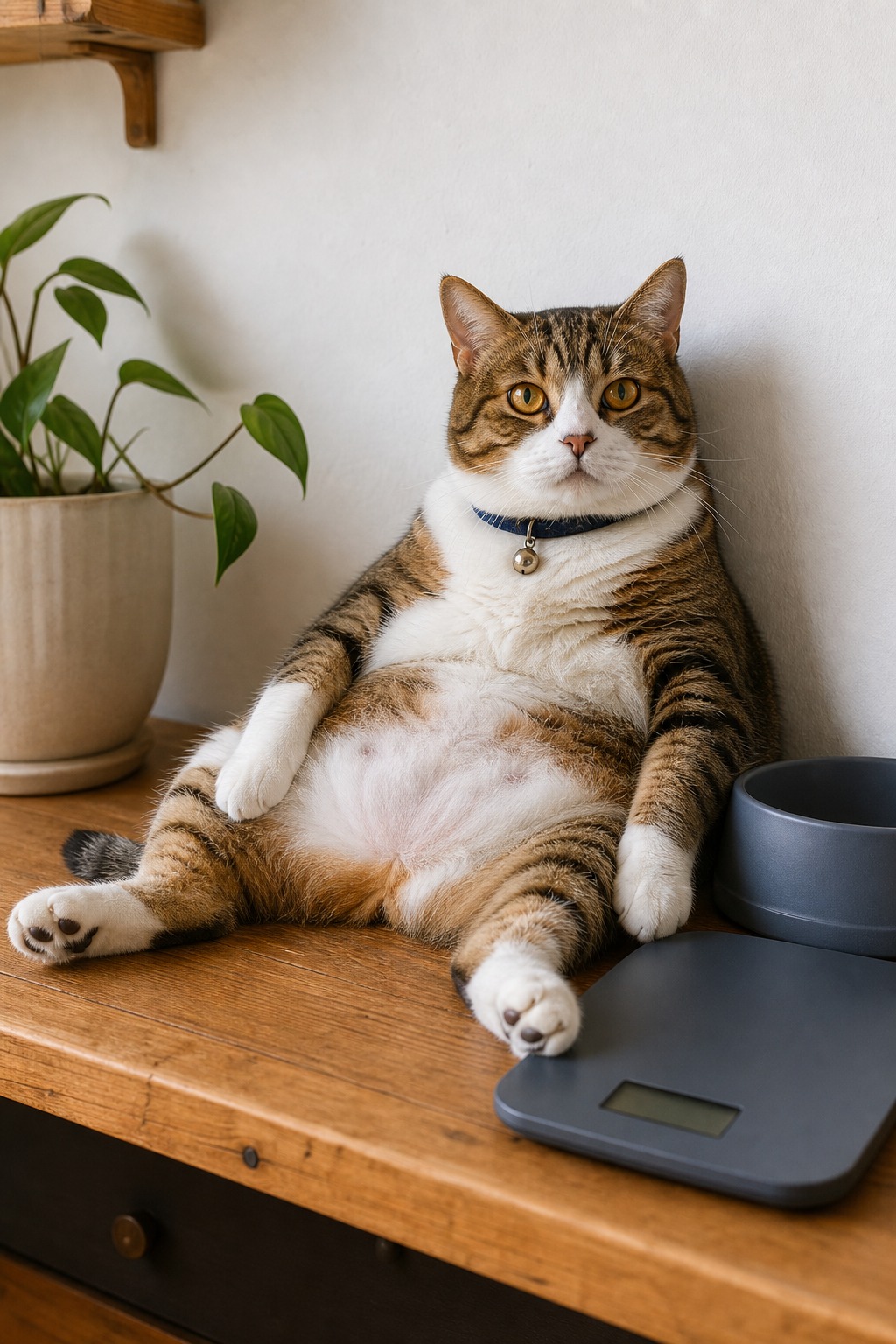
Ask a veterinarian why a cat’s diet stalled and you will rarely hear “the food was wrong.” You will hear about the two quiet saboteurs that undo almost every home weight-loss plan: portions measured by eyeball, and cats stealing food from each other. Both are boring. Both are decisive. And a controlled trial found that when you engineer both of them out of the picture, every single cat in the study lost weight.
That is the real story behind the “smart feeders help cats slim down” headlines. It is less a gadget review than a diagnosis of why the measuring cup keeps losing, and it is worth understanding the mechanism before you spend a dollar on hardware.
Meet the extreme case
When Spudge arrived at the Dane County Humane Society in Madison, Wisconsin, in 2021, he weighed a staggering 37 pounds, roughly 280 percent of his ideal weight. The middle-aged black cat was so heavy he could barely walk. Dr. Ken Lambrecht, a Madison-area veterinarian, offered to foster him and put him on a strict plan, and still calls Spudge the most challenging case he has ever treated.
Spudge is an outlier in degree, not in kind. The scale of feline obesity is genuinely large. In a 2024 analysis of about 1.3 million cats seen at primary-care practices across the United States, a majority carried excess weight, and the newest survey data puts roughly a third of cats in the clinically obese range and around 61 percent in the overweight-to-obese band overall. The problem is common, it is worsening, and owner awareness lags well behind the reality.
The two things that break home diets
Here is why so many of those cats never slim down, even with a good prescription food and an owner who is trying.
The first is measurement. A “cup” of food eyeballed into a bowl is wildly imprecise. Pack it loosely or heap it slightly and you can overshoot a cat’s daily calories by a large margin without noticing, and for a ten-pound cat, a small daily overshoot is the whole diet gone. Cats are small; their calorie budgets are small; the tolerance for sloppiness is small.
The second is theft. In a multi-cat home, the dominant cat typically bolts their own bowl and then raids everyone else’s. That pattern quietly overfeeds the pushy cat and underfeeds the timid one, and no owner standing over the bowls can police it all day.
A research team set out to test whether removing both problems, with hardware, would beat conventional calorie counting.
How the study isolated the culprits
The research, published in the Journal of Feline Medicine and Surgery, split cat owners into two groups that ate the exact same calorie-restricted prescription diet. Only the delivery differed.
The first group used the familiar tools: a measuring cup and an open bowl.
The second group used a digital kitchen scale to weigh each portion to the gram, and microchip-enabled smart feeders that opened only for the assigned cat. Treat cameras watched the feeders and activity trackers logged movement. Every owner in both groups worked with their vet, logging portions and weights in an app so the vet could adjust along the way.
The design is elegant precisely because the food was identical. Any difference in results had to come from the two variables the tech controlled: portion precision and access.
The result was not subtle
After 12 weeks, the gap was stark. In the cup-and-bowl group, 55 percent of cats lost weight. In the tech group, 100 percent did, and they shed four times more weight than the cats measured with a cup.
What jumps out is not just that the tech worked, but how completely. Every cat in the tech group lost weight. In a multi-cat house, where theft and guesswork usually wreck a diet, that kind of clean sweep is almost impossible to get any other way. The devices did not do anything magic. They just closed the two doors the cats kept escaping through.
The researchers credit exactly those two mechanisms. The scale delivered portions a cup never could, and the microchip feeders shut down cross-bowl theft.
Cats being cats, a few still tried to cheat. There is webcam footage of cats coaxing automatic feeders into dispensing extra, and of a dominant cat dragging a submissive housemate close enough to trip open their microchip feeder and steal the meal. Engineering reduces theft; it does not fully outwit a determined cat.
A bonus finding: cats ate better, not just less
The study turned up something the diet alone did not predict. Cats fed through smart feeders shifted from a few large, bolted meals toward slower, more frequent grazing. That grazing pattern was not itself tied to the weight loss, but the vets consider it meaningful on its own terms. The goal for a cat is six to eight small meals a day rather than one gulped bowl, which is closer to how cats are built to eat. Quality-of-life scores in the app rose across every cat enrolled, and both cats and owners adapted to the technology without much friction.
The catch is the price, for now
The obstacle to all of this going mainstream is cost. The full setup used in the study ran over $750. Asked what they would actually pay for something similar, participating owners said $149. That gap is the real barrier, though the researchers expect prices to fall as more devices reach the market. The study focused on multi-cat homes, but the team believes the same approach works just as well for a single overweight cat, where at least theft is off the table and precision does the heavy lifting.
What to take from it
You do not necessarily need the exact ecosystem from the study to apply its lesson. The finding is about mechanism, and the mechanism is cheap to respect: weigh your cat’s food on a gram scale instead of scooping it, and in a multi-cat home, feed cats separately so the pushy one cannot poach. Hardware automates both, which is why it works so reliably, but the principle stands on its own.
What hardware cannot replace is the plan behind it. Smart feeders and scales are tools, not a program. The foundation is still your veterinarian choosing a food that preserves muscle while burning fat and monitoring organ health as the weight comes off. For Spudge, the combination is working: 18 pounds lost over 11 months on a prescription diet and high-tech feeding, with seven to go. As Dr. Lambrecht puts it, obesity is a completely preventable disease. Vets just need better tools to help owners get there, and precise portions plus honest access are two of the best ones.
References
- “Technology-enhanced weight-loss program in multiple-cat households: a randomized controlled trial.” Journal of Feline Medicine and Surgery. pubmed.ncbi.nlm.nih.gov/34672236
- “Overweight and obese body condition in ~4.9 million dogs and ~1.3 million cats seen at primary practices across the USA: Prevalences by life stage.” Preventive Veterinary Medicine. pubmed.ncbi.nlm.nih.gov/39644829
- Association for Pet Obesity Prevention. “U.S. Pet Obesity Survey Results.”
Not a substitute for your vet. Our guidance is educational. For urgent symptoms, contact a vet or emergency clinic right away. Editorial standards
Dr. Mehta is a board-certified veterinary nutritionist who evaluates pet food formulations, ingredient quality, and the science behind dietary trends. He writes and reviews all nutrition content at The Pet Times, including our food rankings and feeding guides.
Meet our experts ↗Keep reading
 FoodWet vs. Dry Cat Food: The Moisture Question Settles Most of ItDr. Mara Chen · 6 min
 FoodCarrots Are the Closest Thing to a Guilt-Free Cat Treat. With One CatchDr. Lena Park · 5 min
 FoodThe Scale Is Lying About Your Cat's WeightDr. Lena Park · 5 min
 FoodYou're Probably Overfeeding Your Cat. The Bag Is Part of the Problem.Dr. Nina Kohl · 4 min
 FoodYour Cat's 'I'm Starving' Act Is Fake. A Skipped Meal Isn't.Dr. Lena Park · 6 min
 FoodForget the Clock: Build Your Cat's Feeding Schedule From Calories, Not Meal TimesDr. Mara Chen · 7 min