


Carrots Are the Closest Thing to a Guilt-Free Cat Treat. With One Catch
For a cat carrying extra weight, a carrot delivers the satisfying crunch of a treat for almost no calories. That makes it genuinely useful, unlike most human foods. The catch is starch, which is why portion and prep matter more than you'd think.

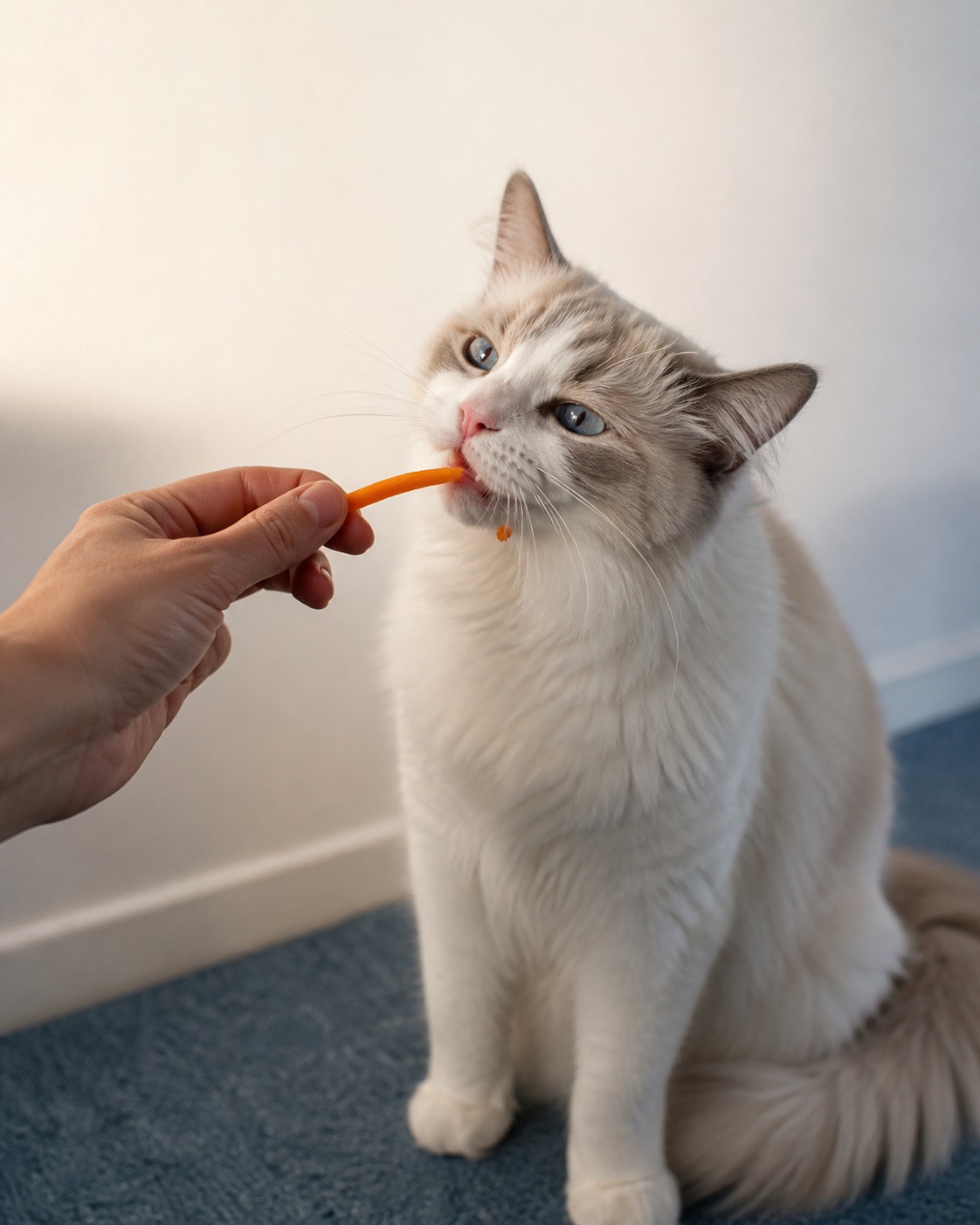
Most “can my cat eat this” human foods land in the same unsatisfying place: technically safe, nutritionally pointless, fine in moderation. Carrots are one of the rare exceptions that actually earn a spot, but not for the reason you would guess. It is not the vitamins. It is the calorie math. For a cat that needs to lose weight, a carrot offers the one thing a treat is really for, a satisfying ritual, at almost no caloric cost. That makes it a useful tool. The single catch, starch, is what keeps it a tool rather than a staple.
The actual reason to reach for a carrot
Roughly six in ten house cats in the United States are overweight or obese, and the hardest part of managing that is not the meals, it is the treats. Owners want to give their cat something, and most treats are calorie-dense. This is exactly where a carrot shines.
Carrots are mostly water and fiber, which makes them low in calories for their size, and they deliver a genuine crunch that many cats find satisfying. So a cat on a diet still gets the between-meal ritual without the calorie load of a richer snack.
When I put a cat on a weight plan, the treats are usually where it falls apart, because the owner still wants that bonding moment. A few shavings of carrot can fill that role for almost no calories. It’s a swap, not a supplement. The real nutrition still has to come from a complete, balanced feline diet.
The nutrients are a small bonus on top. Carrots carry fiber, which feeds the gut microbes and helps a cat feel full, and beta-carotene, a precursor to vitamin A that supports vision, immune function, and cell health. Your cat’s regular food already covers these needs, so treat the carrot’s nutrition as a footnote, not a reason.
The catch: starch a carnivore doesn’t want
Here is what separates a smart carrot habit from a sloppy one. Carrots are low in calories but high in starch, and cats are obligate carnivores with little use for carbohydrates. Their bodies are built to run on protein and fat. A few pieces of carrot now and then is nothing; a steady stream of starchy snacks is working against feline metabolism.
This matters most for diabetic cats, who often do best on a low-carbohydrate diet to help control blood sugar. For those cats, the starch in carrots is a real consideration, not a technicality, so check with your vet before offering any and keep the amount tiny. When in doubt, a diabetic cat is better served by a protein-based treat.
How carrots stack up against other “diet” snacks
If the goal is a low-calorie crunch for a cat watching its weight, it helps to see where carrot sits:
- Carrot: very low calorie, satisfying crunch, but starchy, so portion-limited. Best steamed soft or shaved thin.
- Green beans: also low calorie and a common vet suggestion for overweight cats, with less starch than carrot. Plain, cooked, no seasoning.
- A few flakes of plain cooked chicken: more calories than a vegetable, but it is protein, which suits a carnivore and tends to satisfy more per bite.
- Commercial “lite” cat treats: convenient and portion-marked, but read the label, since some are surprisingly caloric.
Carrots are not the only option, but they are one of the cheapest and most satisfying, which is why they keep coming up.
Prep and portion, the part people skip
The difference between a healthy carrot treat and a problem is almost entirely in the prep:
- Mind the 10 percent rule. Treats of every kind, carrots included, should stay under 10 percent of your cat’s daily calories. Go over and you risk crowding out the balanced food your cat actually needs.
- Fix the texture. A raw carrot is hard and can be a choking hazard. Steam it until soft, or shave or grate it into thin, bite-sized pieces, and never leave a cat alone gnawing a big chunk.
- Serve it plain. No butter, salt, oil, or seasoning. Cooked-into-a-dish carrots (glazed, in soup, in cake) are off the table.
- Don’t force it. Some cats love the crunch and the slightly sweet, earthy smell. Many sniff once and walk away. Both reactions are normal, and a refusal is not a problem to solve.
What about the leafy green tops?
The leaves and flowers of the carrot plant, sometimes called carrot tops, are non-toxic to cats, the same way they are edible for people in pestos and salads. There are scattered reports of mild skin irritation from psoralens, a compound in the flowers, but when it happens it is usually minor and resolves on its own. Tops are not a treat to seek out, but they are nothing to panic over if your cat nibbles one.
The bottom line
Carrots are unusual among human foods in having a real job: a near-zero-calorie crunch for a cat that needs to watch its weight, plus a little fiber and beta-carotene as a bonus. The one rule that keeps them useful is respecting the starch, which means small portions, soft or thin prep, extra caution for diabetic cats, and a complete cat food doing the actual nutritional work. Offered that way, a carrot is one of the few snacks you can hand your cat and feel good about. When in doubt about any new food, check with your vet first.
References
- ASPCA: Sharing Is Caring — Foods You Can Safely Share With Your Pet
- ASPCA Poison Control: Carrot Flower (Non-Toxic Plants)
- Association for Pet Obesity Prevention: U.S. Pet Obesity Survey
- Tufts Cummings School of Veterinary Medicine: Petfoodology — Carbohydrates and Pets
- Cornell Feline Health Center: Feline Diabetes
Common questions
How much carrot can a cat eat?
Keep it to a few small pieces, and keep all treats under 10 percent of your cat's daily calories. Carrots are low-calorie but starchy, so they're an occasional snack, not a free-for-all.
Can diabetic cats eat carrots?
Be cautious. Carrots are starchy, and diabetic cats often do best on a lower-carbohydrate plan, so check with your vet before offering them and keep portions tiny if you do.
Should I give my cat raw or cooked carrots?
Either works, but raw carrot is hard and crunchy and can be a choking risk. Steam it soft or shave it into thin, bite-sized pieces, and always supervise.
Not a substitute for your vet. Our guidance is educational. For urgent symptoms, contact a vet or emergency clinic right away. Editorial standards
Dr. Park is a board-certified emergency and critical care specialist. She reviews our health and safety content for clinical accuracy and contributes guides on recognising urgent conditions. Her focus is helping owners act quickly and correctly when it matters most.
Meet our experts ↗Keep reading
 FoodWet vs. Dry Cat Food: The Moisture Question Settles Most of ItDr. Mara Chen · 6 min
 FoodYour Kitten Isn't Starving. Weigh Them Every Week.Dr. Priya Nair · 7 min
 FoodWhy Home Cat Diets Fail, and What a Smart-Feeder Study FixedDr. Ravi Mehta · 6 min
 FoodHigh-Calorie Cat Food Isn't an Upgrade. It's a Prescription.Dr. Lena Park · 6 min
 Health & WellnessYour Cat's Diabetes Can Go Into Remission. The Window Is Smaller Than You ThinkDr. Mara Chen · 11 min
 FoodForget the Clock: Build Your Cat's Feeding Schedule From Calories, Not Meal TimesDr. Mara Chen · 7 min