


Forget the Clock: Build Your Cat's Feeding Schedule From Calories, Not Meal Times
The number of times you fill the bowl matters less than how much goes in it. Here's how to build a cat feeding schedule backward, from daily calories to cadence to your cat's life stage and any medications, plus what the once-a-day research really shows.

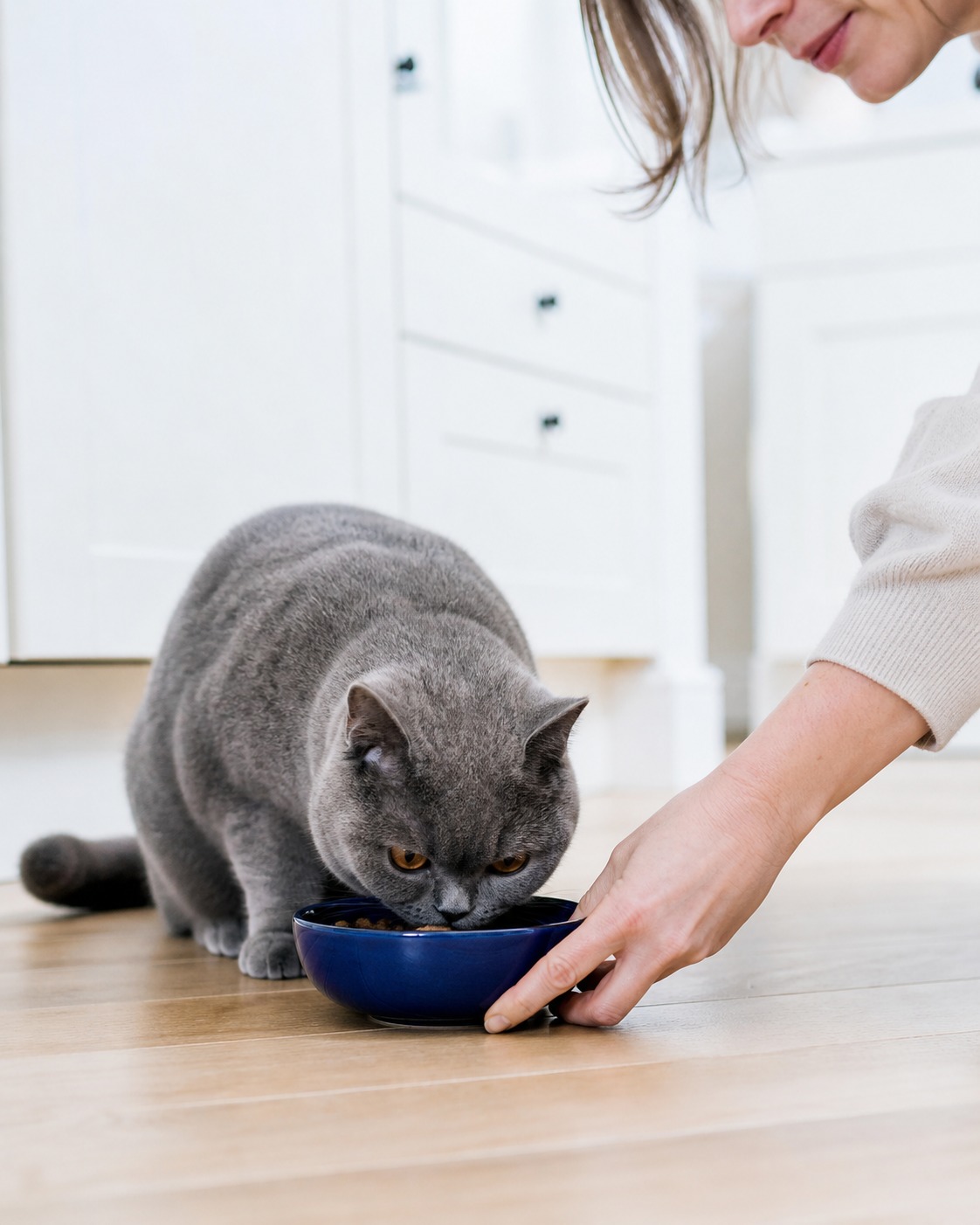
A cat’s wild ancestors never ate on a schedule. A free-ranging cat makes something like ten small kills across a day and night, eating a mouse-sized portion at a time. That is the rhythm your cat’s body still expects, and it is also the reason the usual advice, “feed twice a day,” answers the wrong question. The number that actually keeps a cat healthy is not how many times the bowl gets filled. It is how many calories go in it.
So build the schedule backward. Start with the daily calorie total, then choose a cadence that fits both your cat and your life, then adjust for the things that override the default: life stage, health, and behavior. Get the calories right and the clock is mostly a convenience.
Step one: the daily calorie total
This is the lever that moves weight, and it is the one most owners never calculate. Most commercial foods print feeding guidance by body weight, which is a fine starting point, but you can also work it out from your cat’s resting energy requirement (RER), the baseline calories to keep a cat alive at rest:
RER (calories/day) = 70 × (body weight in kg)^0.75
A typical spayed or neutered indoor adult is usually fed around 1.2 times that RER, while active or intact cats need more. For example, a 4.5 kg (10-pound) cat has an RER of roughly 70 × (4.5)^0.75 = 70 × 3.09 = about 216 calories, and a maintenance target near 260 calories a day. Use your cat’s healthy target weight, not their current weight if they are overweight, and treat the number as a starting estimate: real needs can run meaningfully higher or lower, so confirm with your vet and adjust based on the scale and body condition over a few weeks.
When an owner tells me their cat is gaining weight despite ‘only’ eating twice a day, the problem is almost never the schedule. It’s that nobody ever measured the portion against a calorie target. Two meals of too much food is still too much food. Start with the daily number and the meal count sorts itself out.
Step two: the cadence, where the research surprises people
For most adult cats, two to three meals a day, spaced eight to twelve hours apart, is the practical default. It roughly echoes the natural hunting rhythm, supports a sense of routine, and fits a meal before and after work. Distinct meals also make portion control and changes in appetite easier to spot than a perpetually full bowl.
Here is the part that complicates the old “small, frequent meals are best” wisdom. A University of Guelph study fed healthy indoor cats the same daily calories either once a day or in four meals, across 21-day periods. The cats fed once a day showed a greater and more sustained response in the satiety hormones GLP-1, GIP, and PYY, meaning they felt fuller for longer, voluntarily ate less, and showed metabolic markers pointing toward better fat control. More meals did not produce better weight outcomes.
The takeaway is not “switch your cat to one meal a day.” It is that meal frequency is a weaker lever than total intake. If your cat is at a healthy weight and two or three meals fit your life, keep them. If weight is the concern, the fix is the calorie total and the portion size, not adding more feeding times. And several groups should never be moved to infrequent feeding, which brings us to the overrides.
Step three: the overrides that beat the default
Certain factors trump the standard schedule entirely.
Kittens. The younger the kitten, the more often they eat. Growing kittens need far more energy than adults, and going too long between meals risks dangerously low blood sugar and body temperature. Nursing kittens eat around the clock; after weaning, feed frequently, then gradually consolidate toward two or three meals as they approach adult size. Before about three months kittens self-regulate fairly well, but after that they can overeat, so move off free feeding. A rough growth target is about 2.5 times RER while they are growing.
Health and medications. Some conditions dictate the clock. A diabetic cat must eat before an insulin dose to avoid a blood-sugar crash, so meals are timed to injections. Many oral medications cause nausea on an empty stomach and are best given with food. If your cat is on any medication, ask your vet how feeding should be timed around it.
Eat-and-vomit behavior. Cats who bolt their food and bring it back up do better with smaller, more frequent portions or a food puzzle that slows them down and adds the foraging your cat instinctively wants.
Multi-cat households. If one cat needs a prescription diet, prevent food sharing by feeding separately, in different rooms or at different times, or with a microchip-activated feeder.
Senior cats. Older cats with reduced appetite or chronic conditions often do better on smaller, more frequent meals, the opposite of the once-a-day finding, because consistent intake matters more than satiety optimization at that stage.
Planning for the practical snags
A perfect schedule still meets real life. Long commutes and late hours can make eight-to-twelve-hour spacing tricky; an automatic feeder bridges short gaps. Wet food spoils, so do not leave it out more than a couple of hours, less in heat. Grazing on dry food can suit a single healthy cat but makes appetite changes easy to miss, so refresh thoughtfully and watch intake. And for vacations, a feeder maintains consistency, but for longer absences a human checking in beats a machine, both to catch a feeder failure and to notice if your cat stops eating, which is itself an early warning sign.
The takeaway
Stop starting with the clock. Pin down your cat’s daily calorie target first, pick a cadence that fits your cat and your schedule second, and let life stage, health, and behavior override the default when they need to. Two meals, three meals, even one for the right healthy adult, all work if the daily total is right. The bowl count is convenience. The calorie count is health.
References
- Camara, A., et al. “The daytime feeding frequency affects appetite-regulating hormones, amino acids, physical activity, and respiratory quotient, but not energy expenditure, in adult cats fed regimens for 21 days.” PLOS ONE / University of Guelph, 2020. pmc.ncbi.nlm.nih.gov/articles/PMC7500645.
- WSAVA Global Nutrition Committee. “Calorie Requirements for Cats.” wsava.org.
- Cornell Feline Health Center. “Feeding Your Cat.” vet.cornell.edu.
- University of Wisconsin-Madison Shelter Medicine Program. “Caring for Kittens from Birth to Eight Weeks.” uwsheltermedicine.com.
Common questions
How much should I feed my cat?
Start from total daily calories, not the number of meals. Use your cat's healthy target weight, the calorie guidance on the food label or a vet-calculated requirement, and divide that total across however many meals fits your life. Two cats of the same weight can need different amounts based on age, activity, and whether they are spayed or neutered, so weigh and adjust with your vet rather than eyeballing the bowl.
How many times a day should I feed my cat?
Two to three meals a day suits most adult cats and lines up neatly with a workday. But meal count is the smaller lever. As long as the daily calorie total is right, whether you split it into two meals or several smaller ones matters less for weight than the total itself. Kittens, seniors, and cats with health conditions are the exception and usually need more frequent feeding.
How long can a cat safely go without eating?
A healthy adult cat can usually skip a day without harm as long as fresh water is available, but do not let it become routine. Cats who stop eating for more than a day, especially overweight cats, risk hepatic lipidosis, a serious liver condition. A kitten should never go long without food. Any sudden loss of appetite warrants a call to your vet.
Is it better to feed a cat once a day or several small meals?
Research is more interesting than the old rule suggested. A University of Guelph study found cats fed one larger meal a day had a stronger, longer satiety-hormone response and ate less than cats fed several small meals. That does not mean switch every cat to once a day, kittens, seniors, and sick cats need more frequent meals, but it does mean more meals is not automatically healthier. Total calories drive weight, not meal count.
Not a substitute for your vet. Our guidance is educational. For urgent symptoms, contact a vet or emergency clinic right away. Editorial standards
Dr. Chen is a small-animal veterinarian who leads health and safety coverage at The Pet Times. She writes and reviews the bulk of our illness, condition, and safety content, translating clinical guidance into clear, practical advice owners can act on at home.
Meet our experts ↗Keep reading
 FoodWet Food Beats Kibble. That Doesn't Mean All-You-Can-Eat.Dr. Mara Chen · 6 min
 FoodYou're Probably Overfeeding Your Cat. The Bag Is Part of the Problem.Dr. Nina Kohl · 4 min
 FoodHigh Protein Isn't a Health Upgrade for Cats. It's a Prescription.Dr. Mara Chen · 7 min
 FoodA Kitten's Diet Changes Every Few Weeks. Here's the Whole Schedule on One Chart.Dr. Priya Nair · 7 min
 FoodYour Kitten Isn't Starving. Weigh Them Every Week.Dr. Priya Nair · 7 min
 Health & WellnessNeutering Won't Change Your Cat's Personality. It Will Change His Appetite.Dr. Amara Solis · 8 min