


This Vegan Dog Leash Doubles as a Bangle
Shaya's Italian-made vegan collar and leash prove sustainable pet gear doesn't have to look crunchy. The story of founder Davina Farahi, the sculptural bamboo-and-acrylic handles that turned heads, and the eight-month hunt for an eco-material that could keep up.

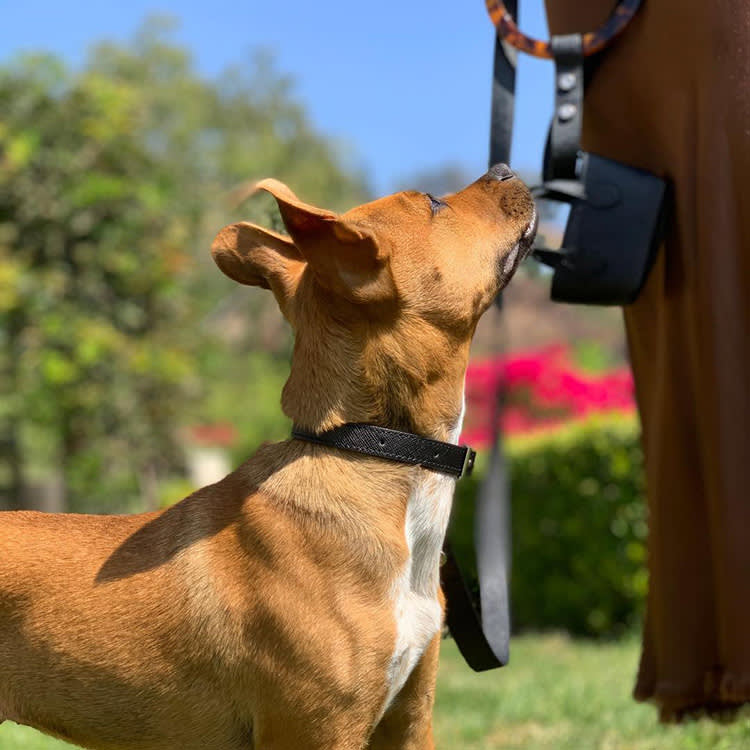
Most sustainable dog gear announces itself. Muted hemp, a lot of beige, packaging that wants you to know how responsible you’re being. Shaya went the other way. Its vegan leash reads first as a fashion object, a sculptural handle that looks more like a bracelet than a walking accessory, and only second as an eco-conscious product. That ordering is the whole trick, and it’s why the thing actually sells.
A brand that started with an ugly pet carrier
Shaya wasn’t born from a lightbulb moment. It came from a gap in the market and, as founder Davina Farahi tells it, some pointed maternal feedback.
“While attending UCLA, I took my dog Baby G to classes, lunches, dinners, and everywhere in between. I was carrying her around in a tacky pet carrier (think: lots of colors), and my Persian mom told me I could no longer be seen using it,” Farahi says.
The fix became the brand’s first product, the Shaya Carrier, and the company expanded from there into leashes, collars, and purses, many made with genuine Italian leather. Farahi chose the brand’s Italian factory as much for its culture as its craftsmanship. “We decided to work with our factory in Italy after seeing not only their beautiful craftsmanship, but also the way the team interacts with each other,” she says. “They are truly family and care about everything they create together.”
The handle that made people look twice
What set the leashes apart was never just the leather; it was the hardware. Shaya’s signature leashes carry circular bamboo or tortoiseshell-patterned handles that look like something you’d wear on your wrist. The idea came straight out of Farahi’s own closet.
“The idea came from my love of the bamboo and acrylic-handled bags I was wearing, and I realized it was a design that could be applied to the pet space,” she says. The brand launched the acrylic-handled Susan Leash and the bamboo-handled Sasha Leash using byproduct leather, chosen partly because it can shrug off “the little love bite and scratches they’ll receive from your best furry friends.”
The hard part: going vegan without going backward
Shaya could have coasted on those leather pieces. Instead it took on a genuinely difficult materials problem, and Farahi is candid that it wasn’t easy.
“To be honest, it’s very hard to find vegan alternatives that don’t cause more damage to the environment than leather,” she says. Byproduct leather, she points out, actually reduces waste and is biodegradable, so a vegan swap that traded those virtues for a pile of plastic would have been a step sideways at best.
It took eight months of searching to land on materials the brand could stand behind: a cotton-based canvas that uses minimal plastic and could pass for Saffiano leather to the eye and the hand. Like everything Shaya makes, the vegan canvas is water- and scratch-resistant, and it’s stitched, edge-painted, and put together by hand in Italy. The market answered quickly. The Susan Leash in vegan canvas became Shaya’s second best-selling leash, and the pieces have turned up on the arms of a rotating cast of famous dog owners, including Kendall Jenner, Maeve Reilly, and Priyanka Chopra and Nick Jonas.
What you can buy now
Shaya’s vegan line has grown into its own collection. Two pieces anchor it:
- The Susan Leash in Vegan Canvas, the acrylic-handled style that became a bestseller.
- The Taylor Collar in Vegan Canvas, hand-made in Italy, dyed with natural colors, and cut so it won’t pull on a dog’s coat.
Both are house-brand pieces sold directly through Shaya rather than a big-box retailer, which is part of the point: this is a small design label, not a mass-market one.
Style with a give-back built in
Farahi is quick to say the celebrity sightings aren’t the reward she’s chasing. “We really love that celebrities are wearing Shaya to take their daily walks or complete their fully styled looks,” she says, “but truly nothing beats seeing our community members use Shaya accessories to connect more with their pets.” The brand has run give-back campaigns tied to that community, donating to Disco’s Dogs, a nonprofit that partners with Freedom Service Dogs of America to adopt rescue dogs and train them as service dogs for children with autism and other developmental disabilities.
That’s the case for a leash like this. It looks like something you’d want to wear, it’s built to last in Italy, and the sustainable version doesn’t ask you to sacrifice either of those things. Good design that happens to be the responsible choice tends to get used, and a leash only does any good if it actually leaves the drawer.
References
Leila Torres leads our Living coverage, from home life and travel to the products and rescue stories that come with sharing a life with animals. She edits and writes across the section, with a soft spot for pieces about the bond between people and their pets.
Meet our experts ↗Keep reading
 Product PicksHermès Gave This Dog Brand an Award. The Leather Is the Real Story.Sara Lim · 6 min
 Product PicksWhy Every Cool Dog's Leash Suddenly Looks the SameLeila Torres · 5 min
 Product PicksOnly One Piece of Dog Car Gear Actually Saves Their LifeMarcus Webb · 8 min
 Product PicksTheir First Dog Backpack Fell Apart in Two Weeks. So They Built One That Doesn't.Sasha Ford · 7 min
 LivingThe Rescue-Chihuahua Coincidence That Built a Cult Leash BrandMarcus Webb · 5 min
 Product PicksYour Dog's Next Bed Might Be 12 Recycled Soda Bottles. On Purpose.Leila Torres · 6 min