


Why Every Cool Dog's Leash Suddenly Looks the Same
Wild One didn't just make better walking gear. It made gear you're willing to leave out in your living room, and the entire pet aisle has been chasing that idea ever since.

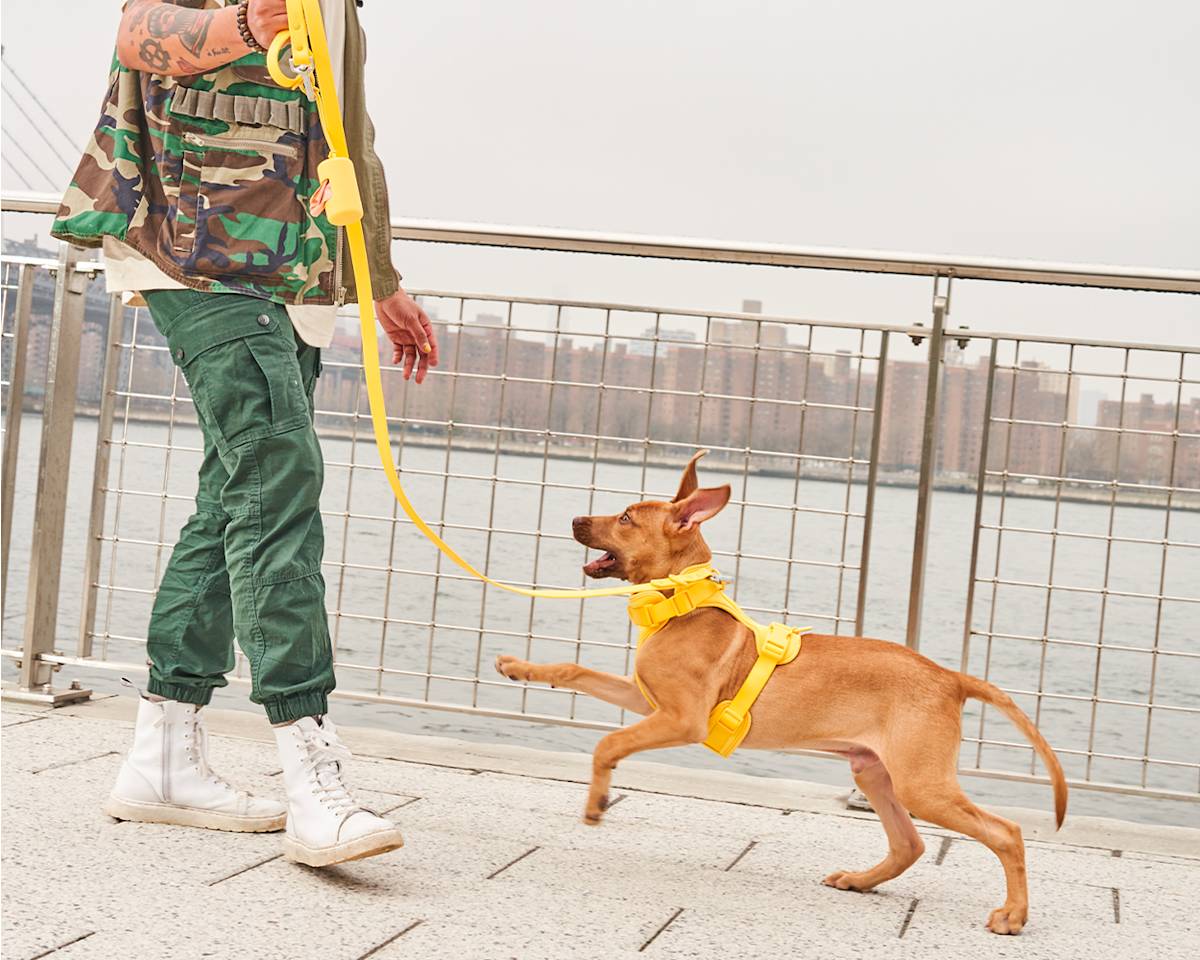
Look at the entryway of any apartment where a dog lives and there is a decent chance you will find the same thing: a matte, muted, faintly candy-colored leash hanging on a hook, next to a matching harness, next to a little screw-top canister of poop bags in the same shade. Eight years ago that did not exist. Pet gear came in tactical black, cartoon paw prints, or fluorescent nylon, and you hid it in a closet.
The company most responsible for the shift is Wild One, and its actual innovation was not a material or a buckle. It was a premise: that the stuff your dog uses is stuff you look at forty times a day, and it should be allowed to live in the room with you.
The problem they were actually solving
Wild One launched in 2018, founded by Minali Chatani alongside Bill Wells and Veronica Becchetti. The origin story is the least glamorous version imaginable, which is why it holds up. They wanted a coherent, well-designed set of dog products they would not be embarrassed to display at home, and they could not find one anywhere.
The deeper they went, the worse it looked. Pet retail was not just ugly, it was overwhelming: an aisle stacked with hundreds of near-identical options, and a treats-and-consumables category full of products with genuinely poor ingredient panels. Bringing home a new dog is already a large responsibility. Shopping for that dog should not add to the pile.
So the fix was aesthetic and editorial at once. Make the products beautiful, make them work, and then, crucially, stop offering so many of them. Wild One’s collection is deliberately narrow. That restraint is the product.
What’s actually in the Walk Kit
The debut was a walking bundle: a collar or harness, a leash, and a poop bag dispenser, sold as a set. The details are where it earns its price.
- The leash and collar are cut from a waterproof flex-poly, a material that sheds dirt and refuses to hold odor. This is the difference between a leash you keep on a hook and a leash you keep in a bag because it smells like a wet gym.
- The harness stretches, adjusts, and stays soft enough to avoid rubbing a dog raw through runs and rough play.
- The poop bag carrier has a screw top, so refilling it takes a second instead of a fight.
- Eight signature colors, available as a matching set or mixed and matched. Whichever you choose, collar or harness, the leash and bag carrier still snap together seamlessly.
That last point is the quiet design win. You get real choice without the paralysis of the pet aisle, because every combination is guaranteed to work with every other one.
The toys followed the same logic. Rather than flooding the category, Wild One picked the three classic modes of play, tug, chew, and toss, and set out to make the best version of each. They are natural rubber and natural cotton, with a reinforced core for durability, and they do not soak up drool, which anyone who has picked up a waterlogged rope toy will appreciate.
The part that isn’t about design
The company gives a portion of every purchase to Badass Animal Rescue, the Brooklyn-based, volunteer-run organization that pulls dogs out of high-risk shelters in the South. The commitment is specific rather than vague: sponsoring the rescue of one pet a week, which is 52 dogs a year lifted out of bad situations, plus the unglamorous costs behind them, rescue transport, medical bills, adoption events.
Chatani has ridden along on one of those rescue missions in Florida, and she fosters dogs through the same partner. Her own resident pet, for the record, is a cat named Otis whose favorite Wild One product is the cardboard shipping box.
The brand has also done the occasional side quest, including a limited-edition run of dog merch with Michelle Obama’s When We All Vote initiative.
The trade secret is a dolphin impression
Wild One’s product photography is famously good, and the technique behind those perfect head tilts is not a lighting rig. Chatani makes dolphin noises. That is it. The team has adopted it as standard practice on shoots, and if you have ever wondered why your own dog photos look dead-eyed while theirs look like the dog just heard the best news of its life, this is the gap.
Product development runs on a similar amount of hands-on chaos. New items get tested first on the staff’s own dogs, then on a widened circle of friends and family, with rounds of feedback before anything goes into production. After launch, customer suggestions actually make it into the pipeline. It is a small enough operation to still work that way.
What’s new since this was written
Wild One is no longer the plucky direct-to-consumer upstart. It now sells through Petco, Target, Chewy, and Nordstrom, and the Walk Kit is still the brand’s bestseller and the thing most people know it for. Chatani was named to Forbes’ 30 Under 30 list for Retail and E-Commerce, which is roughly when the rest of the industry started copying the palette.
That copying is the real legacy. Walk into a big-box pet aisle today and you will find muted, matte, color-matched walking sets from half a dozen brands, several of them house labels. The look Wild One made possible has become the default, which means you can now get the aesthetic for less money from someone else. Whether the flex-poly and the hardware hold up as well is a different question, and one worth asking before you buy the cheaper version.
If you want the original, the Walk Kit is still sold as a bundle, still in a rotating set of colorways, and still the single best entry point into the line.
Leila Torres leads our Living coverage, from home life and travel to the products and rescue stories that come with sharing a life with animals. She edits and writes across the section, with a soft spot for pieces about the bond between people and their pets.
Meet our experts ↗Keep reading
 Product Picks7 Pieces of Dog Gear That Won't Wreck Your Living RoomSara Lim · 6 min
 Product PicksThe Matching Dog-and-Owner Set That Doesn't Make You Rebuy Your Whole ClosetJordan Ellis · 3 min
 Product PicksNobody Tells You What a Designer Leash Can Actually Hold. This One Does.Sasha Ford · 7 min
 LivingThe Rescue-Chihuahua Coincidence That Built a Cult Leash BrandMarcus Webb · 5 min
 Product PicksThe Prettiest Dog Bed of the Terrazzo Era Was Really an ElegyNina Vasquez · 5 min
 Product PicksThe Escape-Proof Collar Shelters Swear By Comes From a Town of 400Nina Vasquez · 5 min