


Nobody Tells You What a Designer Leash Can Actually Hold. This One Does.
There is no safety standard for pet leashes. None. Which means the $200 Napa leather leash and the $12 nylon one are both making a promise nobody is checking, and one small brand borrowed a shoe-industry test to find out.

Here is a fact that should bother you more than it does: there is no pet-industry standard for how much force a leash or a collar has to withstand.
Not a weak one. Not a voluntary one. None. The thing you clip to a seventy-pound animal at the edge of a road is engineered to whatever the manufacturer felt like, tested however they liked, and marketed with a number they were free to invent or omit.
Mostly, they omit it. Go look at the product page for whatever leash you own. It will tell you the material, the length, the color, and the vibe. It will not tell you what force it fails at.
Which is why a very small, very design-forward pet brand is the unlikely hero of this article, because they went and found out.
The company
LUNGE makes puffed Napa leather collars, leashes, and harnesses. Founder Nicholas Schröder began it as an experiment, with a single stubborn ambition: drag the language of modern design into a category that had never been near it, and do so by playing with shapes that were interesting to look at without giving up comfort or function. The puffed leather is where those two demands met.
His stated design brief was to make restraint more playful, which is either a great line or a slightly alarming one depending on how you read it. There is a nod to kink in the aesthetic, and he is upfront that pet accessories are inherently unsexy and that fixing this was the project.
He has a day job, running operations at PORTO ROCHA, a creative and branding agency in Brooklyn. He has a dog, an Italian Greyhound named Twig, who is the reason for all of it and who is, by his account, the world’s most committed cuddler and a superb traveler: trains, cars, hikes, hotels, all of it.
None of that is why the brand belongs in an article about safety. This is:
They tested it, because nobody else would
Napa leather is buttery and soft. It is a strange choice for an object a dog will hurl itself against, and Schröder knows it. He picked it because it was the only material that would hold the puffed form he wanted and because it is comfortable in the hand and against the neck.
Knowing it needed reinforcing, he did three things:
- A resistant lining inside the leash, so the leather is not doing the work alone.
- A custom grommet mold developed with the factory, with a longer base and shorter prongs that grip the leather better. This matters more than it sounds. Hardware, not material, is where most leashes actually fail.
- And then, because there are no existing pet standards to test against, he tested the products using a standard normally applied to footwear, belts, and straps.
The results, published, which is the remarkable part:
- The leash withstands about 80 pounds of force when used with the collar.
- About 105 pounds when used with the harness.
And an honest caveat from the founder himself: it is safe for most dogs, but he does not recommend it for the heaviest pullers.
Now the part that will change how you shop
Read those numbers again, because there is a trap in them, and it is not LUNGE’s trap. It is everyone’s.
A leash rated to 80 pounds of force is not a leash for an 80-pound dog.
Force is not weight. A dog standing still exerts nothing on the leash. A dog hitting the end of a leash at a run exerts a peak force that is a multiple of its body weight, because you are decelerating a moving mass over a very short distance. A forty-pound dog lunging at a squirrel can spike well past what a forty-pound dog “should” produce.
This is why leashes fail. Not on the walk. In the one second of the walk that mattered.
So when a manufacturer gives you a force rating, the honest way to read it is:
- What is my dog’s body weight?
- Is my dog a lunger? A reactive dog, a prey-driven dog, a young dog with no impulse control?
- If yes to the second, assume peak forces several times body weight and buy accordingly.
A calm 25-pound dog on an 80-pound-rated leash is comfortably fine. A 60-pound reactive dog on the same leash is a coin toss, and Schröder, to his credit, tells you so.
The scandal is that he is one of the very few who tells you anything at all.
“The leash failures I see in the clinic aren’t frayed webbing. They’re hardware,” says Dr. Nina Kohl. “A clip that opened, a ring that pulled apart, a stitch line that let go. Owners inspect the strap because the strap is the part they can see, and the strap is almost never the problem.”
What to actually check on any leash
Since almost no brand publishes a number, here is what you can inspect yourself, in order of how likely each is to be the thing that fails:
1. The clip. The single most common failure point. A cheap swivel snap can be popped open by a sideways load. Look for a solid bolt snap or a locking carabiner-style clip on anything attached to a strong dog.
2. The rings. A welded O-ring or D-ring is one continuous piece of metal. An unwelded one is a bent piece of wire with a seam, and under load the seam opens. Look at the ring. If you can see a gap or a join line, that is a wire, not a ring.
3. The stitching. Bar-tacked, box-stitched, or a box-with-an-X at every stress point. A single line of straight stitching at the handle is a countdown.
4. The attachment point. LUNGE’s own numbers make the argument here better than I can: the same leash tested to about 80 pounds on a collar and about 105 pounds on a harness. The harness spreads the load. It is stronger, and, separately, it is the only responsible choice for a dog who pulls hard, because a collar concentrates all of that force on a trachea.
5. Only then, the strap. Leather, webbing, rope, whatever. It is the part you were looking at and the part least likely to break.
The rest of the brand, briefly
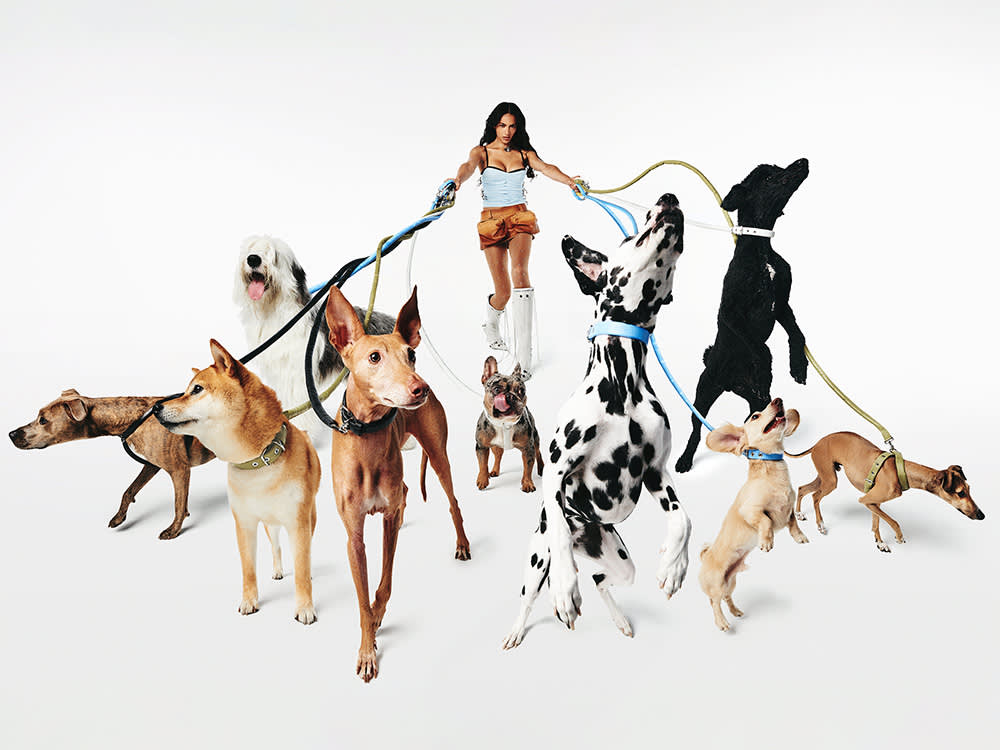
The launch campaign is genuinely beautiful and worth the detour: shot with the photographer and director Geelherme, a former work partner of Schröder’s from Brazil and now global creative lead at Sisley, and built to evoke 1980s Benetton advertising and early-2000s fashion editorial. Crisp, dynamic, styled to within an inch of its life. The brief was motion, dogs mid-lunge, hauling their way across the frame, held by the kind of people he passes on the sidewalk every day while walking Twig. Some of the dogs belonged to friends; the rest were cast off the street or found through Instagram.
The products are made in Brazil, in Novo Hamburgo, a leather-production center near Porto Alegre, where he grew up. The factory partners are audited and approved by the Leather Working Group and ABVTEX for ethical practice, which is a genuinely meaningful pair of credentials in a category where “ethically made” usually means nothing at all.
His dream collaborators, for the record, are Martine Rose, Luar, BOTTER, LOEWE, and Kiko Kostadinov, with a side interest in the home and interiors world: Muller Van Severen, Tekla, Estúdio Rain.
And his stated business philosophy is one you rarely hear out loud. He has no interest in letting revenue targets or growth pressure steer the thing. He would rather trust his own instincts and build something that stays fun and stays personal.
What’s new since this was written
Nothing, and that is the story.
There is still no safety standard for pet leashes, collars, or harnesses in the United States. Car restraints have a voluntary crash-test certification, run by an independent nonprofit, and it exposed how many “crash-tested” harnesses failed outright. Nothing comparable exists for the ordinary walking gear that every dog in the country wears every day.
Until it does, the burden is entirely on you, and the single most useful question you can ask a brand is the one almost nobody asks: what force does this fail at, and how did you test it?
Most will not have an answer. That, by itself, is an answer.
References
- LUNGE. lungepets.com
- Leather Working Group. Certification and Audit Standards. leatherworkinggroup.com
- Center for Pet Safety. Harness Crashworthiness Study. centerforpetsafety.org
- Pauli, A.M., Bentley, E., Diehl, K.A., & Miller, P.E. “Effects of the application of neck pressure by a collar or harness on intraocular pressure in dogs.” Journal of the American Animal Hospital Association, 2006. pubmed.ncbi.nlm.nih.gov
Sasha Ford is a certified cat behaviour consultant who has worked with shelters, catteries, and private clients across the country. They review all feline behaviour content at The Pet Times, with expertise in multi-cat households, indoor enrichment, and stress-related disorders.
Meet our experts ↗Keep reading
 Product PicksThe $350 Viral Boot Sold Out. Your Dog's $49 Version Is Better.Sasha Ford · 4 min
 Product PicksWhy Every Cool Dog's Leash Suddenly Looks the SameLeila Torres · 5 min
 Product PicksDog Ear Muffs for Fireworks: What They Actually Do, and the 6 Worth BuyingNina Vasquez · 6 min
 Product PicksThe No-Pull Harness That Won't Wreck Your Dog's Shoulders: 8 Picks RankedSasha Ford · 13 min
 Product PicksThe Dog Training Gear That Actually Does the Work, Grouped by the JobJordan Ellis · 12 min
 Product PicksYour Puppy's First Leash Should Be Boring. Here's the Upgrade Path AfterSasha Ford · 9 min