


Not All Service Dogs Are Guide Dogs. Here's What They Actually Do
Service dogs do far more than lead people across streets, from catching a blood-sugar crash before it happens to interrupting a panic attack. Here are the real categories, the breeds that suit the work, and the access rules people get wrong most.

Affiliate disclosure. This article contains affiliate links. We may earn a small commission if you buy through a link, at no extra cost to you. How we handle recommendations.
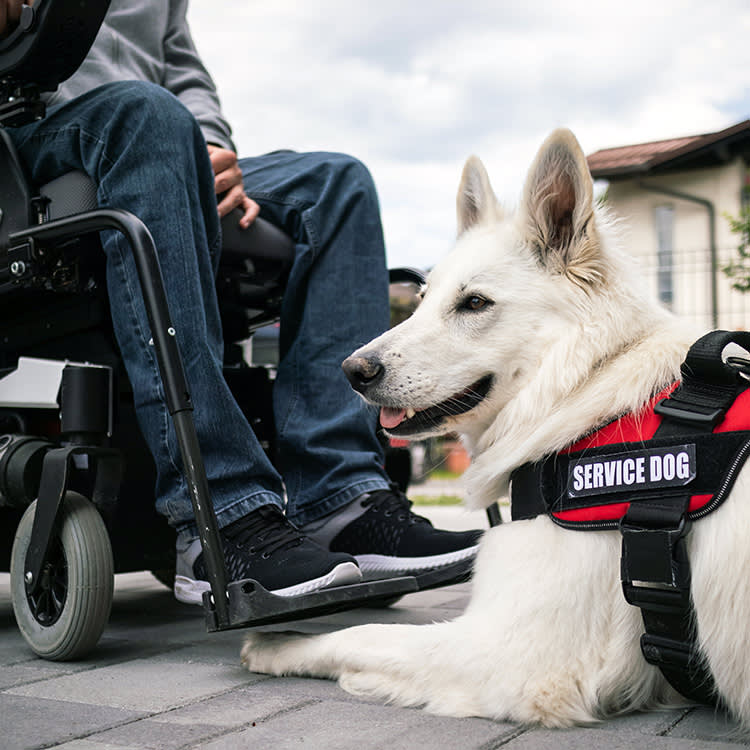
Ask most people to picture a service dog and they’ll describe a harnessed Labrador guiding someone across a busy street. That image is real, but it’s a sliver of the picture. Service dogs make up a broad and growing field of working animals trained to do specific jobs for people with disabilities, and for an estimated half-million Americans they’re the difference between managing on their own and not.
The other thing most people get wrong isn’t what these dogs do, but the rules around them: who counts as a service dog, where they can go, and what a business is allowed to ask. So let’s cover both, the surprising range of jobs first, then the legal reality that trips everyone up.
What makes a dog a service dog
At its core, it’s a working partner for someone with a disability, taught to carry out particular jobs across a wide range of needs. That might look like steadying a person with limited mobility in a public bathroom, warning a deaf handler about danger, or catching a diabetic’s blood-sugar crash before it lands. These dogs frequently wear a vest or harness that flags their role and signals the public to keep hands off (a message that, by now, most of us know).
Here’s the distinction that matters: a service dog does trained work. Emotional support animals and therapy dogs provide comfort and companionship, which is genuinely valuable, but they haven’t been trained to do a specific disability-related job, and they generally don’t come with the same public-access rights. There’s also no official registry for these dogs, and while the Americans with Disabilities Act lets any breed qualify, that only holds if the dog has been trained to do a specific task tied to a disability. Training, not paperwork, is what makes a service dog.
The many jobs service dogs do
The categories below overlap, and many dogs are cross-trained to handle several handler-specific tasks at once. Here’s the range.
Guide dogs help people with visual impairments get around, leading them, finding the path, and steering clear of obstacles. This is the classic role, and still one of the most demanding.
Hearing dogs alert deaf and hard-of-hearing handlers to important sounds: a doorbell, an alarm clock, a smoke alarm.
Mobility-assistance dogs do the physical work that a body with limited mobility can’t. They brace to steady a handler moving in and out of a wheelchair, bed, or chair, retrieve dropped or out-of-reach objects, help navigate crowded sidewalks, and, in the case of some larger breeds, even pull a wheelchair. If you’ve ever watched someone in a wheelchair struggle with something as small as a light switch, you understand why this work is transformative.
Psychiatric service dogs (PSDs) are trained medical partners for people with conditions like PTSD, severe anxiety, or autism. The key word is trained: this is about function, not just comfort. A PSD might sense the first signs of an in-flight panic attack and press its weight down on the handler’s lap for grounding, rouse a veteran mid-night-terror by flicking on a light and nudging them awake, “clear” a room so a person with PTSD feels safe walking in, or plant its body between the handler and a crowd so no one presses in too close. People who were once housebound by anxiety or trauma often regain the ability to shop, keep appointments, and rejoin daily life with a PSD at their side.
“The line people miss is that a psychiatric service dog performs tasks, it doesn’t just soothe,” says Dr. Nina Kohl. “Applying pressure to interrupt a panic spiral or blocking space in a crowd is trained work, and that’s exactly what separates a service dog from a comfort animal.”
Medical-alert dogs detect physiological changes, often before the handler notices anything, and respond. That includes flagging high or low blood sugar in diabetics and warning of seizures, POTS (postural orthostatic tachycardia syndrome), fainting, narcolepsy, severe allergies, and migraines. Beyond the alert itself, they handle support jobs: bringing emergency medication, triggering a medical-alert device, or going to find another person for help.
Autism-assistance dogs help autistic individuals through sensory overload, difficult social moments, self-harm risk, and elopement (wandering from a safe area). They provide calming deep pressure during overwhelming moments, and for children especially, a tethered connection, the dog physically leashed to the child, gives families real peace of mind.
Other specialized roles keep expanding. Dogs now detect allergens, cardiac irregularities, and impending narcoleptic episodes, and do scent detection for specific medical conditions and search-and-rescue work. Notably, the use of service dogs for cognitive and neurological conditions, traumatic brain injury, early-stage dementia, and Alzheimer’s, is on the rise, offering memory cues, safety interventions, and behavioral interruption.
Which breeds are cut out for the work
Here’s a truth that surprises people: temperament matters far more than breed. What best predicts success is a calm disposition, low reactivity, sharp focus, and a desire to please, and dogs fitting that profile come from every kind of purebred and mixed background.
That said, some breeds pair those traits with easy trainability, which is why many programs lean on Labs, Golden Retrievers, and Lab-Golden crosses, blending the Labrador’s work ethic with the Golden’s people-loving warmth. Poodle crosses show up often for their lower-allergen appeal. And smaller dogs can absolutely do certain jobs: it’s not unheard of for someone with a hearing disability to have a Yorkshire Terrier alerting them to sounds. Whatever the breed, quality training and ethical sourcing are what make the partnership work.
How to get a service dog
If you’re exploring this route, a good first step is education. The book Understanding Assistance Dogs: Is an Assistance Dog Right for You? is a useful starting point, available on Amazon. From there, Assistance Dogs International connects people with accredited service-dog organizations by area, and Canines for Disabled Kids helps parents navigate getting a dog for their child.
Programs source dogs through a mix of channels, reputable breeders, shelters, and purpose-driven breeding programs, and every candidate is put through thorough temperament and health screening to make sure it’s genuinely suited to the job. Some organizations, like those training dogs for veterans with PTSD, deliberately combine ethical sourcing with opportunities to rescue dogs in need.
Where service dogs can (and can’t) go
This is the most misunderstood part, so let’s be precise. Under the ADA, service dogs enjoy broad public-access rights, and they may go with their handlers into most places that bar ordinary pets: restaurants, stores, hotels, public transit, and public institutions. They’re also generally permitted at work as a reasonable accommodation. Housing and air travel fall under separate federal rules.
When it comes to what a business may ask, staff are limited to two questions: is the dog required because of a disability, and what work or task has it been trained to perform? They cannot demand documentation, ask about the person’s disability, or require the dog to demonstrate the task. In exchange, handlers are responsible for keeping their dog under control and non-disruptive.
Access is broad but not unlimited. A handful of exceptions exist, including sterile surgical units, certain hospital rooms, and invitation-only private events, and a business needs solid justification (usually a genuine disruption to operations) to deny entry otherwise. On housing, the Fair Housing Act requires landlords to reasonably accommodate service animals, which means setting aside “no pet” policies, pet deposits, and breed or weight caps, provided the animal doesn’t pose a direct threat or cause substantial damage.
The bottom line
Service dogs let disabled people live more safely, more independently, and more connected to the world around them, and the training behind them is far more sophisticated than most of us realize, from guiding someone with low vision and catching a medical emergency before it strikes, to pulling a wheelchair, defusing a panic attack, and keeping an autistic child from wandering into danger. Any breed can potentially do the job, but what decides it is temperament, focus, and serious training, which count for far more than a dog’s size or breeding.
What’s new since this was written
The biggest recent shift is in the air. As of the U.S. Department of Transportation’s rule that took effect in early 2021, emotional support animals are no longer treated as service animals on flights. Airlines are only required to accommodate trained service dogs, and ESAs now travel as regular pets, subject to standard pet fees and carrier restrictions. If you fly with a service dog, airlines may also require you to complete DOT forms attesting to the dog’s health, behavior, and training (and, on long flights, its ability to relieve itself safely). This is the single most common point of confusion, so it’s worth knowing before you book.
The other steady trend is expansion into cognitive and neurological work. Task-trained dogs for traumatic brain injury, early dementia, and Alzheimer’s are becoming more established, offering memory prompts and safety interventions that weren’t a standard part of service-dog work a decade ago.
References
- U.S. Department of Transportation. “Service Animals” and the 2021 Air Carrier Access Act final rule. transportation.gov
- ADA National Network. “Service Animals and the ADA.” adata.org
- U.S. Department of Housing and Urban Development. “Assistance Animals under the Fair Housing Act.” hud.gov
- Assistance Dogs International. “About Assistance Dogs.” assistancedogsinternational.org
Common questions
What's the difference between a service dog and an emotional support animal?
A service dog is trained to perform a specific task tied to a person's disability, and has broad public-access rights under the ADA. An emotional support animal provides comfort by its presence but isn't trained to do a task, and generally does not have the same access rights.
Do service dogs have to be a certain breed?
No. Under the ADA, any breed can be a service dog. What matters is temperament, focus, low reactivity, and quality training, far more than breed or size, though many programs favor Labradors, Golden Retrievers, and Lab-Golden crosses.
Does a service dog need to be registered or certified?
No. There is no official service-dog registry recognized by the ADA, and no certification is required. The dog simply has to be trained to perform a disability-related task. Online 'registrations' are not legally meaningful.
Leila Torres leads our Living coverage, from home life and travel to the products and rescue stories that come with sharing a life with animals. She edits and writes across the section, with a soft spot for pieces about the bond between people and their pets.
Meet our experts ↗Keep reading
 LivingA Stranger Found Him Tied to a Bench in the Rain. A TikTok With 100 Followers Got Him Home.Nina Vasquez · 6 min
 LivingA Sleepy Pug Gave Millions of People Permission to Rest. We Could Still Use It.Marcus Webb · 5 min
 LivingThe Hero Dog Who Smelled His Owner's Cancer Before the Doctors DidDr. Mara Chen · 4 min
 LivingThe Real Reason Dog People Know Everyone on the BlockNina Vasquez · 6 min
 Living15 Rescues Turned Her Down. Then Her Olympics Fell Apart and She Got the Dog.Sasha Ford · 6 min
 LivingWalking Dogs for a Living Is a Real Business. The Boring Parts Are What Make It WorkJames Okafor · 7 min