


15 Rescues Turned Her Down. Then Her Olympics Fell Apart and She Got the Dog.
Maddie Mastro grew up in a house with six rescue dogs and still could not get approved for one of her own. The puppy finally arrived at the exact moment her season did: December, injured, off the snow, and two months out from Beijing.
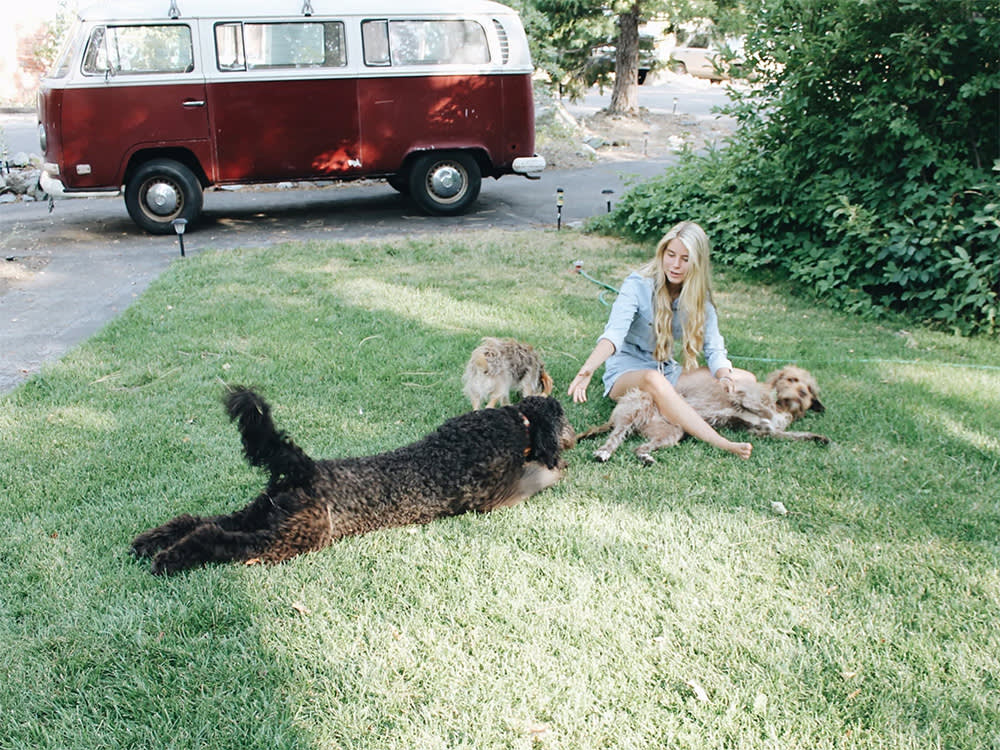
Maddie Mastro has been around rescue dogs her entire life. Two at the low end, six at the high end, running through the house at any given moment, because her parents adopted and rescued as a matter of course and it never occurred to her that anyone did it differently.
She applied for more than fifteen dogs of her own. She was rejected by all of them.
There is something clarifying about that. A professional athlete with a stable income, a lifetime of dog experience, and a family of five rescues, and rescue after rescue passed. The reason, almost certainly, was the travel. Halfpipe snowboarders are not home much, and any decent adoption coordinator is going to squint hard at an application from someone who lives in hotels for half the year.
So she waited. And she kept waiting, through going pro at sixteen, through her first Olympics in 2018, through winning the US Open in 2019 by becoming the first woman ever to land a double crippler 900. Somewhere in there she had presumably absorbed the standard advice, which is to wait for the right time.
The right time arrived in December, in the worst possible costume.
The injury was the opening
She got hurt. Off the snow, out of training, ten weeks from Beijing, doing the thing every injured athlete does, which is being sad in a chair.
And the calculation flipped. Not because anything got easier, but because she stopped believing in the premise. The perfect moment does not exist and never was going to. Something is always going on, and an owner who holds out for a clear calendar is holding out for nothing. What you can actually do is figure out how a dog fits into the life you already have.
Which is a very different question, and a much better one.
Two months before her second Olympics, she met a six-month-old stray from the streets of Los Angeles, and took her home inside fifteen minutes.
Pippy
She came with the name, which Mastro did not choose and would not normally have kept. Then she met the dog, and it turned out to be correct. A pipsqueak with a great deal of pip in her step, bouncy, wiggly, loud, and, less conveniently, extremely clever.
The cleverness runs in the useful direction: she picked up fetch in about a day. It also runs in the other direction, which is that she has developed a sophisticated understanding of how to extract treats from a human and how to become deeply unwilling to leave the moment someone reaches to pick her up. She reads people, quickly, and she uses it.
The other four dogs, Archie, Beasley, Zody, and Stevie, took it in stride, more or less. Mastro’s parents keep three of them, her brother has Stevie, and all of them function as family dogs in the way that dogs in a large dog household do. Pippy is the one who is actually hers, and the one who travels.
She had to learn everyone’s boundaries. Puppies always do.
Building a dog for the life you have
This is where the story gets practically useful, and it is the part most people miss when they romanticize adopting during a hard season.
Mastro did not adopt a puppy and hope it worked out. She started deliberately building a dog who could live the life she lives. Pippy goes to the gym, where she is crate-trained enough to settle while Mastro works out, then plays fetch afterward, and where she has developed an enthusiastic relationship with the trainers and the physical therapist. She goes to hotels. She goes on the road. The goal was never to give a dog a normal life on the side of an abnormal one, it was to make the abnormal life legible to the dog.
The snow was the one thing that did not immediately take. Pippy is a Los Angeles street dog, a warm-weather animal to her bones, and her first exposure to cold was Mammoth Mountain followed by Colorado. She was house-trained, and then, on arriving in the snow, she went on strike and refused to relieve herself outdoors at all. She has since come around, mostly, though Mastro is not convinced she is fully sold, and is unbothered by that, because on the truly cold days she is not sure she wants to be outside either.
“The single biggest predictor of whether a travel-heavy household works for a dog is whether the human treats the travel as the dog’s normal from day one, rather than as a disruption to apologize for,” says Dr. Mara Chen. “A crate that means safety, a routine that survives a hotel room, and food at the same time regardless of the time zone. Do that early and the road becomes ordinary.”
Beijing, and the airport
She finished thirteenth in the women’s halfpipe at Beijing, one place outside the twelve who advanced to the final.
She has been direct about how that felt: heartbreak is the word, on several levels at once, and the immediate impulse in the minutes after was not to analyze anything. It was to go home. To California, to the dog she had just adopted, and to work through it on her own floor.
Her mom had Pippy during the Games. The thing Mastro says she held onto, on the flight back from the worst professional day of her year, was that at the end of it there would be a puppy at the airport.
Which is not a triumphant ending, and is a fairly honest one. The dog did not fix the result. She had also, months earlier, been the thing that got Mastro out of a chair while she was injured and could not ride, a distraction that pointed away from the wreckage instead of at it. Both of those are the same job, and it is the job dogs are best at.
If rescues keep rejecting you
Fifteen rejections is not unusual, and it is not personal. A few things that genuinely move an application:
- Foster first. Many rescues will let you foster when they will not let you adopt, and a good foster record is the strongest reference you can build.
- Be honest about the travel, then solve it out loud. A vague application gets declined. An application that says “I am gone eleven weeks a year, here is my sitter, here is my crate plan, here is my parents’ address” gets read.
- Provide a vet reference, even if your last pet was a childhood dog. Coordinators are trying to establish that you finish things.
- Meet dogs in person. Mastro’s fifteen rejections were on paper. The adoption that worked took fifteen minutes in a room.
And if you are waiting for the right time: there isn’t one. There is only the question of how a dog fits into the life you are already living, which you can answer today.
Pippy came from Pup Culture Rescue in Los Angeles, which is worth a look.
Sasha Ford is a certified cat behaviour consultant who has worked with shelters, catteries, and private clients across the country. They review all feline behaviour content at The Pet Times, with expertise in multi-cat households, indoor enrichment, and stress-related disorders.
Meet our experts ↗Keep reading
 Living12 Questions a Shelter Won't Volunteer, But Will AnswerDr. Priya Nair · 6 min
 First DaysHalf of New Puppy Owners Feel Terrible. The Research Says When It Stops.Dr. Amara Solis · 6 min
 First DaysThe 20-Minute Task That Gets a Lost Dog HomeTom Hadley · 9 min
 LivingThe Victorians Didn't Invent Dog Breeds. The Stone Age Did.Marcus Webb · 4 min
 First DaysThe First 3 Days, 3 Weeks, and 3 Months With a Shelter Dog: A Real Settling-In MapSasha Ford · 9 min
 First DaysForget the Socialization Window. An Adult Shelter Dog Is the Safer BetClaire Sutton · 6 min