


Your Cat Isn't Ignoring You. The Research Says They're Choosing You
A French study often shared as a trick for summoning your cat actually found something better: cats respond to their own person differently than to strangers, and they get visibly annoyed when you ignore them.

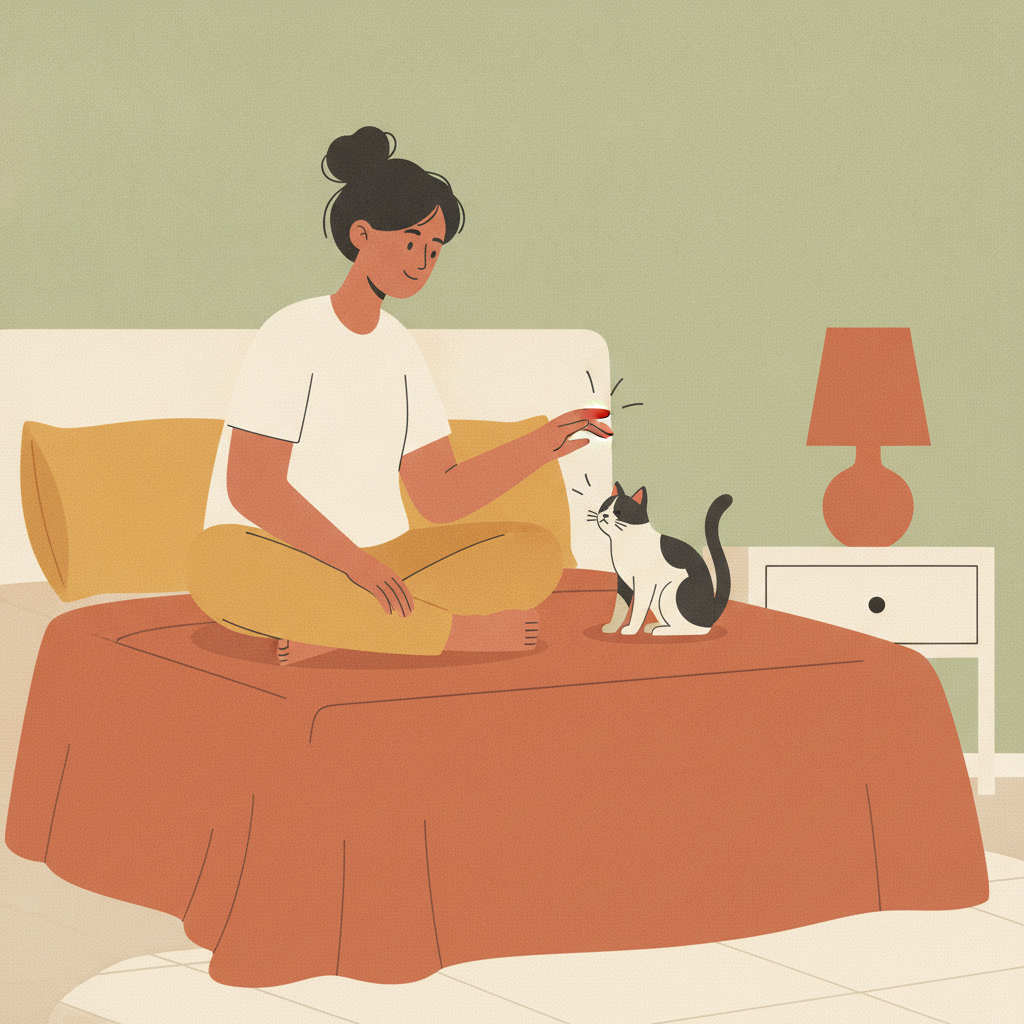
The headline version of this study is a life hack: say your cat’s name and reach out a hand, and you’ll get their attention faster than with your voice alone. True, as far as it goes. But that framing buries the more interesting result. When researchers actually dug into how cats responded, the finding wasn’t really about a summoning technique. It was about relationship. Your cat behaves one way toward you and a measurably different way toward a stranger, and the “trick” only works because you’re you.
What the cats actually told the researchers
A 2023 study from the Laboratory of Compared Ethology and Cognition at Paris Nanterre University set out to rank how well different cues get a cat to react. Behavioral ecologist Charlotte de Mouzon worked with 12 cats at a cat café, first letting them get used to her, then running each one through four scenarios as it entered a room. She would either call out without gesturing, extend a hand without making a sound, do both at once, or ignore the cat entirely.
The cats responded fastest to the combination, and the full ranking looked like this:
- Combined vocal and visual cues: very high
- Visual signals only (a reaching hand): high
- Vocal signals only (the familiar French cat-call, “pff, pff”): medium
- No signal at all: very low
Here’s the part that surprised de Mouzon. She’d expected the café cats to respond best to her voice, since cats famously perk up at the special, high-pitched tones people use with them. Instead they responded best when a recognized call was paired with a familiar gesture, and crucially, that effect was tied to familiarity with the person.
A cat interacting with its own human and a cat sizing up a stranger are running two entirely different programs. The cats weren’t reacting to any human signal. They were responding to a relationship they recognized. That’s a much bigger claim than ‘wave your hand.’
In other words, the gesture worked not because hands are magic but because these cats had learned what this particular person’s outreach meant. That distinction is the actual discovery, and it fits a growing body of feline-cognition work.
The aloof-cat myth, quietly demolished
The study turned up one more telling detail that rarely makes the rounds: the cats wagged their tails more when they were ignored. In cats, a wagging or thrashing tail is not the friendly flag it is in dogs; it usually signals stress, conflict, or irritation. So the cat being “ignored” wasn’t indifferent. It was annoyed. Your cat reserves the right to ignore you, but does not enjoy the favor returned.
That single observation undercuts the lazy stereotype that cats don’t care whether you engage them. They care. They just express it in a vocabulary most people never learned to read, and a flicking tail at the moment you went quiet is one of the clearest tells.
How this lines up with the rest of the science
The Paris group’s work is part of a run of studies showing cats pay close, person-specific attention to their humans.
A separate 2022 study, also led by de Mouzon, found that cats reacted more strongly to cat-directed speech (that soft, lilting “baby voice”) than to adult-directed speech, but only when it came from their own caregiver, not from a stranger using the exact same tone. The voice mattered less than who was using it. And earlier work out of Japan demonstrated that cats can recognize their own names, distinguishing them from similar-sounding words even when a stranger does the calling. Read together, these findings point the same direction: cats are quietly keeping track of who you are, what you sound like, and what your gestures tend to mean.
What to actually do with this
If you want your cat’s attention, the practical recipe is simple: pair a calm verbal cue with an open, unhurried hand, and let the cat close the distance. But the better takeaway isn’t a technique at all. It’s that the responsiveness you can earn rests on a history your cat is tracking. Show up consistently, use the same gentle cues, and read the tail: a slow blink and a relaxed approach mean you’re getting through, while a thrashing tail means back off and try again later. The cat who seems to ignore you is, more often than not, a cat who knows exactly who you are.
References
- de Mouzon, C., Gilbert, C., Di-Stasi, R., & Leboucher, G. (2023). “Discrimination of Cats’ Vocal and Visual Cues by Their Owners.” Animals, 13(9), 1528.
- de Mouzon, C., Gonçalves Costa, A., Leboucher, G., & Gilbert, C. (2022). “Discrimination of cat-directed speech from human-directed speech in a population of indoor companion cats.” Animal Cognition, 25, 611–619.
- Saito, A., Shinozuka, K., Ito, Y., & Hasegawa, T. (2019). “Domestic cats (Felis catus) discriminate their names from other words.” Scientific Reports, 9, 5394.
Dr. Park is a board-certified emergency and critical care specialist. She reviews our health and safety content for clinical accuracy and contributes guides on recognising urgent conditions. Her focus is helping owners act quickly and correctly when it matters most.
Meet our experts ↗Keep reading
 TrainingYour Cat Screams at 3am Because You Never Let It Finish the HuntDr. Mara Chen · 8 min
 TrainingYour Cat Keeps Running Off. The Fix Is to Chase LessLeila Torres · 8 min
 TrainingThat 'Come Here' Cat Video Works. Your Own Voice Works Better.Dr. Lena Park · 7 min
 TrainingScientists Pitted Kittens Against Puppies at Math. The Kittens Won.Dr. Mara Chen · 4 min
 TrainingCat Behavior Has a Photo Problem. Someone Finally Drew Their Way Out of It.Dr. Mara Chen · 7 min
 TrainingThat Adorable Chirping Is the Sound of a Cat FailingDr. Nina Kohl · 7 min