


The Worn-Shirt Trick Doesn't Work. Here's What Actually Calms a Cat
Tucking a shirt that smells like you into the carrier feels like a kindness. The research says it does almost nothing. Here's what genuinely settles a stressed cat, ranked.

Affiliate disclosure. This article contains affiliate links. We may earn a small commission if you buy through a link, at no extra cost to you. How we handle recommendations.
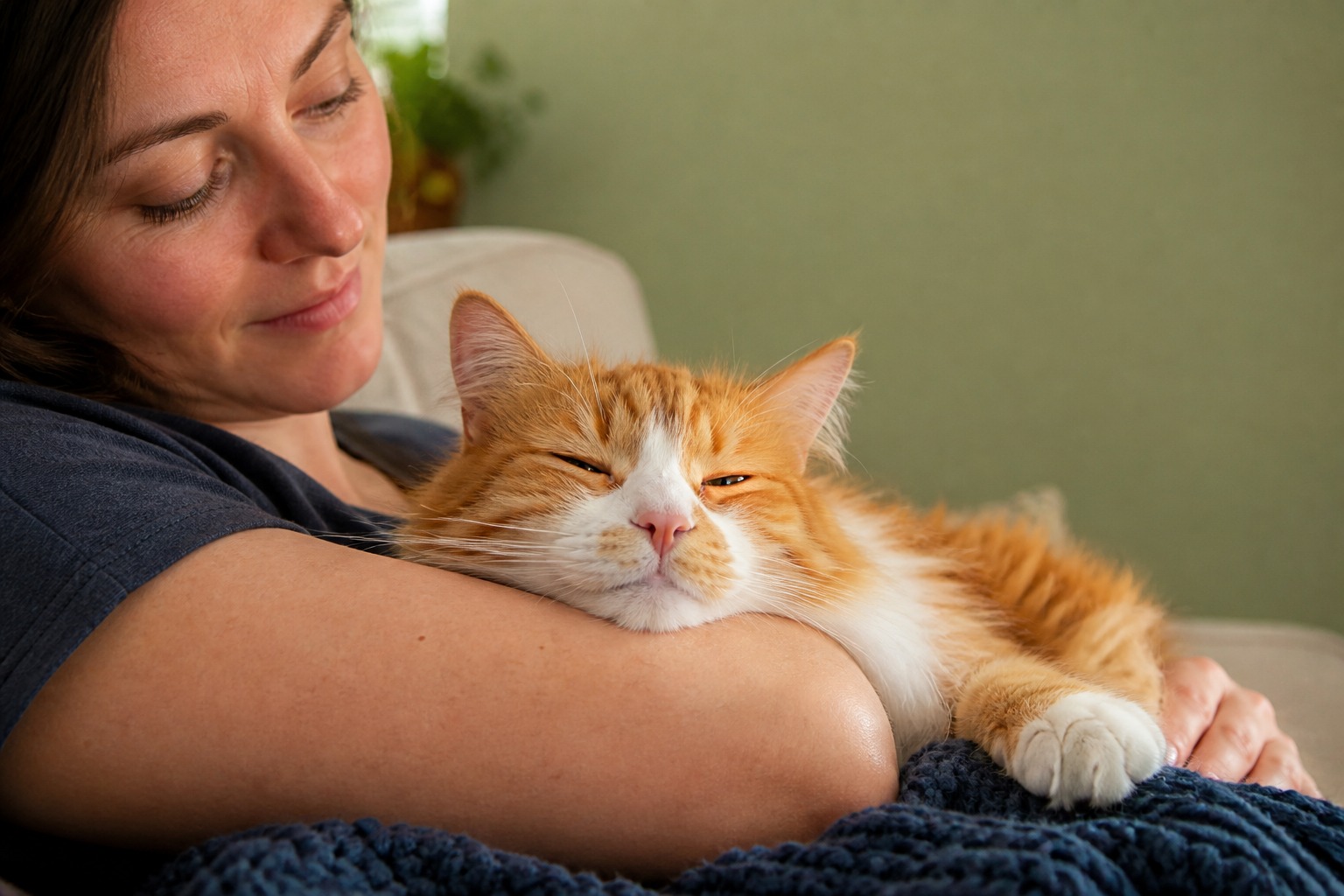
You have probably done it, or been told to: rub a T-shirt around so it smells like you, then leave it in the carrier or the empty house so your cat feels less alone. It is a sweet instinct. It is also, according to the research, mostly wishful thinking. When scientists actually tested whether a guardian’s scent on an object calmed cats, the answer was no. What calmed them was the guardian, in person.
That gap, between the comfort we imagine we are leaving behind and the comfort a cat can actually use, is worth understanding. Because once you know which levers move a cat’s stress and which ones don’t, you stop wasting effort on the shirt and start doing the things that work.
Why we assume scent should calm a cat
The logic is not crazy. A cat’s sense of smell is extraordinary, and the brain regions that handle smell sit right next to the ones that handle the stress response. Cats discriminate between odors even more finely than dogs do. On paper, scent looks like a direct line into a cat’s emotional state.
A study in Frontiers in Veterinary Science set out to test that line and found it far weaker than expected. There is some scattered, anecdotal evidence that scent manipulation can shift a cat’s mood, but nothing consistent or reproducible. Smell, it turns out, rarely runs the show by itself.
The catch nobody mentions: smell loses to sight and sound
Here is the part that explains the failed shirt trick. A cat’s senses operate in a hierarchy, and for a frightened cat, vision and hearing usually win. Researchers found that adding a prey odor to a room, the kind of smell that should grab a cat’s attention, did little without the matching sight or sound of prey. The nose alone was not enough.
So a worn shirt in a carrier is competing against everything the cat can see and hear: the carrier walls, the car, the strange waiting room, the dog two seats over. Against all of that, your faint smell on cotton barely registers.
Owners picture scent as a security blanket the cat can carry anywhere. But for a stressed cat, what it sees and hears drowns out what it smells. If you want to lower the volume on stress, you usually have to quiet the eyes and ears first, not the nose.
There is a second catch, and it is the cruel one. The study found that fear can actively inhibit a cat’s response to scent. In other words, even if your cat genuinely finds your smell soothing on a normal day, a scared cat may not be able to access that comfort at all until it already feels safe. The exact moment you most want the shirt to work is the moment it works least.
What actually calms a cat, in order
Instead of leaning on the weakest lever, work the strong ones. Here is the practical hierarchy, roughly from most to least powerful.
1. You, present and calm. The single biggest finding across this research is that a cat is comforted by its person, not by a stand-in for its person. And there is a multiplier here most people miss: cats read your emotional state and take cues from it. A 2015 study found cats engage in social referencing, looking to their humans to decide whether something new is threatening. If you tense up at the vet, your cat reads that as confirmation the situation is dangerous. If you stay loose and unbothered, you become evidence that things are fine. Your calm is doing more work than any object could.
2. Less to see, less to hear. Because sight and sound outrank smell, controlling them pays off fast. Cover the carrier with a towel so the cat cannot see the chaos around it, leaving airflow. Certified feline behaviorist Jennifer Van de Kieft recommends the covered-carrier trick for exactly this reason: block the visual chaos and you dial down the stimulation feeding the panic. Keep the environment quiet, and skip the radio talk shows on the drive.
3. Cat-specific music. Not human music, which can be neutral or even agitating, but audio composed for feline hearing. Of all the calming aids she suggests, Van de Kieft points clients to feline-composed soundtracks first. It is cheap, easy, and works on the sense, hearing, that actually matters to a frightened cat.
4. Pheromone support. A synthetic facial-pheromone product like Feliway, sprayed in the carrier 15 minutes ahead, may take a small edge off, especially stacked with the steps above. Be honest about the ceiling: the scent study found little reproducible evidence for it on its own, so treat it as a helper, not a solution.
5. Vet-recommended calming supplements. For cats who reliably spiral, an over-the-counter calming aid can help blunt the response. Van de Kieft points to L-theanine or Zylkene. Clear any supplement with your veterinarian first, and for truly panicked cats, ask about a prescription option for vet visits rather than relying on supplements alone.
So should you still leave the shirt?
You can. It costs nothing and a few cats may take a small amount of comfort from it, particularly once they are already settled. Just demote it from “the thing that calms my cat” to “a minor extra,” and put your real energy into staying calm yourself and cutting down the sights and sounds that are actually setting your cat off.
The reassuring version of this story would be that a piece of you, left behind, keeps your cat company. The truer version is better news in a way: the most powerful calming tool your cat has is not a shirt or a spray. It is a person who stays steady. That, you can give them every time.
References
- Vitale, K. R., et al. “The Effect of Scent on Cat Welfare and Stress.” Frontiers in Veterinary Science, www.ncbi.nlm.nih.gov/pmc/articles/PMC9334771.
- Merola, I., et al. “Social Referencing and Cat–Human Communication.” Animal Cognition, 2015, link.springer.com/article/10.1007/s10071-014-0832-2.
- “Cat-Friendly Handling and Reducing Veterinary Visit Stress.” American Association of Feline Practitioners, catvets.com/cfp.
Common questions
Does putting a shirt that smells like me calm my cat?
Usually not on its own. In controlled studies, objects carrying a guardian's scent did not measurably comfort cats, while the guardian's actual presence did. A worn item may help a little as part of a larger calming setup, but it is not a reliable fix by itself.
What actually calms a stressed cat?
Your calm presence first, then reducing what the cat can see and hear, then proven supports like covering the carrier, cat-specific music, pheromone diffusers, and vet-recommended calming supplements. Scent is a minor lever, not the main one.
Why doesn't my scent comfort my cat when I'm away?
A cat's stress and smell centers are linked, but smell rarely overrides sight and sound. Fear can also block a cat's response to scent entirely, so a frightened cat may not register a comforting smell until it already feels safe.
Dr. Kohl is a board-certified veterinary dentist with a particular interest in preventive oral care. She reviews all dental health content at The Pet Times and contributes practical guides on home dental routines, professional cleaning, and oral disease prevention.
Meet our experts ↗Keep reading
 First DaysBringing a Cat Into a Dog's House? The Dog Is Your Real Project.Dr. Nina Kohl · 7 min
 Health & WellnessBringing an Outdoor Cat Inside Isn't Cruel. Doing It All at Once Is.Dr. Nina Kohl · 8 min
 TrainingWe Did Everything Right Introducing Our Cats. It Was Still a DisasterTom Hadley · 7 min
 TrainingYour Cat Isn't Acting Out. The Timing Says It's Anxiety.Dr. Nina Kohl · 6 min
 Health & Wellness'Is My Cat Depressed?' Is the Wrong First QuestionDr. Lena Park · 9 min
 TrainingYour Cat Didn't Choose You. You're Just the Safe One.Dr. Nina Kohl · 6 min