


Stop Watching Your Puppy Breathe. Start Counting.
Fast sleep breathing in a puppy is usually just REM. The way to know for sure isn't a vibe check, it's a number you can take in 60 seconds.

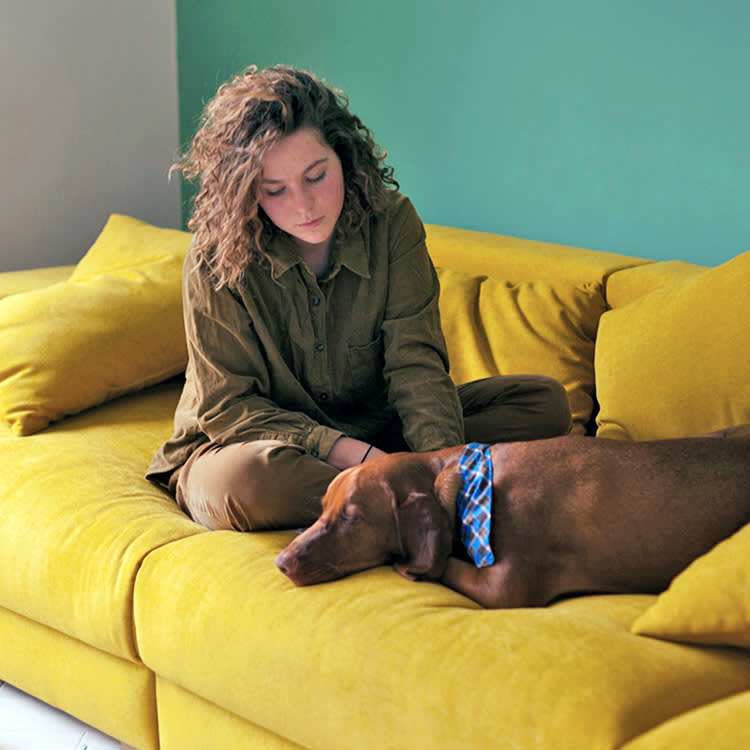
There is a particular kind of 11 p.m. panic that belongs entirely to new puppy parents. The puppy is asleep. The puppy is breathing very fast. You are now counting, badly, in the dark, on your phone’s flashlight, wondering whether this is the thing that ruins your life.
Almost always, it is not. Puppies breathe fast in their sleep because sleep is not one state, it is a cycle, and some phases of that cycle are physiologically busy. But “almost always” is not a plan, and staring harder at your puppy is not a diagnostic. The plan is a number.
Learn to take your puppy’s resting respiratory rate and you replace the whole anxious guessing game with an actual measurement, one that tells you when to relax and, far more importantly, when not to.
First, the reassuring biology
Two things are happening, and both are normal.
Puppies simply breathe faster than adult dogs. If you are comparing your ten-week-old to your parents’ aging Labrador, you are comparing two different machines. A younger puppy runs at a higher respiratory rate than a dog over six months old, awake or asleep.
And sleep changes breathing. Dogs cycle through the same architecture we do: drowsiness, then slow-wave sleep (the deep, still phase), then REM, the active phase where the eyes flick back and forth under the lids and the brain lights up. That is where dreaming lives, and where the twitching, the paddling feet, the little muffled woofs, and, yes, the shallow, rapid breathing all come from.
Here is the part that explains puppies specifically. Young puppies, like human babies, spend proportionally more of their sleep in REM than adults do. As they mature, those REM stretches shorten. So a puppy has more of the sleep phase that produces rapid breathing, and more of the rest of the show along with it. A single nap can run through several full cycles; you just usually miss most of them because you are also asleep.
The tell is that it changes. If you watch a long nap, the fast, shallow, irregular breathing gives way to slow, even, deep breathing, and back again. That oscillation is the signature of a healthy sleep cycle. Fast breathing that never resolves, in a puppy who is otherwise off, is a different story.
The number, and how to take it
The resting respiratory rate is the single most useful home measurement in canine medicine, and vets rely on it heavily in dogs with heart disease. It takes a minute.
Count when your puppy is genuinely at rest, asleep or lying quietly, well away from play, food, a walk, or any excitement. Watch the ribcage. One rise plus one fall is one breath. Count for thirty seconds, double it, and write it down.
Two rules make the number worth something.
Know their baseline. Take it a few times a week while your puppy is well. Dogs are individuals, and what matters clinically is not hitting a magic number, it is a dog whose own rate is climbing.
Know the ceiling. A calm, resting adult dog should be under 30 breaths per minute, and healthy dogs asleep usually sit comfortably below that. Puppies run faster. If your resting puppy is consistently above that ceiling, or if their breaths are shallow, effortful, or labored while they are simply lying there, that is a problem, not a phase.
The single most useful thing a new puppy owner can do is learn to take a resting respiratory rate while their dog is healthy. It costs nothing, it takes a minute, and it means that when something changes, you can tell me ‘he’s been running twenty-two and last night he was thirty-eight’ instead of ‘he seemed like he was breathing weird.’ One of those sentences gets your dog treated faster.
And one thing worth stressing: a real breathing problem does not confine itself to sleep. A dog in respiratory trouble shows it awake too. So when you are worried about a sleeping puppy, watch them awake and at rest for a few minutes. If everything looks normal while they lie quietly on the rug, the odds tilt hard toward “nothing.”
When fast breathing is not the sleep cycle
Dreaming. The default answer. Rapid, shallow breaths, twitching, and vocalizing during REM, which settle when they move into deep sleep or wake up. Perfectly normal, and one of the great free entertainments of dog ownership.
Overheating. Panting is how dogs cool, and it needs fast movement of air. If the room is warm, your puppy will keep breathing quickly even at rest and asleep, simply to hold their temperature down. Cool the room and the rate comes down.
Recent exercise or excitement. Play, a visitor, a car ride, all of it raises heart rate and respiratory rate and can push body temperature up enough that they keep panting for a while. It should settle. Usually, a puppy calm enough to fall asleep has already come back down.
Anxiety or fear. The flight-or-fight response drives the same increases. Same logic applies: once they are calm enough to sleep, the rate should follow.
Pain. Pain raises heart rate and respiratory rate, quietly. A puppy in pain may also hide, dodge affection, growl protectively, go off their food, or limp. Fast breathing with any of those alongside is worth an exam.
Heart or lung problems. This is the category that justifies the whole counting exercise. Puppies can be born with structural problems: heart malformations, diaphragmatic hernias, cleft palates, all of which can show up as abnormal breathing. They are also very catchable when it comes to infection, especially canine infectious respiratory disease complex (CIRDC, what most people still call kennel cough), which can range from cold-like symptoms and a cough to genuine pneumonia in a small puppy.
Anemia. A shortage of circulating red blood cells means less oxygen delivered per breath, so the body compensates by breathing faster. Anemia in a puppy can come from bleeding, including after trauma or after eating a toxin such as rodenticide, from infectious causes like tick-borne disease or a heavy flea burden, or from a bone marrow problem. An anemic dog has pale gums, is very weak, and breathes rapidly. That is an emergency, today, right now.
Brachycephalic syndrome. French Bulldogs, American Bulldogs, Pugs, Pekingese, and Shih Tzus carry anatomical changes to the skull and the airway that make breathing harder work at baseline. Noisy sleep, snoring, and effortful breathing on a quiet evening are all common in these dogs, and their margin in the heat or after a hard play session is thin. In a flat-faced puppy, any sudden change in breathing gets seen the same day, because they deteriorate quickly.
The gum check, in ten seconds
While you are learning to count, learn this too. Lift your puppy’s lip and look at the gums. They should be pink and moist. Press a fingertip against them until the spot blanches white, then release: the color should flood back within about two seconds.
Pale or white gums, blue or grey gums, or a color that takes several seconds to come back are all emergencies. Combine that with rapid breathing and you are not doing any more home diagnostics. You are driving.
So: worry, or not?
Ask yourself four things.
- Is it changing? Fast breathing that alternates with slow, deep breathing across a nap is a sleep cycle doing its job.
- Is the awake dog normal? A puppy who plays, eats, and rests quietly with an unremarkable breathing pattern while awake is very unlikely to have a respiratory emergency that only appears when asleep.
- What does the number say? Resting rate at or near their baseline, or comfortably under 30 in a calm dog, is reassuring. Persistently high, and climbing over days, is not.
- Is there effort in it? This is the one that overrides everything else. Flared nostrils, heaving flanks, a stretched-out neck, elbows pushed away from the body, or pale, blue, or grey gums mean you go now, and you do not stop to count.
What’s new since this was written
Home monitoring of resting respiratory rate has quietly become one of the best-supported things an owner can do, and the case for it keeps getting stronger. Work on sleeping respiratory rates in healthy dogs established that most sit well under 30 breaths per minute, and cardiology practice has since leaned hard on the trend: a rate that is climbing over days is one of the earliest reliable warnings that fluid is building in the lungs, often before a dog looks sick to anyone.
You are not going to catch heart failure in an eight-week-old puppy. That is not the point. The point is that the habit is easiest to build now, on a healthy animal, and the number you are casually collecting this month is the baseline you will be grateful for in a decade.
References
- Rishniw, M., Ljungvall, I., Porciello, F., et al. (2012). Sleeping respiratory rates in apparently healthy adult dogs. Research in Veterinary Science, 93(2), 965–969.
- Kis, A., Szakadát, S., Gácsi, M., et al. (2017). The interrelated effect of sleep and learning in dogs (Canis familiaris); an EEG and behavioural study. Scientific Reports, 7, 41873.
- Bunford, N., Andics, A., Kis, A., et al. (2018). Sleep in the dog: comparative, behavioural and translational relevance. Current Opinion in Behavioral Sciences, 24, 132–141.
- Owczarczak-Garstecka, S. C., & Burman, O. H. P. (2016). Can sleep and resting behaviours be used as indicators of welfare in shelter dogs? PLOS ONE, 11(10), e0163620.
- Liu, N.-C., Oechtering, G. U., Adams, V. J., et al. (2017). Outcomes and prognostic factors of surgical treatment for brachycephalic obstructive airway syndrome. Veterinary Surgery, 46(2), 271–280.
- American College of Veterinary Internal Medicine. ACVIM Consensus Guidelines for the Diagnosis and Treatment of Myxomatous Mitral Valve Disease in Dogs. Journal of Veterinary Internal Medicine, 2019.
Common questions
My dog is breathing heavily. Is that an emergency?
It depends on whether they are at rest. Heavy breathing during exercise, excitement, or fear is normal physiology. Heavy breathing in a calm, cool, resting dog is not, and a resting rate that has climbed well above that dog's own baseline is a reason to be seen.
Not a substitute for your vet. Our guidance is educational. For urgent symptoms, contact a vet or emergency clinic right away. Editorial standards
Dr. Park is a board-certified emergency and critical care specialist. She reviews our health and safety content for clinical accuracy and contributes guides on recognising urgent conditions. Her focus is helping owners act quickly and correctly when it matters most.
Meet our experts ↗Keep reading
 First DaysYour Puppy's First Vet Visit Is Won Before You Leave the HouseDr. Ravi Mehta · 8 min
 Health & WellnessPuppy Breath Doesn't Go Bad. It Goes on Schedule.Dr. Mara Chen · 6 min
 First DaysIs Your Puppy Growing Too Fast? The Window Is Smaller Than You ThinkDr. Ravi Mehta · 5 min
 First DaysEight Weeks Isn't a Feeding Milestone. It's a Behavior Deadline.Dr. Priya Nair · 9 min
 Health & WellnessAnother Blue Ridge Beef Recall: Why This Keeps Happening to Raw-Fed PuppiesDr. Mara Chen · 4 min
 First DaysYour Puppy Wants a Bully Stick. Their Teeth Aren't Ready.Dr. Mara Chen · 6 min