


Your Puppy's 'Bad' Phases Are Actually Milestones. Here Are All 5.
The chewing, the sudden shyness, the day your recall stops working, these aren't your puppy failing. They're a predictable developmental schedule. Here's what happens at each of the five stages, and what to do about it.

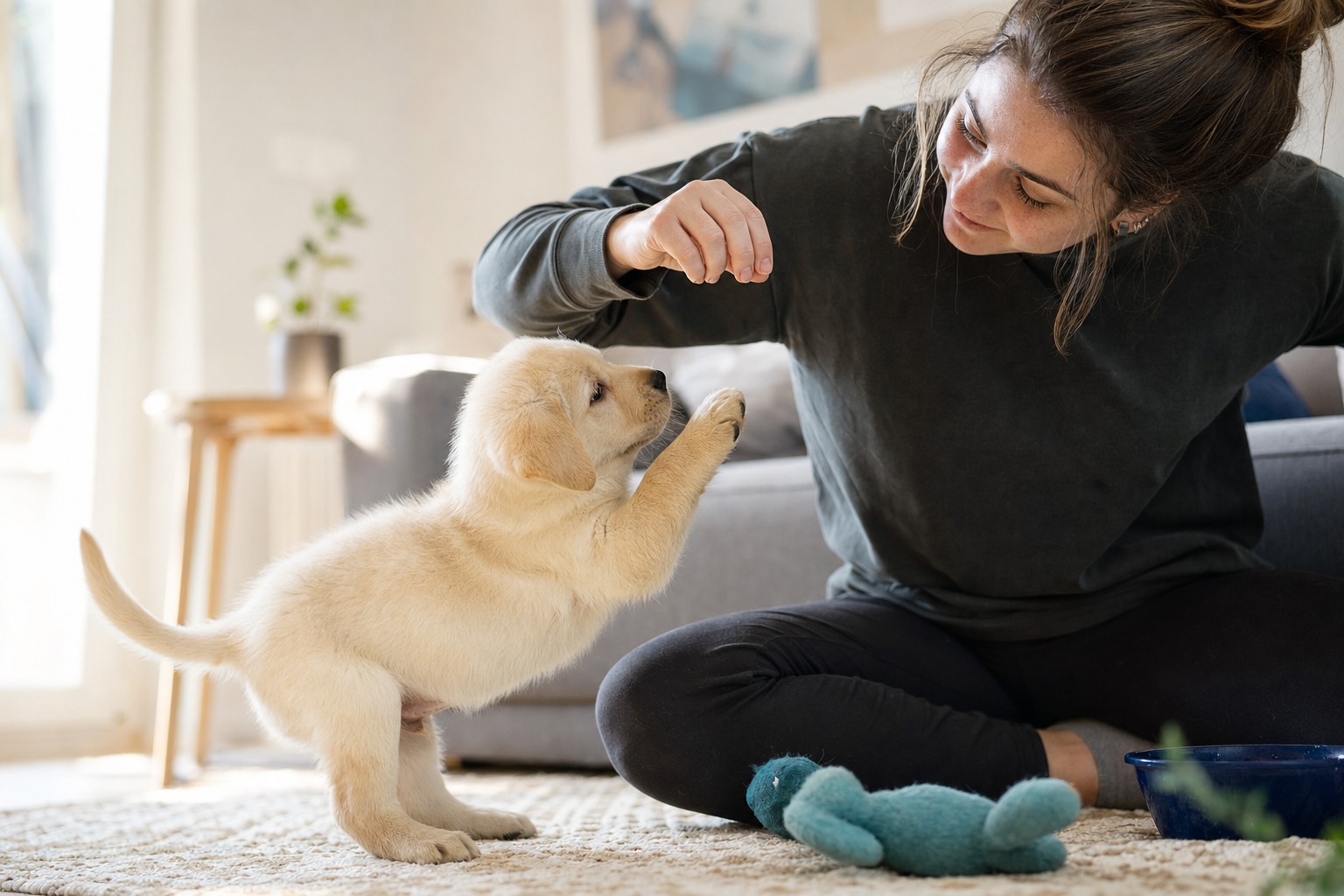
Here is the single most calming thing you can know about raising a puppy: almost nothing they do is random, and almost nothing is personal. The rough play that looks like aggression, the confident pup who suddenly cowers at a cardboard box, the reliable recall that evaporates overnight, these are stages, not setbacks. They arrive on a rough schedule that’s held true across dogs for a very long time.
The ages below aren’t hard borders. Dogs vary, and the transitions are gradual. But if you know what’s coming and why, the whole first two years get easier, because you stop reacting to your puppy’s development as if it were a behavior problem to fix.
Most of the ‘help, my puppy is broken’ messages I get are actually a parent bumping into a completely normal developmental stage they didn’t know was coming. A puppy going through a fear period or an adolescent tuning you out isn’t regressing. Name the stage, adjust what you’re doing, and it passes.
Stage 1: Birth to three weeks, the newborn stage
What’s happening
A newborn puppy can’t do much of anything alone. Mom supplies warmth, milk, and grooming, and even has to stimulate them to pee and poop. Their eyes stay sealed until roughly the back half of the second week, so they neither see nor hear yet, and they move very little. What they can manage is sound, a chorus of mews and squeaks. A pup who drifts away from mom will send up little contact calls to flag the danger of going cold or hungry. Movement is a clumsy front-paw paddle, since their back end can’t yet carry any weight.
Your part
Very little, and that’s the point. Keep them with their littermates and mother constantly, since that’s where care, food, and warmth come from. Keep the space warm and the bedding clean, and otherwise leave them be. Every time you pick a newborn up, you’re pulling them off their heat source and away from a chance to nurse, which happens roughly every two hours at this age.
Stage 2: Three to eight weeks, the world switches on
What’s happening
The senses come online. Eyes open, hearing kicks in, and the whole litter starts to roam and wrestle. Somewhere around five or six weeks, that wrestling can turn startling, all teeth and growling, and plenty of people have panicked that they’re raising a batch of tiny aggressors. They almost never are. This roughhousing is exactly how puppies learn.
Your part
Keep them with mom and siblings; this is non-negotiable, and it’s where some of the most important lessons of a dog’s life get learned. Through play, puppies develop bite inhibition (how hard is too hard) and the social choreography of starting and stopping play. Puppies pulled from the litter too early, at five or six weeks or sooner, are more likely to be aggressive toward other dogs later, more likely to bite too hard in play, and more likely to apply real pressure in a genuine bite, with dogs and people alike.
This is also when gentle human handling should begin, and when a puppy should start meeting a wide variety of people, adults and kids, a mix of appearances, and folks who get around differently, whether that’s with a cane, a walker, or a wheelchair. One underrated tip: puppies decide early, sometimes by eight weeks, what surface counts as “the bathroom,” and they stay loyal to it. Steer them toward grass, dirt, or leaves now and you’ll thank yourself at house-training time.
Stage 3: Eight to 16 weeks, the golden window
What’s happening
This is usually when a puppy comes home, so it’s a stretch defined by transition. Expect a few odd days to a week as they adjust; some puppies barely blink, others need time, and both are normal. Many puppies also hit an early fear period here, so confidence dips and then rebuilds across the stage. A pup who was bold on Tuesday might, on Thursday, cower at a delivery truck, an exuberant dog, or that same cardboard box.
The headline of this stage is the socialization window. Puppies are extraordinarily open to new experiences right now, and good ones leave a lasting imprint. Dogs who meet many people, places, and situations during this period are far more adaptable for life than dogs who don’t. The window opens as early as three weeks but, for most new puppy parents, runs from about eight weeks well into the fourth month, and it closes gradually rather than slamming shut.
They’re also soaking up lessons nonstop: which humans are their people, which companions are safe, where the bathroom is, what everyday sights and sounds mean, and how cues connect to actions. Expect attentiveness, a lot of cuddling (though it never feels like enough), middle-of-the-night potty trips, and some accidents, though most puppies grasp the basic idea that bathroom means outside during this time.
And they are, briefly, at peak cuteness. Research found that people rate puppies as most adorable right around eight weeks, more than earlier or later, and it’s likely no accident: that peak lands exactly when we’re exhausted and doing the hardest work, and it seems to help our brains bond to them anyway. Many parents feel especially close now, partly because puppies this age often trail you everywhere, leash or no leash.
Your part
Patience and gentleness through the transition, and then socialization, socialization, socialization, but the right kind. The goal is not maximum exposure; it’s maximum good exposure. If your puppy meets people and dogs, hears the blender and the washing machine and passing trucks, walks on tile and grass and gravel, and visits new places, and all of it is pleasant, that’s gold. If they have a bad time, it’s counterproductive. Pair novelty with treats, never force your puppy closer to something they’re avoiding, and consider a puppy class built around socialization.
These weeks are also a wonderful time to start training. Even young puppies can learn to sit for greetings and meals, come when called, settle in a crate, walk on a leash, begin a “stay,” wait at doors, and touch a target, and to discover that training itself is a good time, since a puppy will work happily for a snack, a squeaky toy, or a burst of your attention.
Stage 4: Four months to one year, hello adolescence
What’s happening
As the socialization window closes, adolescence opens, usually by six months, and it behaves like adolescence everywhere. Your puppy wants independence, ranges farther from you, and grows less attentive, sometimes seeming not to hear cues they used to nail every time. They need more activity than before and seem hungry for stimulation and company. A lot of that drive comes out as chewing, which can feel almost desperate, especially around eight to 10 months.
Somewhere in the back half of the first year, most dogs hit a second fear period, reacting warily to things that never used to bother them, and looking to you for reassurance when the world overwhelms them.
Your part
Two jobs: give them abundant, appropriate outlets, and protect them from the trouble their new independence invites. Training is your best tool here, both for engaging their mind and for the obvious payoff of a well-mannered dog. Practice it in the living room, on the sidewalk, from the back seat, and anywhere else you happen to be, and keep it varied with classes and fresh environments.
Manage the risks that arrive with speed and independence. A dog who used to drift slowly now bolts, so guard against dashing into roads or charging up to strange dogs; those moments can be dangerous and lasting, and they catch people off guard precisely because the dog changed and the routine didn’t. Don’t over-trust the recall right now, it’s temporarily unreliable, and it comes back with continued training.
For the fear period, stay calm, remove your dog from what’s scaring them, and comfort them; you will not “reward” fear by being kind. Rebuild confidence gradually by pairing a mild version of the scary thing with genuinely great treats or play. If men suddenly seem scary, have a man toss treats or a ball; if it’s dumpsters, hand over a treat every time one appears at a distance, then slowly close the gap.
Channel the chewing before it finds your shoes. Keep a rotating supply of proper chew items, hand over a stuffed food puzzle when you need them occupied, and serve at least some meals in a way that makes them work for it, so dinner doubles as enrichment.
Stage 5: One to two years, the almost-adult
What’s happening
The “puppy” label technically expires at twelve months, but full adulthood is still closer to the two-year mark, and this in-between stretch keeps shaping who they’ll be; what happens now leaves its mark on adult behavior and emotion. Energy demands run high. They can play, walk, or hike for long stretches, rest briefly, and bounce back for more, and they’re up for nearly anything: games, food puzzles, training, dog sports. Throughout the stage, attentiveness gradually returns, and the distracted teenager slowly becomes a dog who listens again.
Your part
Provide the activity all that energy requires, running, fetch, tug, and hikes double as exercise and bonding. Lean hard into enrichment, which this age tends to relish, from frozen food puzzles to digging opportunities to classes and sports like agility, dock diving, or nose work. And keep training, because a dog who can now actually pay attention is ready to polish the useful stuff: a rock-solid recall, a real stay, targeting and tricks, sit and down on cue, waiting politely at doorways, and a dependable “leave it.” Every one of those makes daily life smoother for both of you. Many dogs happily crash for a nap after a training session, and a well-trained young dog is far easier to bring on outings and have around guests, which is its own kind of enrichment.
The one piece of advice that covers all five stages
A wise grandparent once offered a line meant for raising kids that fits raising dogs perfectly: enjoy them at whatever stage they’re in. Each stage is simply easier to savor once you can see it coming and know how to meet it, so the newborn helplessness, the shark-teeth play, the golden window, the eye-rolling adolescence, and the boundless young-adult energy all read as chapters rather than crises.
What newer research adds
The old worry, that you shouldn’t socialize a puppy until they’re fully vaccinated, has been firmly reversed by behavior specialists. The prevailing veterinary-behavior guidance now holds that the risk of behavioral problems from under-socialization during that eight-to-16-week window outweighs the manageable infection risk, and recommends starting socialization and puppy classes as early as seven to eight weeks, as long as pups have had a first round of vaccines and a first deworming and you keep them out of high-risk spots like dog parks until fully vaccinated. In practice: socialize early, socialize smart, and don’t wait for the final shot to start showing your puppy the world.
References
- “Dog Pups’ Attractiveness to Humans Peaks at Weaning Age.” Anthrozoös / Behavioural Processes, 2018 (study finding peak human-rated cuteness around six to eight weeks). https://doi.org/10.1016/j.beproc.2018.05.011
- Pierantoni, L., et al. “Prevalence of Owner-Reported Behaviours in Dogs Separated from the Litter at Two Different Ages.” Veterinary Record, 2011. https://pubmed.ncbi.nlm.nih.gov/21730035/
- American Veterinary Society of Animal Behavior. “Position Statement on Puppy Socialization.” https://avsab.org/wp-content/uploads/2018/03/Puppy_Socialization_Position_Statement_Download_-_10-3-14.pdf
- Santos, N. R., et al. “A Review of Maternal Behaviour in Dogs.” Journal of Small Animal Practice, vol. 61, no. 2, 2020, pp. 85–92. https://doi.org/10.1111/jsap.13085
Dr. Chen is a small-animal veterinarian who leads health and safety coverage at The Pet Times. She writes and reviews the bulk of our illness, condition, and safety content, translating clinical guidance into clear, practical advice owners can act on at home.
Meet our experts ↗Keep reading
 First DaysThe 3-3-3 Rule Is Two-Thirds Made UpDr. Mara Chen · 10 min
 TrainingYour Shy Dog Isn't Antisocial. You're Fighting Two Hidden Deadlines.Dr. Mara Chen · 9 min
 First DaysStop Counting Your Puppy's Sleep Hours. Watch for the Change.Dr. Amara Solis · 8 min
 First DaysThe Only Puppy in the Litter Missed a Class. It Shows Up Years Later as a Bite.Dr. Nina Kohl · 9 min
 TrainingYour Puppy Is Talking to You. Here's the Translation.Dr. Nina Kohl · 8 min
 First DaysYour Puppy Isn't Being Wild. They're Overtired.Dr. Nina Kohl · 6 min