


Your Shy Dog Isn't Antisocial. You're Fighting Two Hidden Deadlines.
Socializing a nervous dog isn't about dragging them to the dog park until they cope. It's a race against two developmental windows, and the second one blindsides almost every owner.

When you bring home a puppy, your priorities are cuddles, naps, and keeping them from eating the furniture. Socialization rarely makes the shortlist. That is a shame, because it is quietly one of the most time-sensitive things you will ever do for your dog, and the window is smaller and stranger than most people realize.
Here is the reframe that changes everything: a shy dog is usually not a dog with a bad personality. It is a dog whose social development got interrupted by timing. Two developmental clocks are ticking in early life, and if you understand them, “my dog won’t play at the park” stops looking like a flaw and starts looking like a solvable gap. A little caution, for the record, is not a problem at all. The goal is not to manufacture a party animal. It is to help a nervous dog feel safe enough to engage, and to head off fear or reactivity before it sets.
The first clock: the socialization window
Puppies move through a developmental stage often called the critical period, or socialization period, that runs roughly from two weeks to about 14 weeks old. Across that stretch, a puppy’s brain is unusually open to novelty. Sights, sounds, surfaces, people, other animals, situations, whatever a puppy meets calmly during this window becomes filed under “normal.” The more varied, positive exposure they get, the more resilient and confident they grow around new things.
Miss it, and the gap shows up later. A puppy who spent those weeks somewhere isolated, a remote home, a quiet rural property, a shelter with little dog-to-dog contact, may simply not have built the social vocabulary other dogs take for granted: how to invite play, how to read another dog’s signals, how to bow out of an interaction gracefully. None of that is the dog’s fault, and none of it is permanent. It just means you are now building a skill that ideally would have been laid down earlier.
One practical note that surprises new owners: leading veterinary behavior guidance says socialization should begin before a puppy has finished its full vaccine series, with sensible precautions, because the behavioral cost of waiting until every shot is done usually outweighs the infectious risk of well-chosen early outings. The old advice to keep a puppy sealed away until fully vaccinated can quietly cost them the very window that matters most.
The second clock: the fear period nobody warns you about
This is the one that ambushes people. Right around adolescence, between roughly six and eight months and lasting until about 18 months, dogs enter a secondary fear period. In the wild, this is about the age a young animal would strike out on its own, so nature installs a useful bit of caution: if you’re not sure, hang back, proceed carefully. Suddenly a dog who was fine last month is spooked by the trash can, the neighbor, or the rowdy dog at the park.
Stack the two clocks together and you get the classic shy-dog story. A sheltered early period leaves a puppy under-socialized, and then the secondary fear period hits and turns mild uncertainty into real wariness. Depending on the dog, the result ranges from a little social hesitation to serious fearfulness. The reassuring news is that most cases land on the milder end, a dog who is simply unsure, not broken, and those dogs respond well to patient, well-paced work.
Shy or fearful? Learn to tell them apart
Reading your dog correctly tells you how gently to proceed. Two rough profiles:
- A fearful dog tends to shrink: flattened ears, lip-licking, yawning, cowering, avoiding eye contact, or tucking the tail when strangers or other dogs are near.
- A shy-tipping-toward-defensive dog may go the other way and try to make the scary thing leave: a hard stare, stiff upright ears, a lot of barking, snarling, or growling and snapping around strangers or other dogs.
Either type might retreat a step, raise their hackles, or go off on a walk even when nothing else is around. The behaviors look different, but the engine underneath is the same: the dog does not feel safe, and it is telling you.
How to actually build confidence
The through-line here is that confidence is built at the dog’s pace, in situations you have set up to succeed. Force is the one thing guaranteed to set you back.
Start smaller than the dog park
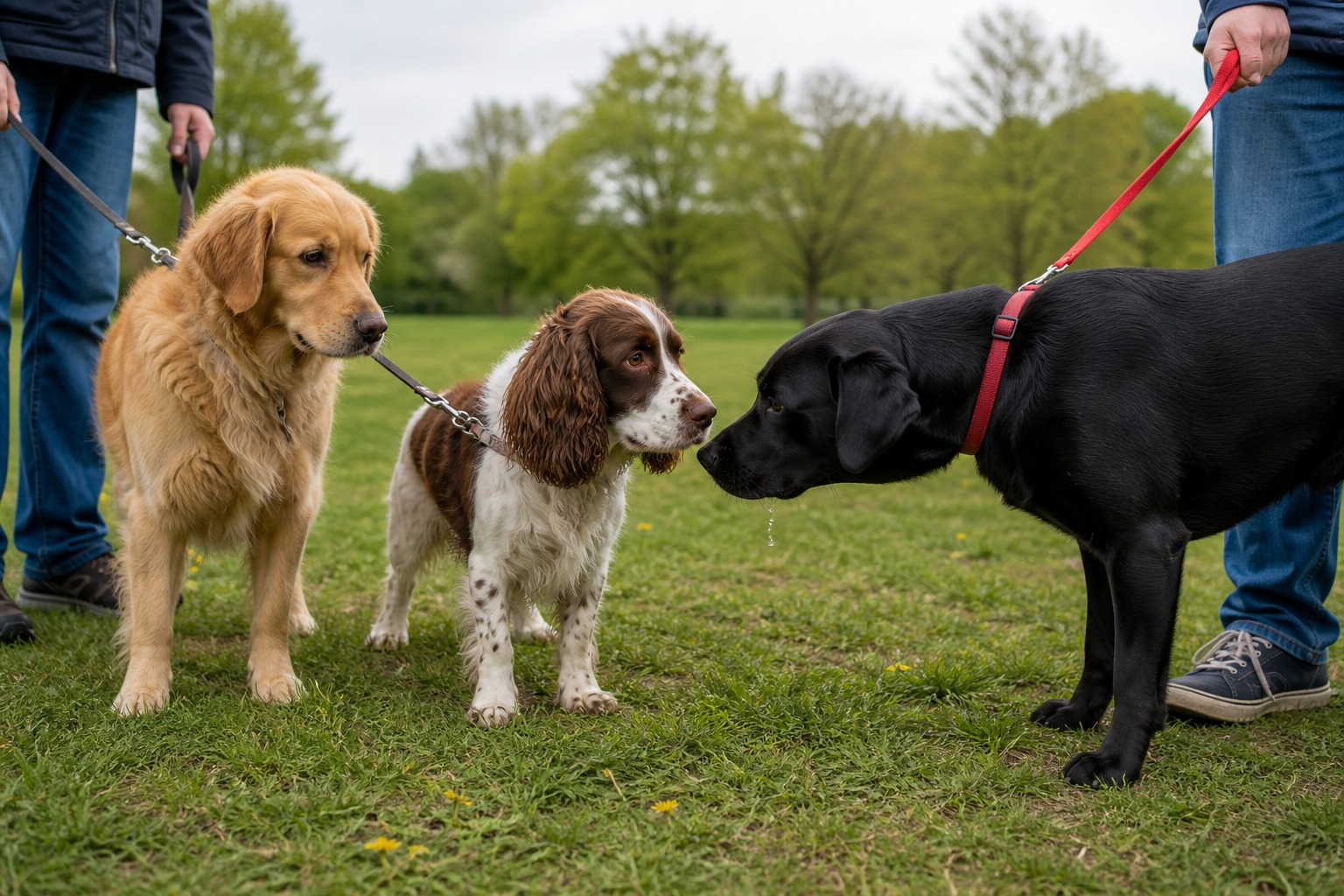
Dog parks, daycares, and free-for-all puppy playdates are often the worst first step for a nervous dog, not the best. A closed space full of dogs charging around is overwhelming. Instead, recruit a friend or relative with a calm, steady dog and take a parallel walk: both dogs moving in the same direction, some distance apart, sharing the environment without any pressure to interact face to face. Let them see and smell each other from a comfortable buffer while they sniff and explore. After ten minutes or so, you can pause and see whether they want a brief sniff. A couple of seconds, then move on again, checking in on comfort as you go. If it is going well, a little off-leash play in a safe space can follow. You are stacking small, safe experiences into a general sense that other dogs are fine to be around.
Find your dog’s kind of friend
Dogs have play styles. Some wrestle, some chase, some just want to trot around and be left alone. When you are helping a timid dog, follow their lead on what kind of company suits them and set them up with compatible playmates and settings. Maybe the Saturday-morning dog park is too much, but a big open field with two mellow friends is perfect. If you find a group your dog genuinely enjoys, make it a standing date, even if it means driving past the crowded park down the block to reach the calmer one across town.
Grow confidence away from other dogs, too
A lot of social confidence is really just general confidence, and you can build that anywhere. Scent games are excellent for this. Put your dog in a down-stay in one room, scatter a few pieces of kibble around another, then release them to hunt it down. If they eat wet or raw food, stuff it into rubber puzzle toys and hide those the same way. Feeding a nervous dog by making them search and forage is one of the simplest ways to help them feel capable, and a dog who feels capable at home carries some of that out the door.
Consider a good class
A well-run group class led by a certified trainer can be a structured way to build social confidence without play being the point. Look specifically for someone who works LIMA-style (least intrusive, minimally aversive) and has real experience with timid dogs. Learning a few solid cues is a confidence booster in itself, and it opens a clear line of communication between the two of you.
When it isn’t going well, back off
It is tempting to keep bringing a shy dog to the busy park on the theory that they will “get used to it.” Resist it, and ignore the well-meaning bystander who tells you to push through. Flooding a fearful dog, especially during that sensitive adolescent window, tends to make the fear worse, not better. Work slowly, and only advance when your dog is genuinely ready and even eager. And once they are enjoying other dogs, keep reading them: know the subtle signs that say “I’ve had enough,” and be the one who calls it before they tip into overwhelm. You are their teacher and their safe person, and they are trusting you to make the call.
What’s new: the case against “toughening them up”
If you needed one more reason to skip the force-it approach, recent research supplies it. A 2020 study out of the University of Porto compared companion dogs trained at schools using aversive methods (leash corrections, scolding, other punishment) with dogs trained using reward-based methods. The aversively trained dogs showed more stress behaviors and higher cortisol during training, and, tested later in a neutral setting, they responded more pessimistically to ambiguous situations, a marker of a more negative underlying emotional state.
For a shy dog, that is the whole ballgame. The very thing you are trying to build, an optimistic “new things are probably fine” outlook, is exactly what harsh, high-pressure handling erodes. Patient, reward-based, well-paced socialization is not just the kinder route. On the evidence, it is the one that actually works.
References
- American Veterinary Society of Animal Behavior. “Position Statement on Puppy Socialization.” avsab.org
- Vieira de Castro, A. C., et al. “Does Training Method Matter? Evidence for the Negative Impact of Aversive-Based Methods on Companion Dog Welfare.” PLOS ONE, vol. 15, no. 12, 2020, e0225023.
- American Kennel Club. “Puppy Socialization.” akc.org
- ASPCA. “Socializing Your Dog.” aspca.org
Common questions
Should I force my shy dog into social situations?
No. Flooding a nervous dog with overwhelming situations tends to deepen the fear, not cure it. Ease them in gradually, starting with low-key setups like a calm parallel walk alongside a friend's steady dog.
Do I need a professional trainer to socialize a shy dog?
Not always, but a well-run group class led by a certified trainer who uses least-intrusive, reward-based methods can be a structured, low-pressure way to build a timid dog's confidence around other dogs.
How long does it take for a shy dog to warm up?
It depends entirely on the dog and why they're shy. Some loosen up in a few weeks, others take months. Progress is rarely linear, and pushing for speed usually backfires.
Can calming supplements or medication help?
Sometimes. Track what specifically triggers your dog's fear and share it with your vet, who can help you decide whether a supplement or medication is a sensible support alongside behavior work.
Dr. Chen is a small-animal veterinarian who leads health and safety coverage at The Pet Times. She writes and reviews the bulk of our illness, condition, and safety content, translating clinical guidance into clear, practical advice owners can act on at home.
Meet our experts ↗Keep reading
 First DaysYou're Accidentally Teaching Your Puppy to PanicDr. Lena Park · 7 min
 First DaysYour Puppy Isn't Regressing. They're in a Fear PeriodJordan Ellis · 8 min
 TrainingYour Puppy Isn't Being Dramatic. Separation Anxiety Is Real, and Fixable.Dr. Lena Park · 7 min
 TrainingYour Puppy Cries at Night for One of Four Reasons. Only One Means Get Out of Bed.Dr. Lena Park · 6 min
 First DaysThe 3-3-3 Rule Is Two-Thirds Made UpDr. Mara Chen · 10 min
 First DaysTwo Puppies Sound Twice as Sweet. Trainers Beg You to Reconsider.Dr. Mara Chen · 8 min