


You're Accidentally Teaching Your Puppy to Panic
The hardest part of leaving a puppy home alone isn't the leaving. It's that most owners train dependence by accident, then wonder why the first goodbye falls apart. Here's how to build alone-time as a skill, starting while you're still in the house.

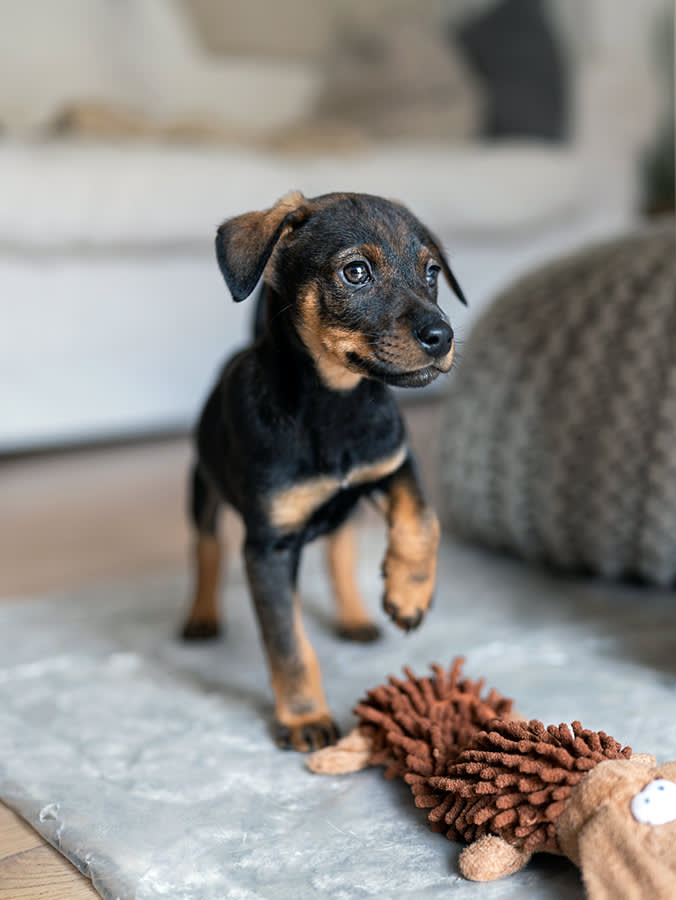
Here is the uncomfortable part almost nobody tells new puppy owners: the way you behave when you are home is quietly teaching your puppy how to fall apart when you are gone.
The scooping-up, the never-closing-the-bathroom-door, the puppy who follows you from room to room and is never asked to do otherwise. All of it feels like love, and it is. But to a young dog, constant company is the only normal they know, and the first real absence lands like a rupture. The good news is that the reverse is also true. Being calmly, briefly alone is a skill, and like any skill it can be taught gently, in small doses, long before you ever pick up your keys.
So let’s reframe the whole project. The goal is not to survive the first time you leave. The goal is to make sure the first time you leave is not the first time your puppy has ever been alone.
Practice leaving while you’re still home
This is the step the standard advice buries at the bottom, and it is the one that matters most.
Build in small solo stretches even on the days you’re home all afternoon with nothing stopping you from scooping them up. Set them up in their own space, a playpen or crate, with a safe chew or a portion of their meal, and step into the next room for a few minutes. Come back before they panic, not after. You are teaching a simple, repeatable lesson: my person steps away, and then my person comes back, and nothing bad happens in between.
Do this many times a day, in absences so short they are almost boring. A puppy who has quietly handled a hundred two-minute separations is a completely different animal from one who is asked to handle eight hours cold. Independence is built in reps, and the reps start on your living room floor.
The bladder math sets the ceiling
No amount of training overrides basic biology. A puppy’s body decides the real limit, and their body is small.
Very young puppies, only days or weeks old, need feeding every few hours, help staying warm, and even stimulation to pee and poop. They cannot be left alone at all; they need nearly constant care. As they grow, they can wait longer between meals and gradually build the bladder control to stay dry for longer stretches. That growth curve, not your calendar, is what tells you when short separations become reasonable, usually around three months of age.
A practical way to hold both facts, the training and the biology, in your head at once:
- Under 8 weeks: essentially never alone. Round-the-clock needs.
- 8 to 10 weeks: a few minutes to an hour, and only after alone-time practice. Frequent potty breaks.
- 3 to 4 months: short, gradual separations, roughly one to two hours, built up slowly.
- 4 to 6 months: a few hours is realistic for a puppy who has practiced, with a midday break.
- 6 months and up: approaching the adult ceiling, but even grown dogs need a bathroom break at least every six hours.
Treat these as starting points, not permissions. A puppy who is stressed at two hours is telling you to go back to shorter reps, no matter what the number says.
A safe space is not optional
Whenever your puppy is unsupervised, whether you are across the house or across town, they belong in a space that is safe and contained. This does two jobs at once. It keeps them away from toxins, cords, and the thousand household hazards a bored puppy finds in seconds, and it gives them a predictable, familiar spot that feels like theirs.
Puppy-proof that space seriously. Anyone who has turned around for one moment and found their puppy mid-disaster knows how fast it happens. A crate, a playpen, or a single gated room all work, as long as you have made it genuinely welcoming: daily playtime in there, treats in there, meals in there. You want your puppy to walk into that space and feel good, which means it can never double as punishment. Locking a puppy away in anger builds fear of the exact place you need them to trust.
Crate training, step by step
Crate training is the most reliable way to give a puppy a secure den for alone time, and it lives or dies on association. The crate has to predict good things.
Start by making the crate the best real estate in the house: meals inside it, chews inside it, praise for wandering in on their own. Then build duration slowly, first with the door open and you close by, then with the door shut for a few seconds, always releasing your puppy while they are calm rather than the instant they bark. Letting a puppy out mid-whine teaches them that noise opens doors, so wait for a quiet beat.
From there, add distance. Move a step away, then out of the room, then briefly out of the house, ideally with a camera running so you can return before your puppy tips into distress. Crates are deliberately sized so a dog can stand, turn, and lie down but not much more, which discourages accidents, but that same design is exactly why a crate is not a place to park a young puppy for hours. A bladder that can’t wait will have no choice, and a body that needs to move can’t. Keep confinement short, and bookend it with real exercise.
The eight-hour question
The honest answer to “can I leave my puppy alone for eight hours” is no.
Biologically, a young bladder simply can’t wait that many hours, and a fast-growing body needs feeding far more often than that. Developmentally, it is worse than it sounds: puppies have a short window when they are most open to new people, places, and experiences, and a puppy who spends the day alone is missing the exposure that builds a confident adult dog. Long, solitary days early on raise the odds of behavior problems later.
Life still happens, and most of us work. If you are bringing home a puppy, bank as much time off as you can manage for those crucial opening weeks. On the days you truly can’t be there, stack up support: a friend or family member on puppy duty, a midday dog walker, or a daycare that can feed, walk, and even reinforce a little training. The point is not perfection. It is not leaving a young puppy to face eight blank hours by themselves.
Prevention versus the real disorder
It is worth drawing a hard line between a puppy who needs practice and a dog with true separation anxiety, because they are not the same thing.
Separation anxiety is a genuine clinical condition: intense fear when left alone, not an occasional grumble but a chronic, extreme reaction that can drive nonstop barking, destruction, or indoor accidents in a fully house-trained dog. It often traces back to something disruptive, a move, the loss of a trusted person, an abrupt change in routine, though sometimes it appears with no clear trigger at all. These reactions usually are not seen in young puppies; they develop over time.
Everything above is prevention. Gradual, positive alone-time, a predictable daily rhythm of meals, walks, and play, solid socialization, and plenty of physical and mental exercise are the best insurance against anxiety ever taking hold. But if your dog is already showing the severe signs, do not try to wait it out. That is the moment for professional help, which may combine behavior modification, training, and sometimes medication to bring the worst of it down.
The puppies who cope best with being alone are the ones who got to practice it in tiny doses while their person was still in the house. You are not being cruel by stepping into another room and shutting the door. You are handing your dog a skill they will use for the rest of their life.
What newer research adds
Two recent studies back up the practice-early approach in ways the old advice only hinted at.
An analysis from the Generation Pup study, a large project following thousands of dogs from puppyhood, found that separation-related behaviors are common, showing up in close to half of puppies by around six months of age. Notably, puppies who were gently accustomed to spending time settled in a crate or a closed room early on tended to be less likely to develop separation problems, not more. Early, kind confinement looks protective, not harmful.
A 2024 study from the Royal Veterinary College went a step further. Researchers gave new puppy owners different bits of advice before their puppy even came home, including guidance on calm departures and returns and on practicing short absences. Puppies whose owners followed that advice settled more calmly and showed fewer quiet stress signals, the lip-licking and panting that are easy to miss, during a controlled alone-time test. In other words, the coaching worked, and it worked before the puppy had a single bad experience to unlearn. That is the whole case for starting now.
References
Common questions
How long can a puppy really be left alone?
It depends far more on age and bladder capacity than on your schedule. A rough working rule is one hour per month of age, capped at three to four hours for most young puppies, and only after they have been gradually taught to settle alone. A newborn cannot be left at all; a six-month-old who has practiced can manage a few hours. When in doubt, plan for shorter and build up.
Can I leave my puppy alone for eight hours?
No. Young puppies physically cannot hold their bladder or bowels that long, they need to eat frequently while they are growing, and eight hours with no interaction, exercise, or new experiences is a real setback during their short socialization window. On days when work demands it, bring in a walker, a daycare, or a friend to break up the stretch.
Is crate training cruel?
Not when it is done with patience and positive associations. A crate that only ever holds meals, chews, and calm praise becomes a den your puppy chooses on their own. A crate used for punishment, or used for long confinement a young bladder can't handle, does the opposite. The tool is neutral; how you introduce it is everything.
Dr. Park is a board-certified emergency and critical care specialist. She reviews our health and safety content for clinical accuracy and contributes guides on recognising urgent conditions. Her focus is helping owners act quickly and correctly when it matters most.
Meet our experts ↗Keep reading
 First DaysThe '1 Hour Per Month' Puppy Rule, and When You Have to Break ItDr. Amara Solis · 8 min
 First DaysNighttime Crate-Training Usually Fails for One Reason: Bladder MathNina Vasquez · 8 min
 First DaysTwo Puppies Sound Twice as Sweet. Trainers Beg You to Reconsider.Dr. Mara Chen · 8 min
 TrainingA Stranger Held His Puppy 50 Times in a Month. The Science Says He Was Right.Dr. Mara Chen · 6 min
 First DaysThe Simple Math That Ends Puppy Potty AccidentsDr. Lena Park · 6 min
 TrainingThe Puddle on Your Bed Has a Size. That's Half the Diagnosis.Dr. Lena Park · 8 min