


The Puddle on Your Bed Has a Size. That's Half the Diagnosis.
A puppy peeing in your bed isn't one problem, it's five, and they need opposite fixes. The volume, the timing, and who was in the room sort it in about a minute.

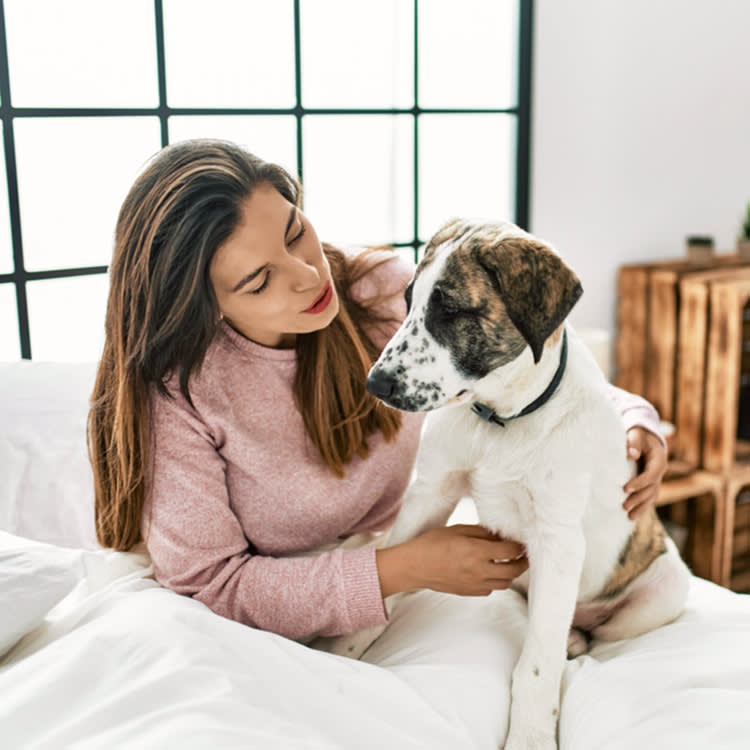
You pull back the duvet and there it is. Again.
Before you strip the bed, do one thing: look at the size of the puddle.
Because “my puppy pees on my bed” is not one problem. It’s about five different problems that happen to leave evidence in the same place, and the fixes contradict each other. Crating the wrong puppy makes it worse. Greeting the wrong puppy enthusiastically makes it worse. Cleaning it the way the internet told you to almost guarantees it happens again in the exact same spot.
The good news is that the puddle itself tells you most of what you need. So does the clock, and so does the answer to “who was in the room.”
First, get spite off the table
Your dog did not do this at you. There’s no evidence dogs urinate as revenge, and the belief is genuinely harmful, because it turns a solvable problem into a grudge and pushes people toward punishment, which is the one intervention guaranteed to backfire.
If your puppy looks “guilty” when you find it, that’s not a confession. That’s a dog reading your face and your body and getting worried. They can’t connect your anger to something they did twenty minutes ago.
The three questions that sort it
1. How much urine is there?
A lot. A real emptying of the bladder, a soaked patch. That’s an accident, an inability, or a medical problem. The dog needed to go and did not have the ability or the opportunity not to.
A little. A small deposit, a few tablespoons, often near an edge or a seam. That’s marking, and it’s a different behavior with a different motive. Marking is a message left in a place that smells strongly of someone.
That single distinction splits your response in half before you’ve done anything else.
2. When did it happen?
Overnight, while everyone was asleep, points at bladder capacity. Puppies simply cannot hold it as long as we assume, and the classic mistake is a heavy-sleeping human trusting themselves to wake up when the puppy stirs.
The rough guide most vets use: roughly one hour of holding per month of age, up to about nine months. A three-month-old puppy can be expected to hold it around three hours, not eight. The bladder muscles themselves are still maturing until around four to six months. This is anatomy, not disobedience.
Right after someone walked in, or right after a greeting, points somewhere else entirely. Keep reading.
3. Who was in the room?
This is the question people skip, and it’s the one that cracks the hardest cases.
If the wetting only happens around one particular person, you are almost certainly looking at submissive urination or excited urination, and they are opposites wearing the same puddle.
Submissive urination is fear. It happens around the person who looms, scolds, corrects, or simply moves fast and loud. The dog is signaling “I’m no threat.” It is not a housetraining failure, and every scolding makes it more likely to happen again.
Excited urination is joy with no brakes. It’s the person who comes through the door at full volume, in the baby voice, whipping the dog into a frenzy. A young puppy’s bladder control collapses under that much arousal. This one usually fades on its own as bladder control matures, and it fades faster if the human dials it down: come in calmly, ignore the dog for the first couple of minutes, and greet them once they’ve settled.
If the wetting happens around everybody, it’s not about a person. Go back to questions one and two.
The two causes that don’t fit the pattern
Medical. If this is new behavior in a dog who was reliable, stop troubleshooting and book a urinalysis. Urinary tract infections are common, uncomfortable, and easy to treat. So is incontinence in older dogs, which is not the same as an accident and doesn’t respond to training at all, because the dog is often asleep when it happens. A senior who leaks while sleeping needs a vet, not a schedule.
Stress. Dogs are sensitive to change in ways that feel disproportionate to us. A new baby, a new job schedule, a move, construction next door, a new pet. Stress can produce urinary behavior in a dog who has never done it before. If the timing of the accidents lines up with an upheaval in the house, treat the upheaval.
“The question I ask first is never ‘has the dog been trained,’ it’s ‘how much urine and who was in the room,’” says Dr. Nina Kohl. “Those two answers point at completely different problems, and the wrong fix doesn’t just fail. It usually makes the dog worse, because the owner starts adding pressure to a dog who was already telling them they had too much.”
Clean it right, or you’re guaranteeing a rematch
Here’s the part the standard advice gets wrong, and it matters more than any training tip in this article.
Urine contains uric acid crystals, and they are not water-soluble. Soap won’t dissolve them. Vinegar won’t. Baking soda absorbs odor at the surface but leaves the crystals sitting in the fibers and the mattress pores, invisible, where humidity reactivates them. That’s why the smell “comes back” weeks later, and it’s why your dog goes back to the same spot: to them, it still smells like a toilet, because it still is one.
The only thing that works is an enzymatic cleaner, which uses protease enzymes to actually break the uric acid molecules apart.
How to clean a mattress properly:
- Blot, don’t rub. Press with towels and lift. Rubbing drives it deeper into the foam.
- Saturate with an enzymatic cleaner. Genuinely saturate. The urine went as deep as it went, and the enzyme has to reach all of it. Under-applying is the most common failure.
- Leave it wet. Enzymes need contact time, usually 10 to 15 minutes, and many products want longer. Do not blot it off immediately.
- Blot the excess and let it air-dry completely. A fan helps. Trapped moisture is its own problem.
- Repeat if the smell returns after drying. A deep soak often needs two rounds. If you want, a baking-soda layer over the dried spot afterward is fine as a final odor absorber. It just cannot be step one.
Strip and wash the bedding on the hottest setting the fabric tolerates, with an enzymatic laundry additive.
Now prevent the next one
- Crate or confine at night until bladder control catches up. This is not cruelty, it’s plumbing. A properly sized crate gives the puppy a space they won’t soil, and it gives you a chance of hearing them stir.
- If the puppy sleeps in your bed anyway (nobody’s judging), set an alarm. If they get up, shift, circle, or seem restless, take them out immediately, on lead, to the same patch of grass, and reward there.
- Take them out after every trigger: waking, eating, drinking, playing, and any burst of excitement.
- Reward outside, at the moment it happens, not when they come back in.
- Make greetings boring. Have a conversation with the household member who riles the dog into a puddle.
- Block access to the bed while you rebuild the habit, especially if the spot has been soiled before. One unblocked relapse on an imperfectly cleaned mattress and you’re back to square one.
- For a senior with incontinence, talk to your vet. Medication often works, and dog diapers can protect the bed in the meantime.
What’s new since this was written
The clearest recent shift is in cleanup, not training. As enzymatic cleaners became standard, the older household-remedy advice (vinegar, baking soda, hydrogen peroxide) has been fairly comprehensively debunked for pet urine: those products deodorize temporarily but do not break uric acid crystals, which is why the smell resurfaces on humid days and why dogs return to spots their owners swear are clean. If you have been fighting a repeat offender in one location, the cleaner is a likelier culprit than the dog.
The other useful correction is about the housetraining clock. Popular timelines are more optimistic than the biology. Bladder muscle control is still developing until roughly four to six months, and the “hours equal age in months” rule is a ceiling, not a target. Most of what people diagnose as a stubborn puppy is a puppy being asked to do something their body cannot do yet.
References
- “House-Training your Puppy.” UC Davis School of Veterinary Medicine, Animal Health Topics. healthtopics.vetmed.ucdavis.edu
- “Submissive and Excitement Urination in Dogs.” UC Davis Veterinary Medicine Behavior Service. vetmed.ucdavis.edu
- “How to Potty Train a Puppy.” American Kennel Club. akc.org
- “The Science of Enzymatic Pet Urine Cleaners.” dogbydrlisa.com
Dr. Park is a board-certified emergency and critical care specialist. She reviews our health and safety content for clinical accuracy and contributes guides on recognising urgent conditions. Her focus is helping owners act quickly and correctly when it matters most.
Meet our experts ↗Keep reading
 TrainingYour 'Dominant' Dog Isn't the Problem. Your Puppy Has No Brakes.Dr. Lena Park · 10 min
 TrainingA Stranger Held His Puppy 50 Times in a Month. The Science Says He Was Right.Dr. Mara Chen · 6 min
 First DaysTwo Puppies Sound Twice as Sweet. Trainers Beg You to Reconsider.Dr. Mara Chen · 8 min
 First DaysThe '1 Hour Per Month' Puppy Rule, and When You Have to Break ItDr. Amara Solis · 8 min
 First DaysYou're Accidentally Teaching Your Puppy to PanicDr. Lena Park · 7 min
 First DaysNighttime Crate-Training Usually Fails for One Reason: Bladder MathNina Vasquez · 8 min