


Pork and Dogs: The Meat Is Fine, the Way We Cook It Isn't
The old fear about pork and parasites barely applies to commercial pork anymore. The risks that actually matter today are the salt, fat, and seasoning we add, plus one exception worth knowing about.

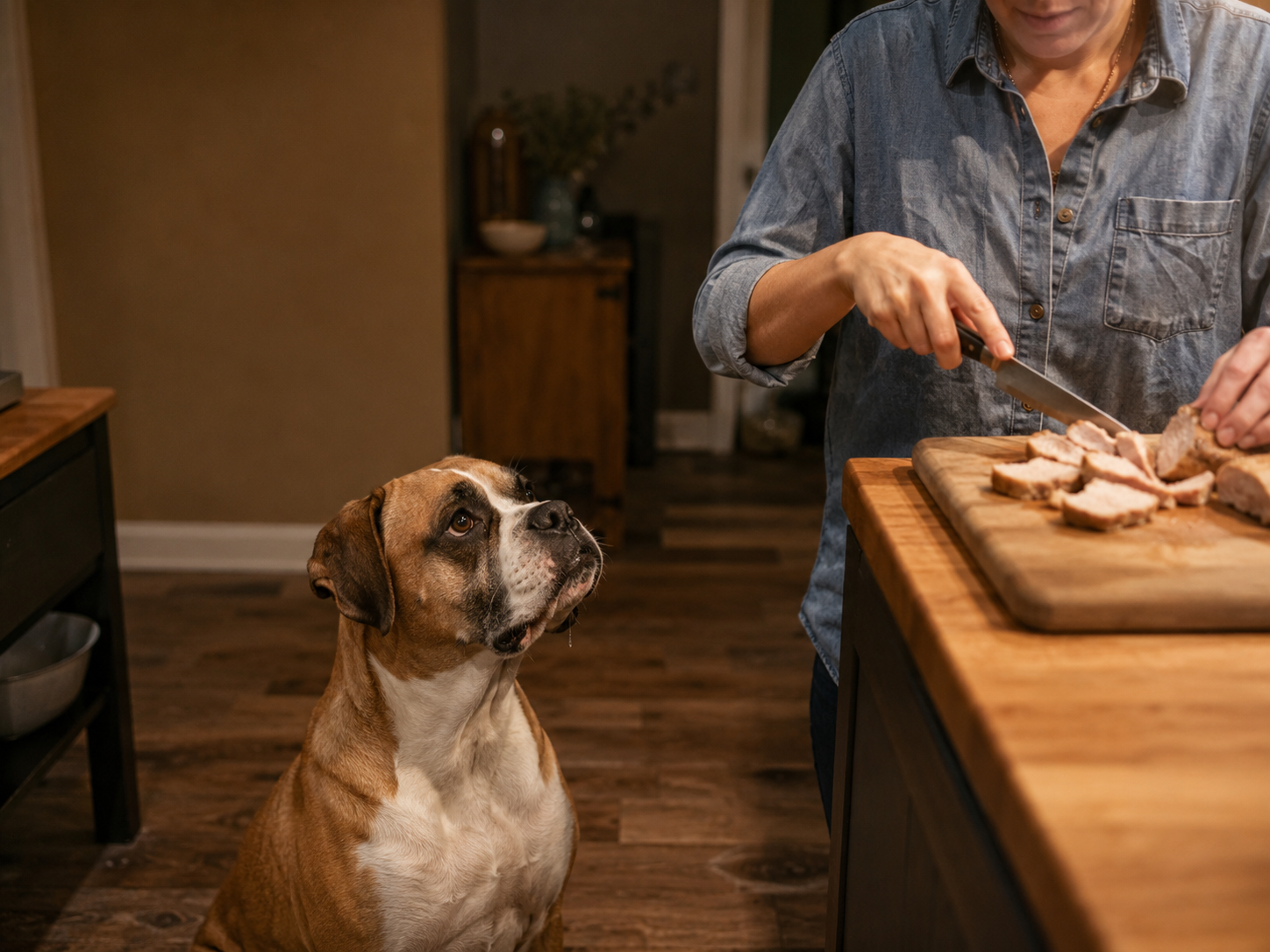
For decades the warning about pork and dogs came down to one word: parasites. Cook it thoroughly or trichinosis will get your dog. That advice made sense in its era, and it left a lasting impression. It is also, for the pork in your grocery cart, nearly obsolete. The threat that scared everyone has been engineered almost out of existence, while the risks that actually send dogs to the vet are the ones we create ourselves at the stove. This is a story about aiming your caution at the right target.
First, the good news that got buried
Plain pork is a genuinely good protein for dogs. It delivers complete, high-quality protein that supports muscle, tissue repair, and energy, and it brings real micronutrients along:
- B vitamins (B1, B6, B12) for nerve health, brain function, and energy metabolism.
- Zinc for skin health and immune support.
- Iron for red blood cell production and oxygen transport.
Set beside chicken or beef, lean cooked pork holds its own. Dogs are rarely shy about asking for a bite, and on the merits of the meat itself, that instinct is sound.
The parasite fear, brought up to date
Here is the part the old advice never caught up to. Trichinella, the roundworm behind trichinosis, has been driven to negligible levels in U.S. commercial pork by modern farming and inspection. A 2024 USDA survey tested 3.2 million pigs raised under quality-assurance programs and found zero Trichinella infections, giving 95 percent confidence that prevalence is below one in a million. Human trichinellosis in the United States has fallen to roughly 15 confirmed cases a year, and the recent ones trace overwhelmingly to undercooked wild game, bear especially, not to pork from a store.
So the parasite risk from commercial pork is now vanishingly small. It is not literally zero, which is why thorough cooking is still the right habit, but it is no longer the headline. The one place the old warning fully holds is wild or non-commercial pork, boar or a backyard hog of unknown provenance, which can still carry the parasite and needs to be cooked hard.
I still tell people to cook the pork, but I’ve changed why. It’s no longer ‘because it’s crawling with parasites.’ It’s basic food hygiene, and it matters most for wild game. For pork from the supermarket, the thing I actually worry about is what’s on it, the salt, the sugar, the garlic, not what’s in it.
The risks that actually matter now
With parasites demoted, the real hazards come into focus, and almost all of them are things people add to pork rather than the pork itself.
Processed pork is the true no. Bacon, ham, sausage, and deli meats are cured, which means loaded with salt and preservatives. The sodium alone can be a problem, and the fat compounds it. These belong off the dog’s plate entirely, not as a “small amount” exception.
Fat and pancreatitis. Fatty cuts and fatty products push a lot of fat into a system that does not handle sudden fat loads well. Too much can trigger pancreatitis, a painful and sometimes serious inflammation. Trim the fat and choose lean.
Seasonings. Pork rarely reaches a table plain. Garlic and onion powder are genuinely toxic to dogs and can damage red blood cells; heavy salt and rich sauces cause their own trouble. A seasoned pork chop is a hazard a plain one is not.
Cooked bones. Cooked pork bones splinter into sharp fragments that can choke a dog or perforate the gut. This is a firm no. Reach for an appropriate chew toy or dental chew instead.
Allergies. Food allergy is fairly common in dogs, and pork is one protein some react to, with signs like itching, ear infections, or GI upset. Introduce it gradually and watch.
Why you rarely see pork in dog food
If pork is such a solid protein, why is the kibble aisle full of chicken, beef, and fish instead? A few reasons, none of them about danger:
- Pork tends to run higher in fat than the leaner proteins pet-food formulators prefer.
- Some cultures avoid pork, which shapes markets.
- The long historical worry about parasites, the very concern that has now faded, discouraged its use for years and the habit stuck.
How to serve pork the right way
The safe version is simple and mostly subtractive, take away everything we like to add:
- Cook it fully. For whole cuts, an internal temperature of at least 145°F (63°C) with a short rest is the USDA guideline; ground pork should reach 160°F. For any wild or unknown-source pork, cook to 165°F to be safe.
- Serve it plain. No salt, no seasoning, no garlic or onion, no sauce, no frying oil.
- Trim the fat and choose lean cuts.
- Remove all bone, every time.
- Keep it a treat, not a staple, and count it toward the small share of the diet reserved for extras.
- Introduce it gradually if it is new, starting with a small portion and watching for any reaction.
Signs of a bad reaction
Whether from an allergy or from fat and seasoning, stop the pork and call your vet if you see:
- Vomiting or diarrhea
- Facial swelling
- Swollen paws
- Persistent scratching of the skin or ears
The bottom line
Dogs can eat pork, and plain, lean, fully cooked, boneless, unseasoned pork is a fine protein for most of them. The parasite fear that defined the old advice barely applies to commercial pork anymore, though it is still worth respecting with wild game. The risks that remain are the ones we introduce: the cure on bacon and ham, the fat, the garlic and salt, and the bones. Handle the meat plainly and the pork is not the problem. Dress it up the way we like to eat it, and it is.
References
- USDA Agricultural Research Service: Research Documents Absence of Trichinella Infection in Commercial Pigs, 2024.
- CDC: About Trichinellosis.
- USDA Food Safety and Inspection Service: Safe Minimum Internal Temperature Chart.
- Cole SD, et al. Evaluation of Canine Raw Food Products for Extended-Spectrum Beta-Lactamase- and Carbapenemase-Producing Bacteria. American Journal of Veterinary Research, 2022.
Common questions
Do I still have to worry about parasites in pork?
In U.S. commercial pork, barely. A 2024 USDA survey of 3.2 million pigs found zero Trichinella infections, and human trichinellosis is now down to roughly 15 cases a year nationwide, mostly from wild game like bear, not store-bought pork. Cook pork properly anyway, but the parasite panic is largely outdated for commercial cuts.
Which pork should dogs never eat?
The processed kind: bacon, ham, sausage, deli meats, and anything cured or heavily salted. Also skip cooked pork bones, which splinter, and any pork seasoned with garlic or onion.
Not a substitute for your vet. Our guidance is educational. For urgent symptoms, contact a vet or emergency clinic right away. Editorial standards
Dr. Chen is a small-animal veterinarian who leads health and safety coverage at The Pet Times. She writes and reviews the bulk of our illness, condition, and safety content, translating clinical guidance into clear, practical advice owners can act on at home.
Meet our experts ↗Keep reading
 FoodSpinach for Dogs: One Compound Decides Whether It's a Superfood or a SkipDr. Ravi Mehta · 6 min
 Food"Lactose Intolerant" Is the Wrong Question About Your Dog and DairyDr. Ravi Mehta · 7 min
 FoodThe People Foods That Actually Do Something for Your DogDr. Amara Solis · 7 min
 Food7 Foods the Internet Swears Are Bad for Dogs. They Aren't.Dr. Amara Solis · 6 min
 FoodBaby Food Is a Sick-Day Tool for Dogs, Not a Treat. Read the Jar Like OneDr. Mara Chen · 6 min
 FoodProduce Is a Treat, Not a Topping: 11 Fruits and Veggies, Served RightDr. Mara Chen · 9 min