


Baby Food Is a Sick-Day Tool for Dogs, Not a Treat. Read the Jar Like One
Baby food's best use for a dog isn't as a snack. It's as a highly digestible bridge for a sick or picky eater. That reframes everything, including which jar you reach for and the one word on the label that's a hard stop.

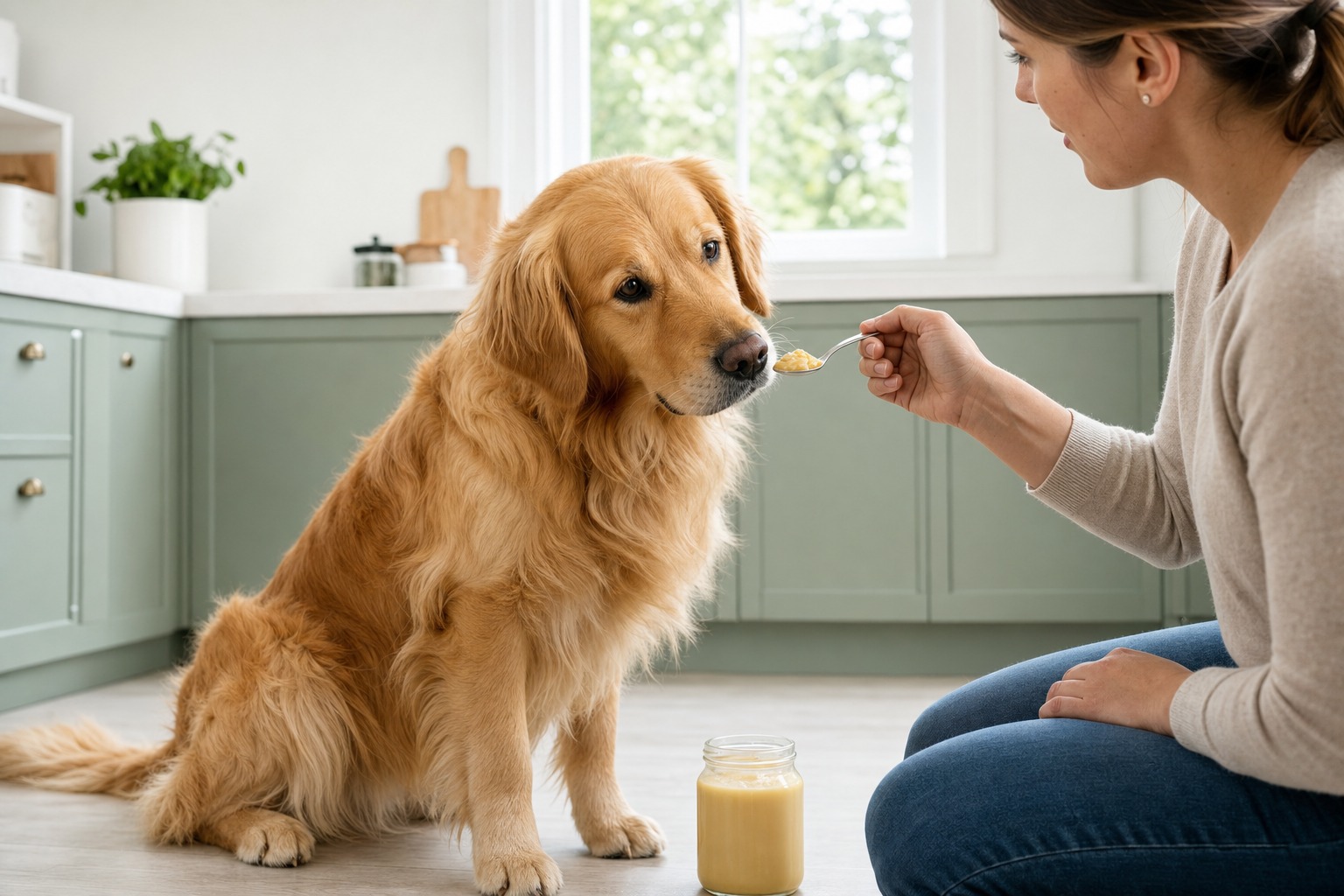
Let’s be honest: most of us have eyed a jar of baby food at some point and thought, that actually looks kind of good. It’s smooth, easy to eat, easy to digest, a complete little package. And if the thought has crossed your mind, it’s definitely crossed your dog’s, who is almost certainly lobbying for a taste.
Good news: most baby food is safe for dogs. But the more useful framing is that baby food isn’t really a treat at all. Its genuine value is medical: it’s an easy-to-digest food that can coax a sick or off-their-food dog into eating when nothing else works. Once you see it that way, two things follow. You stop thinking of it as an everyday snack, and you start reading the jar with the seriousness a sick dog deserves, because a few common ingredients are off-limits and one is an emergency.
Why “sick-day tool,” not “snack,” is the right frame
A healthy dog does not need baby food. It isn’t complete nutrition, so as a casual treat it’s unremarkable, roughly on par with any plain purée, and there are dog-specific options that do the same job. Where baby food actually earns its place is the narrow, genuinely useful situations below, where its smooth, highly digestible texture becomes a real advantage. Treat it as something you keep in the cupboard for a bad day, not something you spoon out for fun, and you’ll use it well.
Which kinds are safe (and which need a closer look)
Baby foods are sold in stages. Stage one is single-ingredient purées, blended smooth. Stage two introduces slightly chunkier blends of multiple ingredients.
For dogs, stage one is the safer pick precisely because you know exactly what’s in the jar. Lots of fruits and vegetables are dog-safe, and single-ingredient varieties dramatically reduce the chance of sneaking in something your dog shouldn’t have.
Stage two foods call for more caution. They tend to be the ones dogs find most exciting, since they can include meats and vegetables, but the added ingredients are where trouble can hide.
The ingredients to avoid
Here’s the thing: it’s usually not the headline ingredient that’s the problem, it’s the seasonings and additions.
- Onion and garlic. These show up for flavor, but both can harm dogs, potentially causing vomiting, diarrhea, and even damage to red blood cells.
- Xylitol. This is a hard no, and it’s why the “read the jar” habit is not optional. Xylitol is a sweetener added to plenty of “sugar-free” products, candy, peanut butter, toothpaste, and yes, sometimes baby food. In dogs it triggers a rapid, dangerous drop in blood sugar at doses as low as about 0.1 gram per kilogram of body weight, with liver injury a risk at higher doses. Watch for its alias too: xylitol increasingly appears on labels as “birch sugar” or “wood sugar,” especially in imported and sugar-free products. Same toxin, quieter name.
Baby food can genuinely help in the right moment, but I always tell owners to read the jar like a hawk. A plain, single-ingredient meat or vegetable purée is one thing. The second you see onion, garlic, or any sweetener, put it down. When in doubt, a single-ingredient stage-one jar is your safest bet.
When baby food actually earns its place
Your dog doesn’t need baby food, and it should never replace dog food long term, but it can be genuinely useful in a few specific situations:
- Coaxing a picky eater. Baby food has a texture and aroma similar to canned dog food, so it can tempt a reluctant dog to eat. (That said, canned dog food is often the smarter choice, since there’s less chance of a risky ingredient.)
- Supporting a dog with a digestive illness. Baby food is highly digestible, which is exactly why it works for babies. When a dog’s gut is struggling, an easy-to-break-down food can deliver nutrients while giving their system a much-needed rest.
- Getting pills down, or hiding a lick’s worth of medicine. A dab of plain meat purée on a spoon or smeared inside a stuffable toy is a low-stress way to deliver a pill or reward a nervous dog at the vet. The small pouches travel well for this. Dog-specific pastes do the same job, so you’re not limited to baby food.
How to introduce it the right way
As with any food change, don’t switch abruptly. Of course, when a dog has stopped eating or is unwell, a slow transition isn’t always realistic, you just want them to eat something. But whenever you can go gradual, do, because it gives your dog’s gut microbiome time to adjust.
Watch closely once you start. Vomiting, diarrhea, or signs of stomach pain mean it’s time to stop the baby food and try something else. And if your dog won’t eat baby food, or anything at all, for longer than 24 to 48 hours, call your vet.
Remember the boundary: baby food isn’t complete nutrition for a dog, so it shouldn’t make up a meaningful chunk of the diet for more than a few days. Use it to bridge a dog back to balanced food, or sprinkle it in occasionally as a treat alongside their regular meals.
Bottom line
- Baby food can be a great training treat or a stand-in meal for picky eaters and under-the-weather dogs.
- Not every ingredient is safe: onions, garlic, and xylitol are toxic, and baby food isn’t something to feed in large amounts over time.
- If you want to try it, check with your vet first to make sure it’s a good fit for your dog.
Why “highly digestible” is more than a marketing word
The instinct behind reaching for baby food when a dog’s stomach is off has real science under it. Research into the canine gut microbiome now maps in detail how a dog’s gut bacteria respond to dietary changes, which is part of why two old pieces of advice keep holding up: transition foods gradually when you can, and lean on gentle, easy-to-break-down options when a dog is unwell. A smooth, low-residue purée gives an irritated gut something it can absorb without much work, which is the same reason it suits human babies. That is the mechanism behind baby food’s usefulness, and it’s also why the tool belongs to sick days, not snack time.
FAQs
Is Gerber baby food safe for dogs?
Gerber is a long-established, rigorously tested baby food brand, so its products are generally trustworthy in terms of safety. But it’s still made for humans, not dogs, so you’ll need to check the label for ingredients that could be toxic to dogs and feed only in moderation.
Which baby food pouches are safe for dogs?
The brand matters less than the ingredients. Avoid anything with onion, garlic, or xylitol (including its alias, birch sugar), and choose products trusted by pediatricians and parents as a quality marker.
Can I give my sick dog baby food?
Baby food is one option for delivering highly digestible nutrition to a sick dog, but it isn’t the only one, and a dog-specific product may be a better choice. Talk to your vet about how to feed a sick dog safely so they get the nutrition they need.
References
- Hayes, Cristine, DVM. “Garlic and Onion (Allium spp) Toxicosis in Animals.” Merck Veterinary Manual. Sep. 2024. https://www.merckvetmanual.com/toxicology/food-hazards/garlic-and-onion-allium-spp-toxicosis-in-animals
- Suchodolski, Jan S. “Analysis of the gut microbiome in dogs and cats.” Veterinary Clinical Pathology. 12 Sep. 2021. https://pmc.ncbi.nlm.nih.gov/articles/PMC9292158/
- “Paws Off Xylitol; It’s Dangerous for Dogs.” U.S. Food and Drug Administration. https://www.fda.gov/consumers/consumer-updates/paws-xylitol-its-dangerous-dogs
Not a substitute for your vet. Our guidance is educational. For urgent symptoms, contact a vet or emergency clinic right away. Editorial standards
Dr. Chen is a small-animal veterinarian who leads health and safety coverage at The Pet Times. She writes and reviews the bulk of our illness, condition, and safety content, translating clinical guidance into clear, practical advice owners can act on at home.
Meet our experts ↗Keep reading
 Food9 Human Superfoods Worth Adding to Your New Dog's BowlLeila Torres · 6 min
 Food7 Foods the Internet Swears Are Bad for Dogs. They Aren't.Dr. Amara Solis · 6 min
 Food"Lactose Intolerant" Is the Wrong Question About Your Dog and DairyDr. Ravi Mehta · 7 min
 FoodProduce Is a Treat, Not a Topping: 11 Fruits and Veggies, Served RightDr. Mara Chen · 9 min
 FoodPork and Dogs: The Meat Is Fine, the Way We Cook It Isn'tDr. Mara Chen · 5 min
 FoodPeas Are a Fine Snack for Dogs. As a Diet Staple, It's Complicated.Dr. Ravi Mehta · 7 min