


Produce Is a Treat, Not a Topping: 11 Fruits and Veggies, Served Right
Fruits and veggies are great for dogs, but only if you respect the 10 percent rule and prep them right. Here are 11 safe picks and the prep that keeps the nutrients in.

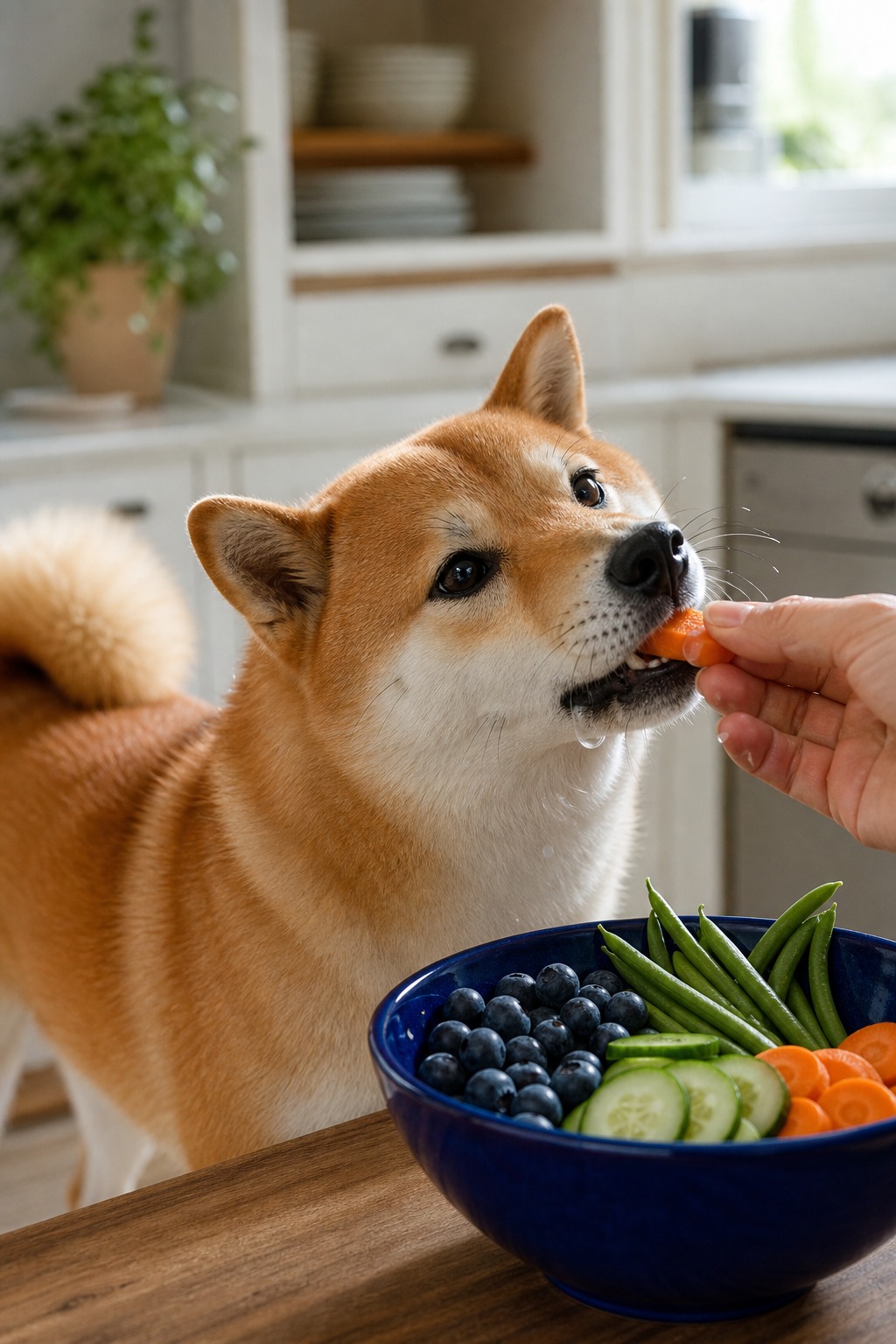
Sharing food with your dog feels modern, but it is how dogs have eaten alongside us for thousands of years. The bond itself grew partly from the fact that we could share a meal. What most guides skip, though, is the rule that makes produce actually good for your dog instead of just extra calories: the 10 percent rule. Treats and extras, fruits and vegetables included, should make up no more than a tenth of your dog’s daily calories. The other 90 percent has to come from a complete and balanced food, because no carrot, berry, or green is a meal on its own. Get the portion right and the prep right, and the eleven picks below earn their place in the bowl.
The two rules that matter more than the list
Before any specific food, two principles do the heavy lifting.
First, the 10 percent rule. A 30-pound dog needs roughly 700 calories a day, which leaves about 70 for extras, less than you would think. That is a few baby carrots and a small handful of blueberries, not a bowl of vegetables on top of dinner. Overdo it and you crowd out balanced nutrition and pack on weight.
Second, prep decides whether the nutrients survive the trip. Boiling greens until they are gray dumps the vitamins into the water. Feeding hard raw vegetables whole wastes most of what is inside, because dogs cannot break down cellulose well. The right method changes by food, so we have flagged it for each one below. Always introduce a new food in a small portion first to check that your dog likes it and tolerates it on the, ahem, digestive side.
1. Banana
Bananas deliver potassium for muscle and blood-vessel function, vitamin B6 to help metabolize protein, and a dose of vitamin C. They are also higher in sugar than most veggies, so they are a small-portion treat, not a daily staple. Serve it: mash a thin slice into food. Heads up, the same aroma compounds we love put some dogs off entirely.
2. Carrots
Crunchy, sweet, and a near-universal hit, carrots bring beta-carotene, fiber, vitamin K, and potassium. A raw carrot also scrapes lightly at the teeth as your dog chews. Serve it: for nutrient absorption, steam and chop, since dogs barely digest raw cellulose. For dental benefit and a long-lasting chew, give a whole raw carrot sized to your dog, and supervise to avoid choking. Soaking lightly steamed carrots in a little low-sodium broth wins over picky dogs.
3. Sweet potato
A favorite for good reason: sweet potatoes are loaded with beta-carotene, vitamin C, potassium, fiber, and manganese, and they sit easy on sensitive stomachs. Serve it: bake or boil until soft and serve plain, with no butter, salt, or marshmallows. Skip raw, which is hard to digest. Homemade dehydrated sweet potato chews are a great single-ingredient treat.
4. Green beans
Low in calories and high in fiber, green beans are the vet-favorite weight-management snack, with vitamins A, C, and K plus iron and calcium. Serve it: raw, steamed, or blanched. If you buy canned, choose no-salt-added and rinse them. A green-bean swap for half your dog’s usual treats is a painless way to trim a few calories.
5. Cucumber
A warm-weather hydrator, cucumber is mostly water with a satisfying crunch, making it an ideal hot-day, low-calorie treat for a dog watching their weight. Serve it: sliced or cubed to size, plain. Never offer pickles, which add salt, garlic, and spices your dog does not need.
6. Pumpkin
The digestive multitool. Pumpkin’s soluble fiber can firm up loose stool and ease mild constipation alike, and it brings carotenoids, potassium, and vitamin C. Serve it: plain canned (read the label for 100 percent pumpkin, not pie filling) or fresh, steamed and mashed. A spoonful on a lick mat, then frozen, doubles as a slow treat.
7. Blueberries
Tiny antioxidant powerhouses, blueberries supply anthocyanidins, vitamins C and E, manganese, and fiber, and they make a perfect bite-sized training reward. Serve it: rinse and offer fresh or frozen. Introduce slowly, because a dog who gorges gets the same stomachache a person would.
8. Papaya
This tropical fruit carries papain, a protein-digesting enzyme, along with carotenoids, vitamin C, B vitamins, potassium, and fiber. Serve it: scoop the ripe flesh and remove the seeds, which are technically edible but peppery enough to turn most dogs off. As a sweeter fruit, keep the portion small.
9. Turnip greens
An overlooked nutrient bomb, turnip greens pack vitamins K and C, carotenoids, fiber, and manganese, plus calcium and potassium. One real caveat: they are bitter and contain oxalates, which bind minerals, and goitrogens, which can interfere with thyroid function in susceptible dogs. Serve it: sauté or blanch lightly, and check with your vet first if your dog has thyroid or kidney concerns.
10. Swiss chard
A striking cousin of beets and spinach, chard supports bone, eye, and immune health. Like turnip greens, it carries oxalates that blanching helps release. Serve it: blanch the leaves and stalks briefly, never boil to mush, then chop and add a touch of olive oil. Skip it for dogs prone to calcium-oxalate bladder stones.
11. Watermelon
The summer treat that is almost pure hydration, watermelon brings vitamins A, B6, and C with a high water content perfect for hot days. Serve it: cube the seedless flesh and remove any rind. Seeds and rind are both choking and obstruction risks, especially for small dogs, so prep matters here more than with softer fruits.
A prep cheat sheet
The method is half the value. Roughly:
- Steam, then chop: carrots and other dense root vegetables, so dogs can absorb what is inside.
- Blanch lightly: leafy greens like chard and turnip greens, to keep vitamins in and release some oxalates.
- Bake or boil soft: sweet potato and pumpkin, served plain.
- Rinse and serve raw: blueberries, cucumber, watermelon flesh, green beans.
- Always remove: pits and stems (cherries, apricots), apple seeds and cores, melon seeds and rind, and any added salt, sugar, oil, onion, or garlic.
The hard “no” list
Some produce is never safe. Grapes and raisins can cause kidney failure even in small amounts. Onions and garlic, including powders, damage red blood cells. Anything containing xylitol is acutely toxic. Cherry, apricot, peach, and plum pits contain cyanide and pose an obstruction risk, and apple seeds carry trace cyanide too. When in doubt, leave it out and ask your vet, and if your dog eats something on this list, call your vet or the ASPCA Animal Poison Control Center right away.
References
- American Kennel Club. “Fruits and Vegetables Dogs Can and Can’t Eat.” akc.org.
- U.S. Food and Drug Administration. “FDA Investigation into Potential Link Between Certain Diets and Canine Dilated Cardiomyopathy.” fda.gov.
- ASPCA. “People Foods to Avoid Feeding Your Pets.” aspca.org.
- VCA Animal Hospitals. “Body Condition Scores and Treat Guidelines for Dogs.” vcahospitals.com.
Common questions
Are raw or cooked vegetables better for dogs?
It depends on the vegetable. Dogs cannot digest the cellulose in raw carrots well, so steaming helps. But boiling leafy greens into mush leaches out the nutrients; blanching or light sautéing preserves them.
Which common produce is dangerous for dogs?
Grapes and raisins, onions, garlic, and anything with xylitol are toxic. Cherry and apricot pits, apple seeds, and corn cobs are choking or cyanide and obstruction risks. Always remove pits, seeds, and rinds.
Not a substitute for your vet. Our guidance is educational. For urgent symptoms, contact a vet or emergency clinic right away. Editorial standards
Dr. Chen is a small-animal veterinarian who leads health and safety coverage at The Pet Times. She writes and reviews the bulk of our illness, condition, and safety content, translating clinical guidance into clear, practical advice owners can act on at home.
Meet our experts ↗Keep reading
 FoodPeas Are a Fine Snack for Dogs. As a Diet Staple, It's Complicated.Dr. Ravi Mehta · 7 min
 Food"Lactose Intolerant" Is the Wrong Question About Your Dog and DairyDr. Ravi Mehta · 7 min
 FoodPork and Dogs: The Meat Is Fine, the Way We Cook It Isn'tDr. Mara Chen · 5 min
 FoodBroccoli for Dogs: Great Snack, Until You Hit the 10% LineDr. Lena Park · 5 min
 FoodThe People Foods That Actually Do Something for Your DogDr. Amara Solis · 7 min
 Food9 Human Superfoods Worth Adding to Your New Dog's BowlLeila Torres · 6 min