


The Play Bow Is the Clearest Word Your Dog Knows. Learn to Say It Back
Elbows down, rear in the air: the play bow is the least ambiguous signal in a dog's vocabulary. Here's what it really means, what new research says it's for, and how to use it to build a better bond.

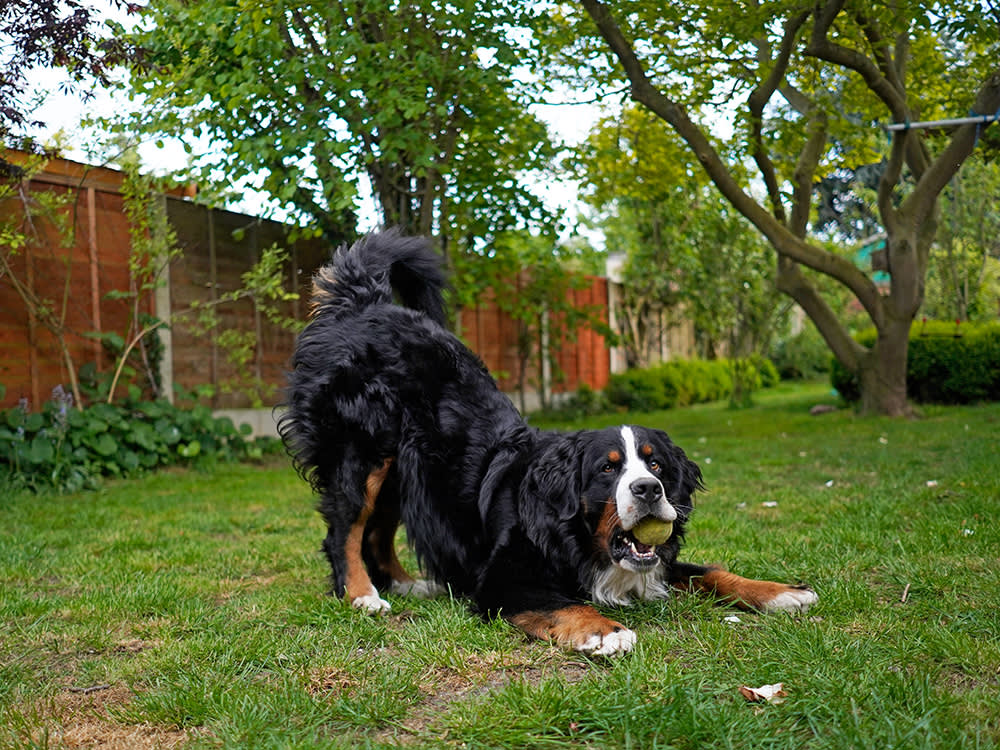
Most of what dogs tell us gets lost in translation. Tail wags are misread, growls are misunderstood, and half our guesses about what a dog “means” are projection. But there is one signal that almost never gets garbled, one word every dog and most humans can read on sight: the play bow. Front legs folded to the ground, chest low, rear end hoisted high, tail going. It means one thing, and it means it clearly. Let’s play.
That clarity is exactly why it is worth learning to speak back.
What the bow actually communicates
A play bow is a promise. It tells the dog on the receiving end that whatever comes next, the chasing, the mouthing, the body-slamming, the wrestling that can look alarmingly like a fight, is all in fun. There is no intent to do harm. By flashing that promise first, a dog dramatically lowers the odds that rough play gets misread as an attack and tips over into a real scrap. It is a tiny piece of grammar that keeps play safe.
Because the meaning is so stable, the bow doubles as a bridge between species. A dog does not need to be taught what it means when a human does one, which makes it one of the few genuine two-way words we share.
What newer research adds
For years the standard explanation, going back to biologist Marc Bekoff’s foundational work, was that dogs bow to clarify intent right before or after something easy to misread, like a hard bite-shake. More recent observation has refined the picture. A 2016 study of adult pet dogs found that during play between two dogs, bows most often function to restart the action after a pause, a “let’s go again” more than a “don’t worry about that last move.”
That fits a bigger body of research on why dog play stays civil at all. Play is governed by fairness: self-restraint, honest signaling, self-handicapping (the stronger dog throttling back), and role reversal, where the bigger or bolder dog deliberately takes the weaker role to keep a game going. Bekoff’s long study of wild canids found there are real stakes to breaking those rules. Young coyotes who played dishonestly or unfairly tended to get frozen out of the group, and the outcasts were far more likely to die young. Fair play, it turns out, is survival behavior, and the bow is one of its punctuation marks.
Why bothering to play back matters
We tend to treat play as the fun part that happens after the “real” relationship is built. Researchers increasingly think it is the other way around. As behaviorist Patricia McConnell has put it, play does not just improve the bond between a dog and a person, it is what creates that bond in the first place.
The trouble is that a lot of us do not do enough of it. A 2020 University of Bristol survey of some 4,000 dog owners found that many simply were not playing with their dogs much, and the study tied skimpy playtime to more behavior trouble, including dogs who grew anxious in solitude, ignored commands, and lashed out at other animals. Play is not filler. It is maintenance.
People come to me for obedience and I keep steering them back toward play, because play is where the real learning happens. A dog who plays with their person is a dog who trusts them, watches them more closely, and takes cues better afterward. If you want a dog who listens, get on the floor and make them laugh first.
How to throw a play bow yourself
You can absolutely do the full version. Get down on all fours, drop both elbows toward the ground, and leave your rear in the air. The detail that sells it is the energy: dogs bow with a bouncy, springy quickness, so match that. Snap into the pose rather than easing into it like a slow yoga stretch, and your dog is far more likely to buy it.
If the floor is not an option, there is a standing shorthand. Lean forward from your hips, bend both knees, and fling your arms out to the sides at roughly a 45-degree angle. To read as playful, go in fast, maybe with a little hop, and then immediately do something fun, bolt a few steps to kick off a chase, for instance. The movement is the message.
Turning play into a stronger bond
Once you are speaking the language, a few habits compound the payoff.
Let them win sometimes. During tug or chase, handing your dog the occasional victory builds trust and buys you more of their attention. It is called play for a reason. The second you start keeping score, the good stuff evaporates.
Play to their side of the relationship. Dogs will often play longer and more cooperatively with humans than with other dogs, presenting and surrendering toys to us more readily. Even dogs in multi-dog homes frequently prefer a human play partner. Lean into that; you are the favorite.
Stack your cues. To pull a dog into a game, hold a toy out front, slap both hands on the ground, throw a bow, or make a quick darting move. Adding a playful voice to the gesture makes a dog more likely to respond.
Use it before training. Dogs who regularly roughhouse with their people tend to be more confident and score higher on measures of attentive obedience right after a play session than before it, which is a strong argument for a few minutes of play as a warm-up to any training.
So the next time your dog drops into a bow at your feet, do not just smile at it. Bow back. You are answering in the one language you both speak fluently.
References
- Byosiere, S.-E., Espinosa, J., & Smuts, B. Investigating the function of play bows in adult pet dogs (Canis lupus familiaris). Behavioural Processes (2016). https://www.sciencedirect.com/science/article/abs/pii/S0376635716300286
- Bekoff, M. Dogs at Play: How and Why Bowing Came to Mean “Let’s Play.” Psychology Today (2025). https://www.psychologytoday.com/us/blog/animal-emotions/202503/dogs-at-play-how-and-why-bowing-came-to-mean-lets-play
- University of Bristol. Survey on dog play and behavior problems (2020). https://www.bristol.ac.uk/
Dr. Park is a board-certified emergency and critical care specialist. She reviews our health and safety content for clinical accuracy and contributes guides on recognising urgent conditions. Her focus is helping owners act quickly and correctly when it matters most.
Meet our experts ↗Keep reading
 TrainingYour Dog Doesn't Know It's 5 O'Clock. It Knows You.Dr. Mara Chen · 6 min
 TrainingMore Dogs Isn't More Chaos, If You Know What Actually Starts the FightsDr. Mara Chen · 7 min
 LivingMost Dog Fights Happen at Home. Pick the Second Dog Accordingly.Dr. Mara Chen · 7 min
 LivingA Wolfdog Is Not a Fluffier Husky. Nobody Can Tell You What You Actually Own.Dr. Ravi Mehta · 8 min
 TrainingYour Dog Isn't Stalling Before They Poop. They May Be Checking a Compass.Sasha Ford · 8 min
 LivingThe Bark Translator Isn't Sci-Fi Anymore. It Started With Human SpeechTom Hadley · 4 min