


The Real Pig Ear Risk Isn't Your Dog's Stomach. It's Your Kitchen Counter
Pig ears are a perfectly decent chew. The danger most owners overlook isn't fat or calories. It's salmonella, which in 2019 sickened 154 people through their dogs' treats. Here's how to buy and handle them safely.

Affiliate disclosure. This article contains affiliate links. We may earn a small commission if you buy through a link, at no extra cost to you. How we handle recommendations.
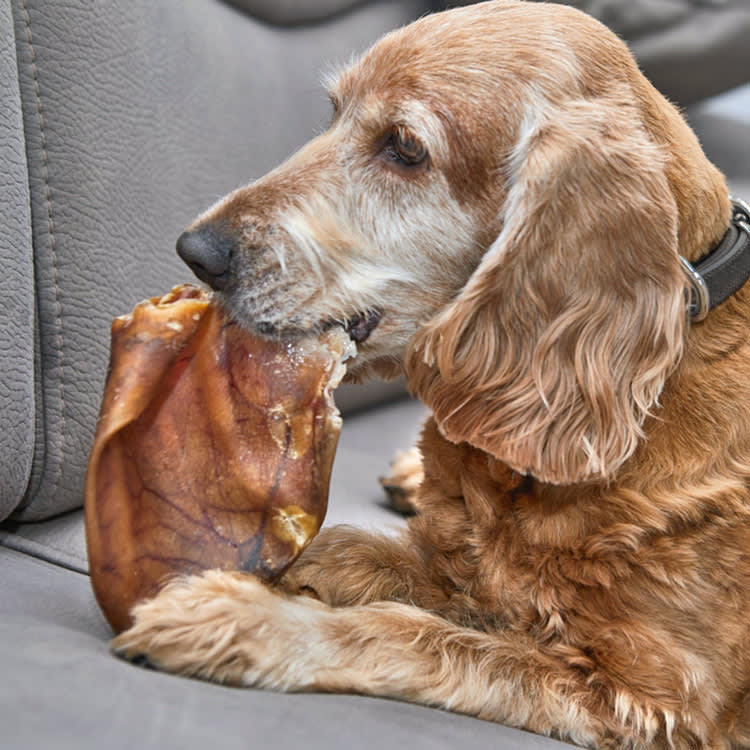
Ask the internet whether pig ears are “good for dogs” and you will get a tidy debate about protein, fat, and joint nutrients. That debate is real, but it is also a distraction. The single most consequential fact about pig ears has nothing to do with your dog’s waistline. It is that pig ears have a documented history of contaminating the people who handle them. In 2019, a salmonella outbreak traced to these treats did not just make dogs sick; it sent dozens of people to the hospital. So before we get to whether a pig ear is a healthy chew, let’s reframe the actual risk: a pig ear is a raw-animal product that lives in your kitchen, and that is where it deserves your attention.
What a pig ear actually is
Pig ears are exactly what they sound like, the cartilaginous ear flap (the pinna) of a butchered pig, cleaned and dried into a chew most dogs find irresistible. How they are processed makes all the difference. The best are slowly baked or dried, which keeps them flexible and shelf-stable. The worst are heavily smoked or flash-dried until brittle, which is where the physical hazards begin.
Nutritionally, they are unremarkable but not empty: mostly skin and cartilage, typically 60 to 75 percent protein and around 20 percent fat, with some naturally occurring glucosamine and chondroitin from the cartilage, plus a little B vitamins, zinc, and iron. If your dog already eats good food, a pig ear is not filling a nutritional gap. It is a treat that happens to carry a few useful extras.
The genuine benefit isn’t nutrition. It’s the chewing itself
The strongest case for a pig ear is behavioral. Chewing is genuinely good for dogs. It releases feel-good endorphins, burns nervous energy on days you cannot get out for a real walk, and occupies a dog who would otherwise find their own entertainment. There is even research suggesting that long-lasting chews put dogs into a more positive emotional state during short stretches alone.
The mechanical scraping of a chew also helps lift plaque and tartar, and the gum massage promotes blood flow, both of which modestly support dental health. None of this replaces toothbrushing or a vet’s dental care, but as a small assist with a big enrichment payoff, a good pig ear earns its place.
The risk owners actually underestimate: contamination
Here is the part the “is it healthy?” framing buries. Because pig ears are a dried animal product, they can harbor bacteria, and salmonella is the headline threat. This is not a hypothetical.
In the summer of 2019, the FDA and CDC investigated an outbreak of human salmonella infections tied directly to pig ear pet treats. The final numbers are sobering: 154 people infected across 34 states, with 35 hospitalized. Twenty-seven of the illnesses were in children younger than five. Many of the strains involved were multidrug-resistant, and traceback pointed to pig ears imported from Argentina, Brazil, and Colombia. The contamination was serious enough that the FDA issued a blanket advisory urging people not to buy or feed any pig ear treats while the investigation was open, and multiple brands issued recalls.
The crucial lesson is how people got sick. You do not need your dog to fall ill for your household to be exposed. Salmonella spreads through ordinary handling: touching the treat, then your face or food; a child handling a chew; the dog licking a family member after gnawing. That is why the right mental model is “raw chicken,” not “dog snack.”
So the practical safety habits are kitchen habits. Wash your hands after touching a pig ear. Keep them away from young kids’ reach. Store them sealed and away from human food prep. And buy only from brands with a clean recall history.
The secondary risks, briefly
Contamination is the big one, but two others are worth a sentence each. Fat: at roughly 20 percent, pig ears are rich enough that frequent feeding can drive weight gain and, in susceptible dogs, contribute to pancreatitis, so keep them occasional. Texture: an over-smoked or flash-dried ear can turn brittle and splinter, risking mouth injuries or, rarely, a digestive perforation or obstruction. A safe pig ear flexes; it does not snap.
How to buy one that is actually safe
Put it all together and the shopping checklist is short:
- Slowly baked or heat-dried, never heavily smoked. Low-and-slow drying kills bacteria while keeping the ear flexible. Smoked options skew brittle and may carry additives.
- Single ingredient. The label should say “pig ear” and little else. A string of unpronounceable additives is a reason to put it back.
- A reputable brand with no bacterial recalls. This is your best defense against contamination. If you are unsure, your vet can point you to trustworthy options.
A solid example that fits all three is Best Bully Sticks USA-Baked Pig Ears, a single-ingredient, slowly baked, USA-sourced and packed chew, the kind of profile you want over a mystery-origin bulk-bin ear. Whatever you choose, the same handling rules apply once it is in your home.
If pig ears aren’t your thing
They are far from the only good chew. Flexible, single-ingredient alternatives include cow or buffalo ears, collagen chews, tendon chews, and sweet potato chews, and the texture rule still holds: flexible, not brittle, additive-free. Plenty of dogs also love crunchy fresh foods like carrots, cucumber, apple slices, and green beans. For puppies, check with your vet about when and whether any harder chew is appropriate.
The bottom line
Pig ears are a reasonable occasional chew with real enrichment value and a few minor nutritional perks. But the question that actually keeps your household safe is not “are they healthy?”, it is “did I buy and handle this like the raw-animal product it is?” The 2019 outbreak that sickened 154 people, many of them kids, is the reason this matters more than fat or calories. Choose a slowly baked, single-ingredient ear from a reputable brand, wash your hands every time, keep them occasional, and a pig ear stays a treat instead of a problem.
References
- U.S. Food and Drug Administration. “FDA Investigates Contaminated Pig Ear Pet Treats Connected to Human Salmonella Infections.” https://www.fda.gov/animal-veterinary/outbreaks-and-advisories/fda-investigates-contaminated-pig-ear-pet-treats-connected-human-salmonella-infections
- Centers for Disease Control and Prevention. “Outbreak of Multidrug-Resistant Salmonella Infections Linked to Pig Ear Dog Treats.” https://www.cdc.gov/salmonella/pig-ears-07-19/index.html
- Flint, H. E., et al. “Long-Lasting Chews Elicit Positive Emotional States in Dogs during Short Periods of Social Isolation.” Animals, 2023. https://pmc.ncbi.nlm.nih.gov/articles/PMC9951671
- U.S. Food and Drug Administration. “Pig Ear Pet Treats: Q&As.” https://www.fda.gov/animal-veterinary/resources-you/pig-ear-pet-treats-qas-retailers-distributors-importers-suppliers-manufacturers
Common questions
Can pig ears make people sick, not just dogs?
Yes, and this is the underrated danger. In a 2019 outbreak, contaminated pig ear treats infected 154 people across 34 states with salmonella, hospitalizing 35, including many young children, often through ordinary handling rather than the dog getting sick at all. Treat pig ears like raw meat in your kitchen.
How often can my dog have a pig ear?
Keep them occasional rather than daily, mainly because of the fat content, which can contribute to weight gain and, in sensitive dogs, pancreatitis. Ask your vet about the right frequency for your individual dog.
What's a safer alternative to a pig ear?
Flexible, single-ingredient chews like cow or buffalo ears, collagen chews, tendon chews, or sweet potato chews, plus crunchy fresh foods like carrots, cucumber, apple, or green beans. The rule for any of them: flexible, not brittle, and free of additives.
Not a substitute for your vet. Our guidance is educational. For urgent symptoms, contact a vet or emergency clinic right away. Editorial standards
Dr. Park is a board-certified emergency and critical care specialist. She reviews our health and safety content for clinical accuracy and contributes guides on recognising urgent conditions. Her focus is helping owners act quickly and correctly when it matters most.
Meet our experts ↗Keep reading
 FoodYogurt Isn't a Health Food for Your Dog. It's a Brilliant Delivery DeviceDr. Priya Nair · 6 min
 Food10 Human Superfoods for Dogs: The Prep Matters More Than the ProduceDr. Ravi Mehta · 8 min
 FoodA Cashew Won't Poison Your Dog. That's Not the Same as 'Go Ahead'Dr. Ravi Mehta · 7 min
 FoodTurmeric Barely Absorbs in Dogs. This Treat Recipe Fixes the Flaw.Dr. Nina Kohl · 5 min
 FoodYour Meatloaf Could Hospitalize Your Dog. This One Won't.Dr. Lena Park · 7 min
 LivingHow to Run an Easter Egg Hunt Your Dog Won't End Up at the Vet ForDr. Amara Solis · 5 min