


The Persimmon Rule for Dogs: Flesh Yes, Everything Else No
A persimmon is one of the few dog treats where the danger isn't the fruit but a chemical reaction its skin and seeds set off in the stomach. Here's the one rule that makes them safe.

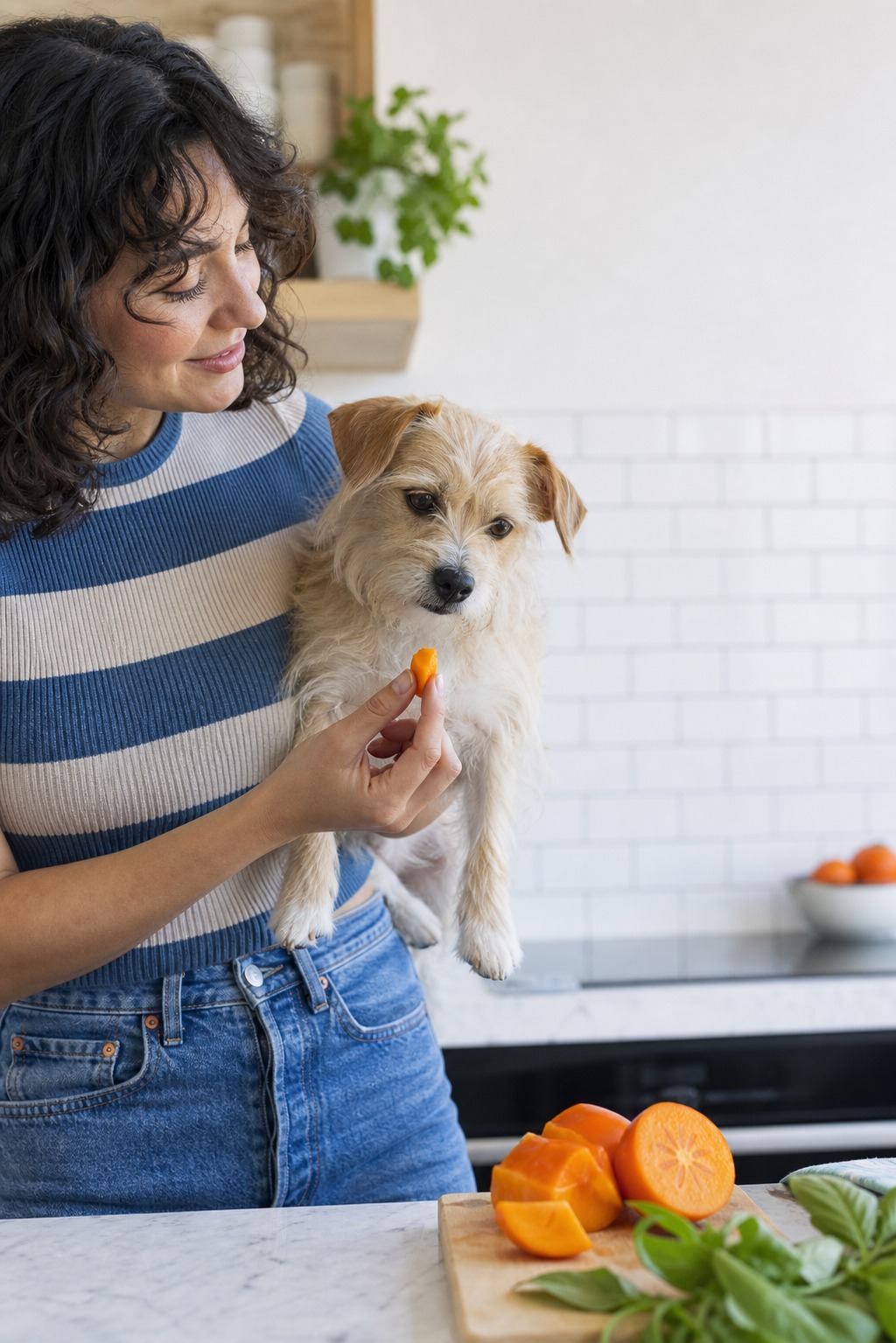
Most “can my dog eat this fruit” questions come down to sugar and portion size. Persimmons are the rare exception. Here, the fruit itself is a perfectly good snack, and the real hazard is a chemical reaction that the skin and seeds trigger once they hit your dog’s stomach. Understand that one reaction and the whole persimmon question becomes simple: share the flesh, discard the rest, and pay attention to ripeness.
The one reaction that makes persimmons different
Persimmon skin and seeds are rich in a soluble tannin called shibuol. When shibuol meets the hydrochloric acid in the stomach, it polymerizes, coagulating into a sticky matrix that traps fiber, cellulose, and food debris. That growing lump is a phytobezoar, and the persimmon-specific version even has its own name in the medical literature: a diospyrobezoar, after Diospyros, the persimmon genus.
This is not a vague “indigestible material” warning. It is a specific, documented mechanism, and it is why doctors warn people against eating whole unripe persimmons too. Human case reports describe diospyrobezoars large enough to block the stomach outlet or lodge in the small intestine, sometimes requiring endoscopy or surgery to remove. In a dog, the same mass can cause a life-threatening obstruction.
A persimmon is one of the only fruits where I care more about the peel and seeds than the flesh. The flesh is a lovely, harmless treat in small amounts. The skin and seeds do something almost no other fruit does, forming a hard blob in the gut. Peel it, seed it, keep it ripe, and the danger essentially disappears.
Ripeness is the hidden variable
Here is the part most persimmon articles skip: the phytobezoar risk is not constant. It rises sharply with unripe, astringent fruit, because that is when soluble tannin is highest. As a persimmon ripens, much of that tannin becomes insoluble and the mouth-puckering astringency fades. A rock-hard, bitter persimmon is the worst-case input for the stomach reaction; a fully soft, jelly-ripe one is far less reactive.
That matters because the two persimmons you are most likely to find behave very differently:
- Fuyu are the squat, tomato-shaped ones. They are non-astringent, meaning they are sweet and crunchy even when firm, and they carry less soluble tannin at any stage.
- Hachiya are the longer, acorn-shaped ones. They are astringent and genuinely unpleasant, for you and your dog, until they are so soft they look overripe, nearly translucent. An underripe hachiya is both the bitterest and the most bezoar-prone version of the fruit.
If you only remember one thing about type, remember this: a hachiya is not ready until it feels almost like a water balloon.
The peel-and-seed protocol
Sharing persimmon safely takes about thirty seconds of prep. The flesh is the only part that goes to your dog, and everything else goes in the trash where a counter-surfer cannot reach it.
- Choose ripe. Firm-ripe fuyu or fully soft hachiya only. Skip anything hard and astringent.
- Peel completely. No skin, since the skin is a primary shibuol source.
- Remove every seed. Persimmon seeds are large and the other half of the phytobezoar equation.
- Cut to size. Bite-sized pieces sized to your dog, to sidestep any choking risk.
- Start with one piece. Confirm your dog tolerates it before offering more, the same as any new food.
What the flesh actually gives your dog
Prepared this way, persimmon flesh is a genuinely decent occasional snack:
- Fiber, and a lot of it. Persimmons are notably high in fiber, which adds stool bulk, supports regularity, and feeds beneficial gut bacteria. The flip side is that too much, too fast can cause gas, bloating, or diarrhea, which is the main reason to keep portions small.
- Vitamin A. A fat-soluble vitamin dogs use for growth, healthy skin, and vision. A complete diet already supplies it, so from a snack it is a bonus, not a requirement.
- Antioxidants. Persimmons are rich in flavonoids and phenolic compounds that neutralize free radicals. Comparative studies have measured persimmon’s antioxidant activity favorably, and it is part of why persimmons have a health-food reputation in people. For a dog, that value is a nice extra rather than a reason to feed them regularly.
When to call the vet
If your dog swallows a whole persimmon, eats the skin and seeds, or gets into unripe fruit, do not wait for symptoms to escalate. Call your vet or a pet poison hotline right away, and watch closely for the signs of an obstruction:
- Repeated vomiting or retching
- Refusing food
- Lethargy or hiding
- A tense, painful, or bloated belly
- Straining without producing stool
A phytobezoar can take time to grow and lodge, so a dog that seems fine in the first hour is not in the clear. Early veterinary contact is what keeps a manageable problem from becoming an emergency surgery.
The bigger picture on human food
Persimmon is a useful reminder that “safe for dogs” and “safe as served” are not the same thing. Plenty of human foods are fine in one form and dangerous in another. When you are unsure, verify before you share, and lean on your vet or a poison hotline rather than guessing. Even the safe foods should stay small extras: aim for roughly 90 percent of your dog’s calories from a complete, balanced diet, with treats filling the rest. Fill a dog up on snacks and scraps and you risk crowding out the nutrition they actually need.
References
- Frontiers in Medicine (2026): Case Report: Successful Endoscopic Treatment of Gastric Outlet Obstruction Due to a Duodenal Persimmon Phytobezoar.
- Gastroenterology Report: An Unusual Case of Gastric Outlet Obstruction Caused by Multiple Giant Persimmon Phytobezoars.
- Preventive Nutrition and Food Science: Comparative Studies of Antioxidant Activities and Nutritional Constituents of Persimmon Juice.
- Merck Manual (Professional Edition): Bezoars and Foreign Bodies.
- Tufts Veterinary School Clinical Nutrition Service: Nutrients Essential for Dogs.
Common questions
What happens if my dog eats a whole persimmon with the skin and seeds?
Call your vet. The skin and seeds can react with stomach acid to form a hard mass called a phytobezoar that can block the digestive tract. Watch for vomiting, refusal to eat, lethargy, and belly pain, and treat those signs as urgent.
Is unripe persimmon worse for dogs than ripe?
Yes. Unripe, astringent persimmons carry far more soluble tannin, which is exactly what drives the phytobezoar reaction. If you share persimmon at all, it should be fully ripe and soft.
Are persimmons actually good for dogs?
The flesh offers fiber, vitamin A, and antioxidants, but a complete dog food already covers those needs. Treat persimmon as an occasional snack, not a supplement.
Not a substitute for your vet. Our guidance is educational. For urgent symptoms, contact a vet or emergency clinic right away. Editorial standards
Dr. Nair is a veterinarian focused on diet and feeding. She covers everyday nutrition, treats, and the many "can they eat this?" questions owners ask, grounding each answer in what is actually safe and sensible for dogs and cats.
Meet our experts ↗Keep reading
 FoodYour Meatloaf Could Hospitalize Your Dog. This One Won't.Dr. Lena Park · 7 min
 Food"Dogs Are Basically Wolves" Is How Raw Chicken Gets Fed. Here's the Catch.Dr. Lena Park · 7 min
 FoodSalmon Is Great for Your Dog. Raw Salmon Can Kill Them.Dr. Ravi Mehta · 7 min
 FoodOne Slim Jim Has as Much Saturated Fat as a Whole Serving of FriesDr. Priya Nair · 6 min
 FoodSteal the Popsicle's Best Idea for Your Dog, Skip Everything Else In ItDr. Lena Park · 7 min
 FoodYour Dog Doesn't Need an Orange's Vitamin C. That Changes EverythingDr. Priya Nair · 5 min