


Your Dog Doesn't Need an Orange's Vitamin C. That Changes Everything
Oranges get sold to dog owners as a vitamin-C boost. But dogs make their own vitamin C, which reframes oranges as a sugary novelty, not a health food, with one part that is genuinely off limits.

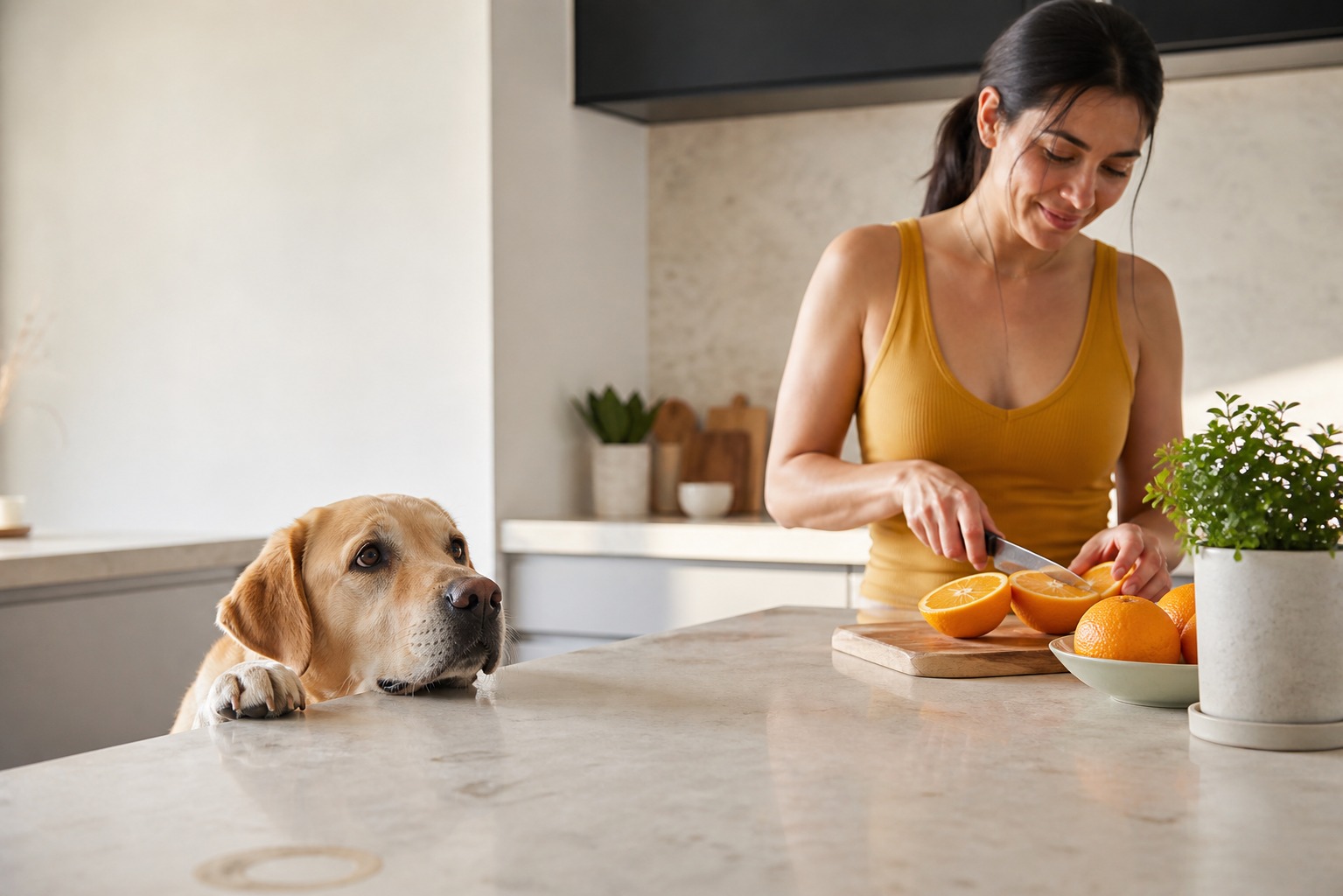
Search “oranges for dogs” and you will drown in the phrase “great source of vitamin C.” It sounds like a reason to feed your dog oranges. It is not, because of one fact almost nobody mentions: dogs make their own vitamin C.
That single detail flips the whole premise. For a person, an orange is a legitimate vitamin-C delivery system, we cannot synthesize the vitamin and have to eat it. A dog’s liver produces vitamin C on its own, using an enzyme called GULO that humans lost somewhere in our evolutionary past. A healthy dog eating a complete, balanced diet is not vitamin-C deficient and cannot be “topped up” in any meaningful way by a slice of orange. So the marketing hook, the thing that makes oranges sound healthy, is doing nothing for your dog. Once you know that, oranges settle into their real category: a sugary novelty some dogs enjoy, fine in tiny amounts, with exactly one part worth policing.
The vitamin-C myth, spelled out
The claim you keep seeing runs like this: oranges are packed with vitamin C, vitamin C is good, therefore oranges are good for dogs. The chain breaks at the second link.
A single orange gives a person about 75 percent of their daily vitamin C. Impressive, for a species that needs the dietary source. Your dog is not that species. Because dogs synthesize ascorbic acid internally, the AAFCO nutrient profiles that define a complete dog food do not even list vitamin C as a required nutrient, there is no need to add it. Supplemental vitamin C has a few niche uses that a vet might raise in cases of stress, illness, or aging, but “a segment of orange at snack time” is not one of them.
So the honest read is that oranges are not harmful in a small amount, but they are also not a health food for dogs. They are a sweet treat, and should be treated like one.
When someone tells me they are feeding oranges for the vitamin C, I gently correct the premise. Your dog is a little vitamin-C factory already. If your dog likes a bite of orange, the value is the shared moment, not the nutrition. Enjoy it as a treat and don’t kid yourself that it’s medicine.
The one hard rule: skip the peel
If oranges have a real danger, it is not the flesh, it is everything around it. Orange peels, along with the tree’s leaves and stems, contain essential oils that irritate a dog’s gut and can cause vomiting and diarrhea. The peel is also dense and fibrous, which makes it a choking and intestinal-blockage risk on top of the oil problem.
The rule is simple: flesh in, peel out. Peel the orange completely, hand over a small piece or two of the segment, and put the peel somewhere a curious nose cannot reach it, a secured trash can, not the counter or an open bin.
The sugar problem, which is the real reason to go easy
Set aside the vitamin-C myth and the peel, and you are left with the actual reason to keep oranges rare: they are high in natural sugar. For a healthy dog, an occasional small piece is no issue. For a dog that is diabetic, overweight, or prone to weight gain, that sugar is a genuine reason to skip citrus entirely and pick a lower-sugar option.
This is where the “treats under 10 percent of daily calories” rule earns its keep. Fruit is one of the easiest ways to quietly overshoot that budget, because it feels healthy. An orange is not a free pass just because it grew on a tree.
How to serve it, if your dog is even interested
Most dogs are put off by the sharp, acidic tang of citrus and will decline. If yours is one of the few that likes it:
- Peel it fully and remove any seeds and the stringy white pith you easily can.
- Offer one or two small, bite-sized pieces of flesh, not a whole segment gulped at once.
- Introduce it the way you would any new food, a little, then watch for stomach upset before making it a repeat.
- Skip it for diabetic or overweight dogs, and check with your vet first if your dog has health issues or takes medication.
Fruits that earn their place better
If the goal is a fruit treat, some options carry more upside per bite than oranges:
- Blueberries. Bite-sized, easy to toss, high in fiber and antioxidants, and a great frozen summer treat. Lower sugar than most fruit.
- Apple or applesauce. High in fiber. Cut apple into safe pieces so an excited dog does not choke, remove the core and seeds, and choose unsweetened applesauce.
- Banana. High in potassium and fiber, but sugary, so a couple of slices is the ceiling. The peel is not toxic but is a choking and obstruction hazard.
And the fruits to keep away entirely:
- Grapes and raisins. Capable of causing acute kidney failure. The toxin is tartaric acid, and dogs are uniquely bad at clearing it, so there is no safe amount, avoid completely.
- Tamarind. Sweet and tangy, but even higher in the same tartaric acid that makes grapes so dangerous.
The bottom line
Oranges are safe for dogs in the sense that a small piece of peeled flesh will not hurt a healthy dog. But the “vitamin-C treat” story that gets them recommended is a myth, your dog makes its own vitamin C and gets none of the intended benefit. What is left is a sugary snack with a genuinely risky peel. Peel it, keep the portion tiny, skip it for dogs watching their sugar, and feed it for the fun of sharing, not for your dog’s health.
References
- Chatterjee, I. B. “Evolution and the biosynthesis of ascorbic acid.” Science / L-gulonolactone oxidase in dogs. https://pubmed.ncbi.nlm.nih.gov/4820165/
- Association of American Feed Control Officials. “AAFCO Dog Food Nutrient Profiles.” https://www.aafco.org/
- ASPCA Animal Poison Control. “Toxic and Non-Toxic Plants: Orange.” https://www.aspca.org/pet-care/animal-poison-control/toxic-and-non-toxic-plants/orange
- Merck Veterinary Manual. “Grape, Raisin, and Tamarind Toxicosis in Dogs.” https://www.merckvetmanual.com/toxicology/food-hazards/grape-raisin-and-tamarind-vitis-spp-tamarindus-spp-toxicosis-in-dogs
Common questions
How much orange can a dog eat?
A small piece or two of peeled flesh is plenty for a dog who likes it. Because oranges are high in natural sugar, keep them occasional and skip them entirely for diabetic or overweight dogs.
Are orange peels toxic to dogs?
The peel is the one part to be strict about. Peels, plus the leaves and stems of the tree, contain essential oils that can cause vomiting and diarrhea, and the peel is also a choking and blockage risk. Toss peels in a secure trash can.
Why do some dogs turn their nose up at oranges?
Most dogs are put off by the tartness and acidity of citrus. Some enjoy the sweetness of the flesh, but plenty want nothing to do with it, and that is fine, because they are not missing out on anything essential.
Not a substitute for your vet. Our guidance is educational. For urgent symptoms, contact a vet or emergency clinic right away. Editorial standards
Dr. Nair is a veterinarian focused on diet and feeding. She covers everyday nutrition, treats, and the many "can they eat this?" questions owners ask, grounding each answer in what is actually safe and sensible for dogs and cats.
Meet our experts ↗Keep reading
 FoodThe Real Problem With Ritz Crackers Isn't the Salt. It's the Whole RecipeDr. Priya Nair · 5 min
 FoodCinnamon Isn't the Problem for Your Dog. What's Next to It IsDr. Lena Park · 5 min
 FoodLettuce Does Almost Nothing for Your Dog. Here's When It's Still Worth Feeding.Dr. Amara Solis · 5 min
 FoodYour Dog Can Have Pineapple. The Sweet Part Isn't the Problem.Dr. Priya Nair · 6 min
 FoodBlueberries Are the Rare 'Superfood' Your Dog's Aging Brain Actually UsesDr. Priya Nair · 5 min
 FoodCantaloupe Is Great for Dogs. The Rind Is the Part That Isn'tDr. Nina Kohl · 5 min