


You Want a Lapdog, Your Partner Wants a Mount. The Dog You Fight Over Is Rarely the One You Get
Couples spend months negotiating breed, size, and gender, then fall for an animal who matches none of it. Here's why the spec-sheet argument almost always dissolves, and how to actually decide together.

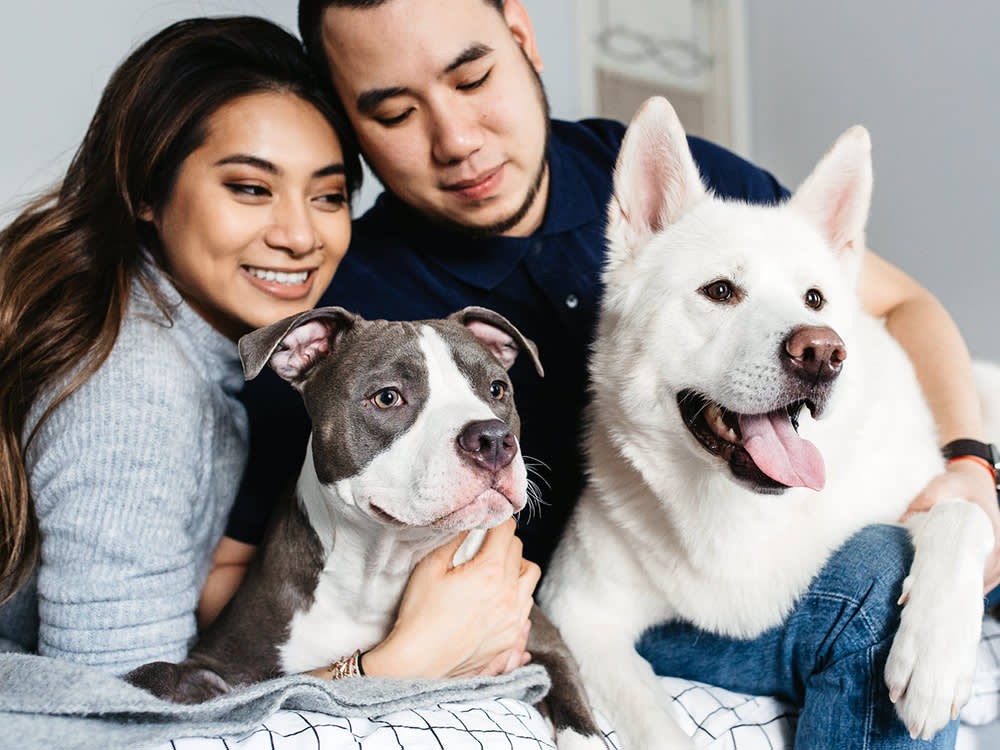
Maybe you’re picturing something small and easygoing, the kind of dog whose messes are quick to clean up. Your partner is picturing a hundred pounds of enthusiasm that can chase a ball until dark and keep the bed warm on a cold night. You keep coming back to the graying mixed breed at the shelter down the block; your partner has never adopted an animal and isn’t sure about starting now. One of you is set on a female, the other on a male. One of you wants a replica of the dog from childhood, the other a replica of a roommate’s dog from college. This isn’t a whim for either of you, it’s a decision you’ve each turned over for ages, together and alone, and neither side is inclined to give.
It feels like a real impasse, the kind of thing that could genuinely stall a relationship. But if you talk to enough couples who have lived through it, a funny pattern emerges, and it is worth knowing before you dig your trenches any deeper. The dog people argue about beforehand is almost never the dog they end up with, and it is even less often the dog they end up loving. The spec sheet, size, breed, gender, all the terms you are fighting over, tends to evaporate the instant a specific animal walks up and chooses one of you. So the real question is not “whose list wins.” It is “how do we stay open long enough to meet the dog we don’t know we want yet.”
Lesson one: personality beats the checklist, every single time
The most consistent thing couples report is that once they met the actual animal, the criteria stopped mattering. One couple spent their deliberations split between a small, low-shedding dog and something over sixty pounds, the partner insisting that small dogs were not “real” dogs. Then they walked into a shelter and a Great Pyrenees mix came straight up to them, and they both instantly agreed she was theirs. She was nowhere near the size either of them had planned for, and it did not register as a compromise, because, as the adopter put it, all the other details simply stopped mattering the moment they met her. It came down to who the dog was, not what she was.
That story repeats with different casts. A couple divided between a lapdog and a big adventure dog ended up with a medium Australian Shepherd mix who was, by both their accounts, the best dog either of them had ever had, smaller than one of them wanted and bigger and smarter than the other had hoped, and beloved by both. Another pair who had wanted, respectively, a Boxer or Pit Bull and an Australian Shepherd landed on a shepherd puppy from a farm litter, only to watch her bond most fiercely with the partner who had not asked for that breed at all. The lesson keeps landing the same way: you are not choosing a category, you are meeting an individual, and individuals overturn categories.
Couples come in with a spreadsheet and leave with a dog who matches none of it, and they’re thrilled. I tell people the argument about size and breed is really an argument about a fantasy. The dog in front of you is a fact. When you let the actual animal into the room, the fantasy loses, and honestly, everybody’s relieved when it does.
Lesson two: the size debate is usually about something else
When one partner insists on a big dog and the other on a small one, they are rarely really arguing about pounds. They are arguing about what a dog means to them. The big-dog partner often wants an outdoorsy companion, a running buddy, a presence, the mountain dog they picture on a trail. The small-dog partner may want something they can physically manage, lift, and handle, or they are quietly worried about being intimidated by an animal they cannot control, or they have real practical constraints like apartment size or dander allergies.
Those are legitimate needs on both sides, and naming the need underneath the size is far more productive than defending the number. A partner who wanted a manageable dog because of bad dander allergies ended up with two big, shedding shelter dogs, and reported that her allergies improved over time and, in any case, the dogs were worth it. A husband who dreamed of a dog he could “ride into battle” cheerfully accepted a much smaller rescue and, twelve years later, would not trade him. What made those compromises painless was that the underlying worry, can I handle this dog, will this dog fit our space, got addressed, so the size itself became negotiable. Fight about the need, not the number, and the number tends to sort itself out.
Lesson three: “get a dog” is not the only winning move
Here is the option couples forget is on the table: you do not have to resolve the disagreement by acquiring a dog right now. Two of the happiest arrangements are the ones that sidestep ownership entirely, at least for a while.
One couple who could never quite agree became the devoted go-to sitters for a friend’s Goldendoodle, who moves in with them during the owners’ long trips abroad. They get the family walks, the companionship, the charisma of a great dog, without the full-time commitment, and both partners describe themselves as genuinely happy with the setup, the equivalent, one of them said, of being a beloved uncle rather than a parent. Another couple, both from dog-loving families and fully expecting to get a dog eventually, simply decided who would make the final call when the time came, with one partner graciously ceding the choice to the other, trusting that whatever dog they picked, the love would follow. Fostering, sitting, borrowing a friend’s dog, or just agreeing on a timeline and a decision-maker are all real resolutions. The disagreement does not require a purchase to end.
So how do you actually decide together?
Pull those lessons into something you can use. A few principles do most of the work.
Match energy, not aesthetics. The single best predictor of whether a dog fits your life is not size or breed; it is activity level and temperament against your actual daily routine. A calm big dog can be a wonderful apartment companion, and a high-drive small dog can run a couch-loving household ragged. Talk honestly about how much time, exercise, and stimulation you can genuinely provide, then look for that, and let the packaging be whatever it is.
Meet individuals before you commit to a type. Because personality overrules category, the most important step is spending real time with actual dogs rather than debating hypotheticals. Shelters and rescues let you interact with a dog before deciding, and fostering lets you test-drive the fit in your own home with an easy exit. The dog who is right for both of you is a specific dog, and you cannot argue your way to them on paper.
Name the need under the preference. When you find yourselves stuck on a trait, dig one layer down. “I want a small dog” might mean “I’m scared of not being able to control a big one.” “I want a big dog” might mean “I want a hiking partner.” Solve the underlying need, and the surface preference usually becomes flexible.
Consider adoption seriously, and go in clear-eyed. Many couples land on a shelter mix, and there are a lot of wonderful ones waiting. If you go this route, learn to recognize a responsible source and, if you ever do consider a breeder, know the red flags. The point is not that one path is morally required; it is that both of you understanding where the dog comes from prevents a different argument later.
The reassuring part
The dog you settle on will be loved. All of them are. That is the thread running through every one of these stories, the couples who wanted opposite things and then adored the compromise, the ones who found their dog by accident, the ones who solved it by not getting a dog at all. The pre-adoption argument feels enormous because it is standing in for a real question, what will our life together look like, and that question is worth taking seriously. But the dog is not a referendum you win. The dog is a specific creature you have not met yet, who will walk up, pick one of you, and quietly make the whole debate irrelevant. Stay open long enough to let that happen, and you will both, somehow, get exactly what you wanted.
References
- ASPCA. “Adopting a Shelter Dog: What to Consider.” aspca.org
- The Humane Society of the United States. “How to find a responsible dog breeder / adoption guidance.” humanesociety.org
Leila Torres leads our Living coverage, from home life and travel to the products and rescue stories that come with sharing a life with animals. She edits and writes across the section, with a soft spot for pieces about the bond between people and their pets.
Meet our experts ↗Keep reading
 LivingThat Adorable Valentine's Shelter Shoot Is a Targeted Adoption StrategyLeila Torres · 5 min
 LivingShe Was Supposed to Be Elliot Page's DogSasha Ford · 7 min
 LivingMissouri Tops the 'Horrible Hundred' for a 14th Year. The 2026 Report Is Grim.Nina Vasquez · 6 min
 LivingThe Rescue That Saved His Life Nearly Went Under Without HimJames Okafor · 9 min
 LivingNobody Designed Your Mutt. That's Their Superpower.Nina Vasquez · 7 min
 LivingA Comedian Built a Movement Around the Dogs Nobody WantedLeila Torres · 5 min