


The One Dog Problem Where a Webcam Beats a Trainer in the Room
For most behavior issues, a trainer in your living room helps. For separation anxiety, their presence is the problem. Here's why remote coaching has become the gold-standard approach, and what the slow, second-by-second protocol actually looks like.

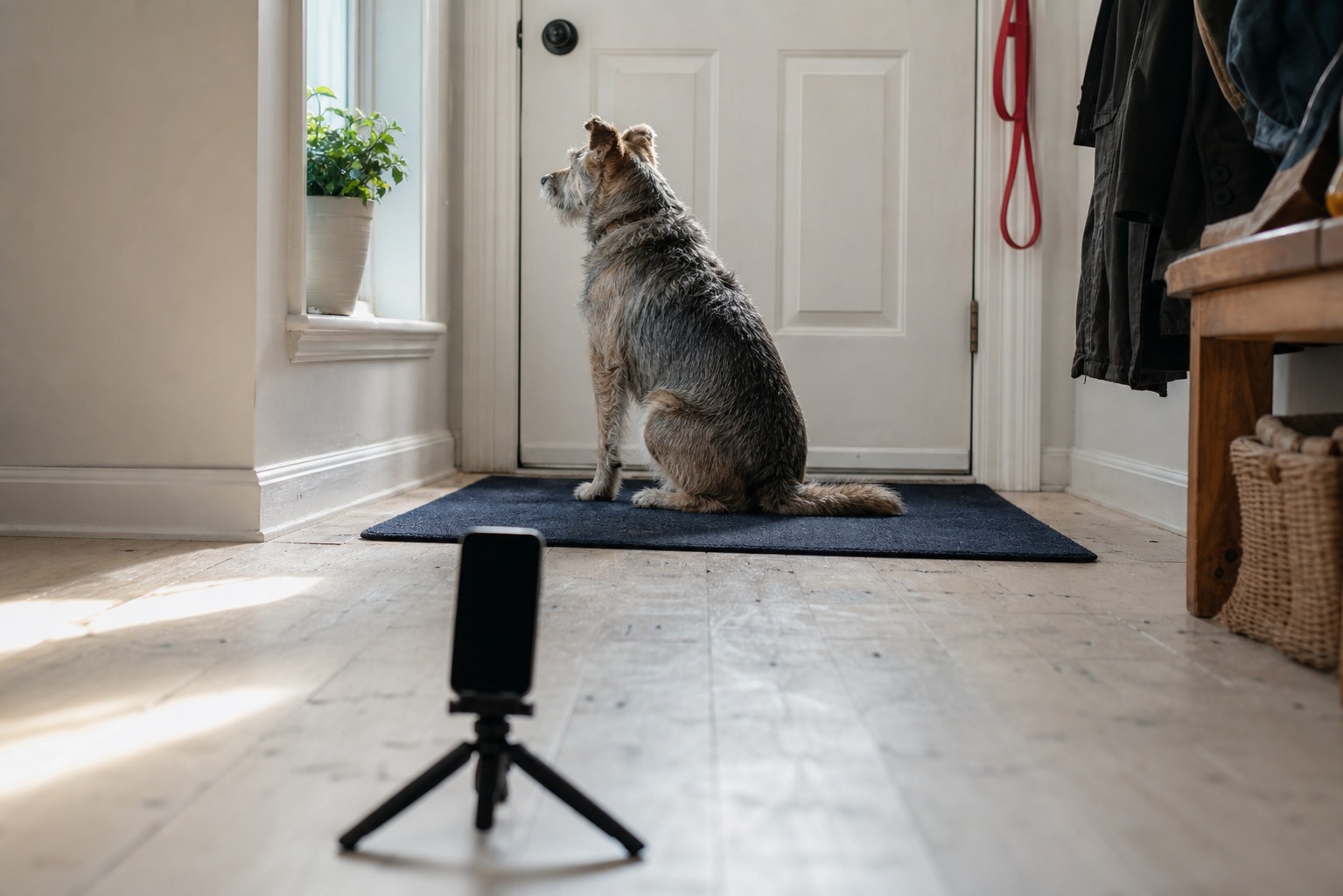
Bring a trainer into your home for leash reactivity or jumping, and their being there is the whole point. Bring one in for separation anxiety, and their being there quietly wrecks the session. The entire disorder is about your dog panicking when it is genuinely, verifiably alone. Put a friendly human on the couch and the dog isn’t alone, so nothing you’re trying to treat is even happening. That single contradiction is why separation anxiety has become the one behavior problem where the remote approach isn’t a budget compromise. It’s the better method, and the camera is doing real clinical work.
Why “alone” has to mean actually alone
Separation-related distress is common, affecting somewhere in the range of 14 to 20 percent of pet dogs, and it spiked as households that adjusted to constant company suddenly went back to leaving the house. The signs are hard to miss once they start: barking or howling that doesn’t stop, pacing, drooling, house-soiling from an otherwise trained dog, and destruction aimed at doors and windows, the exits the dog is desperate to follow you through.
The treatment that actually works is systematic desensitization: exposing the dog to being alone in doses so small they never trip the panic, then growing the dose. Studies of this approach, usually paired with counterconditioning, report success rates ranging widely from about half to nearly all cases, with owner consistency being the deciding variable. And here’s the mechanical catch that makes remote coaching essential. If a trainer is in the room, the dog knows it’s a staged absence, not a real one, and the training doesn’t transfer to the moment you truly walk out the door. The goal is for the dog to be alone, so the trainer has to not be there.
A camera solves it cleanly. The trainer watches your dog through a phone, tablet, or laptop while you genuinely leave, seeing exactly how the dog behaves in real solitude rather than reconstructing it afterward from your description. They can read the live body language, subtle early stress signals most owners miss, and adjust the plan as the behavior unfolds instead of a week later. Remote observation isn’t a lesser version of in-person work here; it’s a clearer window than an in-person trainer could ever get.
With most things I train, I want my hands on the leash. With separation anxiety it’s the opposite, my job is to become invisible and let the dog discover that nothing bad happens when the door closes. A screen lets me coach that from the outside without ever contaminating it with my presence.
What the protocol actually looks like
The approach has a pioneer worth crediting: trainer Malena DeMartini built her practice entirely around separation anxiety and has trained a network of certified specialists who work exclusively online, meeting clients over video, sharing daily training spreadsheets, and reviewing footage together to teach owners how to read their dogs. She began offering it remotely well over a decade ago, and the reason was practical, working online let her observe a dog live and modify the protocol as the behavior was happening rather than after the fact.
In practice, the first session is an assessment. The owner props a device facing the door and steps outside while the trainer watches, and the goal is to find the dog’s threshold, the exact length of absence the dog can tolerate before distress begins. For a severe case that might be astonishingly short. A dog that unravels after ten seconds starts at nine. That number is the entire foundation, because everything after it is built in increments just under it.
From there the work is a series of tiny, scripted missions. An early one might be a handful of micro-departures: crack the front door and shut it again, step out for a single beat before coming back, or simply rattle the handle without leaving at all. On the way out the owner picks up keys and a bag and sets them down again on return, so the pre-departure cues that normally spike a dog’s anxiety, the jangle of keys, the coat going on, gradually stop predicting abandonment. Between each rep the owner waits a minute or two and logs what the dog did and how fast it recovered. The trainer reviews the log, then writes the next day’s slightly harder mission based on how the dog actually responded, not a fixed calendar.
Progress feels glacial and that’s the design. A dog might repeat the same one-second mission for a week before graduating to five seconds. The point of going this slowly is that the dog never gets to rehearse panic; it only ever practices being fine. Owners often balk at starting so small, convinced it’ll take years. It usually doesn’t. Most cases take somewhere between a few months and half a year to reach several hours of calm alone time, though the honest answer is that it depends on the dog, and a dog’s baseline anxiety doesn’t reliably predict how fast it moves.
Two supports matter alongside the drills. First, the dog can’t be left past its threshold outside of training, or the daily gains erode, so owners lean on sitters, daycare for dogs who enjoy other dogs, or friends to cover real absences in the meantime. Second, some dogs are simply too flooded with anxiety to learn at any increment, and for them anti-anxiety medication prescribed by a vet can lower the baseline enough that the desensitization can finally take hold. Medication isn’t a failure or a shortcut; for the right dog it’s what makes the training possible.
The quiet payoff is that this work tends to spill over. A dog that learns the front door isn’t a threat often gets braver about other things too, less rattled by sudden noises, calmer in the car, more willing to settle. Teaching a dog that being alone is survivable turns out to build a steadier dog across the board.
What newer evidence adds
The case for remote-first separation-anxiety work has firmed up rather than softened. Post-pandemic clinical reporting documents a sharp rise in separation-related cases as work-from-home routines ended, which pushed more trainers and behaviorists toward scalable video-based programs. The underlying science hasn’t changed, gradual desensitization and counterconditioning remain the evidence-backed core, but the delivery has, and practitioners increasingly treat live remote observation as a feature of the method rather than a workaround. The other steady theme in current guidance is realism about medication: for moderate-to-severe cases, vets are more comfortable using anti-anxiety drugs early as an adjunct, on the understanding that a dog too panicked to think can’t be trained no matter how small the steps.
This piece covers a behavior and mental-health issue and mentions medication. A dog’s severe distress is worth a real evaluation, so loop in your vet or a qualified behavior professional before starting a plan, especially if medication might be part of it.
References
- Butler, R., et al. “The efficacy of systematic desensitization for treating the separation-related problem behaviour of domestic dogs.” Applied Animal Behaviour Science. https://www.sciencedirect.com/science/article/abs/pii/S0168159110002923
- Sherman, B.L., and Mills, D.S. “Canine Anxieties and Phobias: Separation Anxiety.” Veterinary Clinics of North America: Small Animal Practice. https://pubmed.ncbi.nlm.nih.gov/18922501/
- DeMartini-Price, M. “Separation Anxiety in Dogs: Next Generation Treatment Protocols and Practices.” https://malenademartini.com/
Common questions
How is online separation-anxiety training different from a regular trainer visit?
The trainer watches your dog through a camera while you actually leave, so they see genuine alone-time behavior instead of a rehearsed absence with a stranger in the house. They read the live footage and adjust the plan in real time, which is exactly what this specific problem needs.
How long does it take to fix separation anxiety?
It varies enormously by dog. Many cases resolve over roughly three to six months of consistent daily work, at which point the dog can handle several hours alone. Some need medication to make progress, and a few never fully clear it. Anxiety level doesn't reliably predict speed.
Can I ever leave my dog during training?
Not outside the training sessions, at least at first. If the dog keeps being left past its threshold between sessions, the desensitization unravels. Owners bridge the gap with sitters, daycare, or friends until the dog's tolerance grows.
Dr. Park is a board-certified emergency and critical care specialist. She reviews our health and safety content for clinical accuracy and contributes guides on recognising urgent conditions. Her focus is helping owners act quickly and correctly when it matters most.
Meet our experts ↗Keep reading
 TrainingYour Dog Isn't Being Bad When They Lunge at Cars. Their Brain Thinks It's HuntingDr. Ravi Mehta · 6 min
 TrainingYour Reactive Dog Can't 'Settle.' Stop Asking and Give Them a Job.Dr. Mara Chen · 8 min
 TrainingSome Dogs Hate Walks. Dragging Them Only Makes It Worse.Dr. Ravi Mehta · 8 min
 TrainingYou Didn't Cause Your Dog's Leash Reactivity. Here's How to Manage ItDr. Amara Solis · 7 min
 TrainingDog Anxiety Isn't One Thing. That's Why Treating It Like One FailsDr. Nina Kohl · 8 min
 TrainingCanine Dysfunctional Behavior: Why the First Step Is Ruling It OutDr. Ravi Mehta · 8 min