


Some Dogs Hate Walks. Dragging Them Only Makes It Worse.
A dog who plants their feet at the door isn't broken or stubborn. There are 8 reasons behind the refusal, one of them is medical, and the fix is almost never a firmer tug.

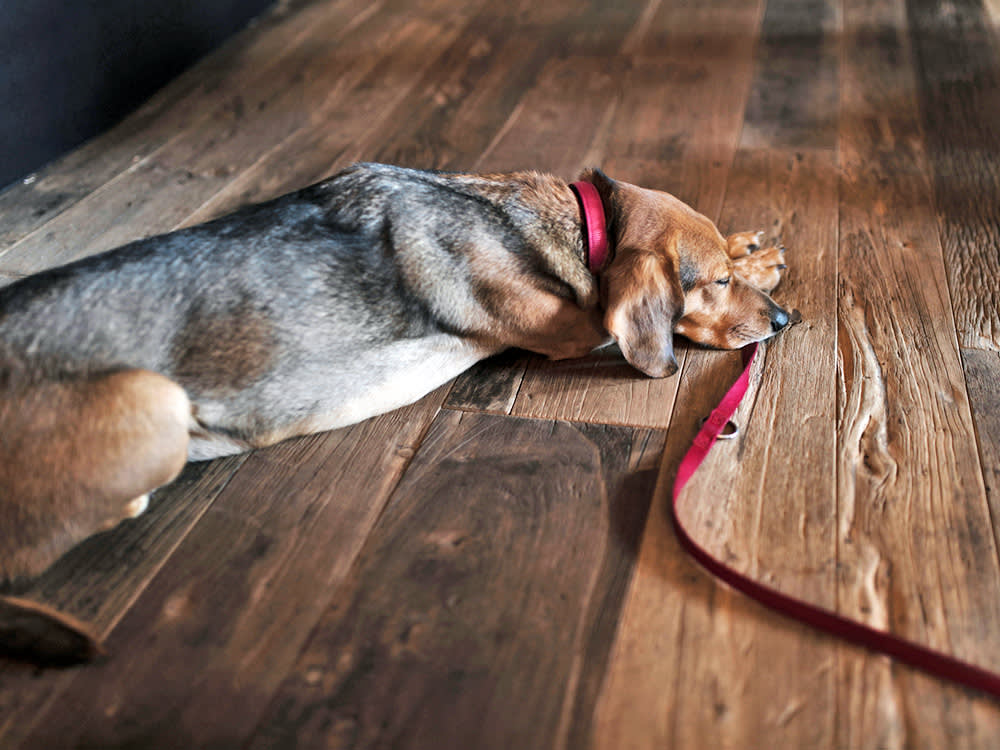
Every dog blog on earth promises you the same scene: the leash comes off the hook, the dog explodes into joyful circles, you have to spell out w-a-l-k to keep the peace. And then there is your dog. Who looks at the leash. Who looks at you. Who lies down.
It is a genuinely disorienting thing to own the one dog who did not read the manual, and the disorientation is what leads people to the worst possible response, which is to pull harder. So let us start with the honest premise: a dog who refuses a walk is telling you something specific, and every single one of the reasons below responds better to being answered than to being overruled.
Eight of them, and one of them is a medical emergency dressed up as stubbornness.
1. There is something hurting
Put this first, not seventh, because it is the one that costs you the most to miss.
If a walk hurts, a dog will decline the walk. Pain and stiffness are easy to accept in an old dog, because we expect it, and easy to dismiss in a young one, because we don’t. Both assumptions get dogs hurt.
Signs worth taking seriously:
- Getting up off the floor has become a slow, deliberate operation.
- Mobility swings: some days fine, some days stiff.
- Touch they used to lean into now gets a flinch or a turn of the head.
- The change arrived suddenly rather than creeping in over a year.
That last one is the loudest signal in this article. A dog who liked walks last month and refuses them this month needs a vet, not a training plan. If you even suspect pain, go now.
2. They are very young
Plenty of puppies are indifferent to walks. They dawdle, they anchor themselves, they generally will not get with the program, and none of that is a problem to fix. It is a puppy.
Getting them comfortable in a collar and on a leash matters. Making them complete a route does not. If your puppy only wants the yard or twenty yards of sidewalk, take the twenty yards. Bring treats or a favorite toy, quit while they are still interested, and let the distance creep up over the following weeks and months. Pushing buys you nothing.
The best trick here is directional. Put them in the car, or under your arm, and start one block away, so the whole walk points back toward the house. Home is the strongest motivator a young dog has, and heading into unfamiliar territory is the part they are refusing.
3. The weather is genuinely unpleasant
Some dogs hate cold. Some refuse rain. Some wilt in the mildest heat. And a dog who plants themselves at the door in weather they dislike is doing something remarkable, which is communicating clearly with a member of another species. Take the win.
Then adjust. Booties and a sweater for snow and cold, an umbrella for rain, shady routes in heat. Walk in the warmest part of a winter day and the coolest part of a summer one. And when it is truly coming down, wait it out. Nobody is losing anything.
4. Something bad happened out there
Dogs respond to traumatic events much the way people do, and it reshapes what they are willing to do and where they are willing to be.
A thunderclap. A dog who attacked them. A snowplow that threw a wall of ice. A collision with a bike. Any one of those can attach fear to walking in general, and, very often, to the specific place it happened. That specificity is useful: a lot of dogs are completely fine in a brand-new location, even if you have to drive there to find one.
5. Walks bore them
Some dogs find a slow amble around the block deeply uninteresting. These tend to be the play-driven dogs, the ones who would rather their outdoor time be a game than a stroll.
You can make an outing worth their while:
- Add bursts of speed. You do not have to run the whole way.
- Change pace and direction often.
- Find routes with better smells: a new park, a trail, a different neighborhood.
- Bring a toy, detour into a fenced area, or break out a tug rope mid-route.
- Bring a friend. Dogs who like other dogs walk better next to one.
6. The gear is the problem, not the walk
Sometimes the dog is not refusing the walk. They are refusing the collar.
If a dog is not used to a leash and collar, teach them. Put the gear on, hand over something outrageously good, peanut butter or chicken, take it off, then put it back on and pay again. Three to five reps a day for a few weeks turns most gear-averse dogs around.
And be willing to change the equipment. Many dogs hate having anything around the neck and do far better in a harness. Some hate the loud snap of a clip going off near their ears. In general, smaller and lighter wins: a thinner leash, a lighter collar, a quieter clip. Going minimalist is often the entire fix.
7. The world is too loud
Walks are an unrelenting stream of unpredictable events: strangers, trucks, jackhammers, an off-leash dog jogging up uninvited, a skateboard appearing from nowhere. For a dog who is anxious in general, or thrown by novelty, or unable to absorb surprises, that is not a leisure activity. That is a shift at a difficult job.
The answer is a quieter setting, not a braver dog. Trails away from crowds. Early mornings. Industrial streets on a Sunday. Make the environment smaller before you ask the dog to be bigger.
8. The leash telegraphs your mood
This one is not in most lists and it belongs there.
Tension travels down the leash. A handler who is braced for a scene, shortening the lead every time another dog appears, walking fast and scanning, is broadcasting all of it into their dog’s collar. Some dogs who “hate walks” are actually reacting to a walk that has become a stressful event for their person, and they are simply the second one to notice.
Test it honestly. Loosen the leash. Slow down. Stop steering. If your dog’s walking improves when your grip relaxes, you have found something worth working on, and it is not the dog.
Refusal is not defiance, it is a vote. The dog is telling you the cost of this walk is higher than the reward. My job is to find out which cost, and pain is always the first thing I rule out, because a dog will absolutely limp quietly for months before they will complain.
If walks are never going to be their thing
Then stop insisting on walks.
The purpose of a walk is stimulation and movement, and there is nothing sacred about the delivery method. Fetch, puzzle feeders, tug, trick training, and nose work all deliver it. So do swimming, training classes, agility, and hide-and-seek down the hallway. So does twenty minutes of chase in the yard, a play date with a dog they actually like, or three short training sessions spread across the evening.
Walks are a bit like parties. Some individuals build their whole week around them. Others would rather do almost anything else, and they are not defective for it.
When you accept that your dog is not a fan, you have not failed at dog ownership. You have learned something true about who your dog is, and then you have let them tell you what they would rather do instead. That is not a lesser relationship. It is a more accurate one.
What newer research adds
The strongest recent argument for backing off the forced march comes out of research on scent work. Studies looking at nose-based enrichment have found that dogs given regular opportunities to use their noses show measurable shifts toward more optimistic judgments in cognitive bias tests, which is about as close as we currently get to measuring a dog’s mood.
Meanwhile, work on canine sleep and stress has established that dogs carry a difficult day into the night, showing sleep patterns consistent with heightened arousal after stressful experiences. Put those together and the practical conclusion is uncomfortable but clear: a walk your dog spends braced and frightened is not a neutral event that failed to help. It is a stressor with a cost attached, and a sniffy fifteen minutes in a quiet field is worth more than a tense forty-five around the block.
References
- Duranton, C., and Horowitz, A. “Let me sniff! Nosework induces positive judgment bias in pet dogs.” Applied Animal Behaviour Science, vol. 211, 2019, pp. 61-66.
- Bunford, N., et al. “Emotional Arousal and Sleep in Dogs.” Scientific Reports, vol. 8, 2018.
- Mills, D., et al. “Pain and Problem Behavior in Cats and Dogs.” Animals, vol. 10, no. 2, 2020.
- Overall, K.L. Manual of Clinical Behavioral Medicine for Dogs and Cats. Elsevier, 2013.
Common questions
Is it OK to skip walks entirely?
For some dogs, yes. Walks exist to provide stimulation and movement, and both can come from fetch, puzzle feeders, tug, trick training, nose work, swimming, agility, training classes, hide-and-seek, or play dates. The walk is one delivery method, not the goal itself.
Should I just carry my puppy past the scary part?
Often that helps, and it is not cheating. Many puppies walk better if you carry or drive them a block from home and then walk back, because returning to the familiar is more motivating than heading into the unknown.
Dr. Mehta is a board-certified veterinary nutritionist who evaluates pet food formulations, ingredient quality, and the science behind dietary trends. He writes and reviews all nutrition content at The Pet Times, including our food rankings and feeding guides.
Meet our experts ↗Keep reading
 TrainingWhat Corook's Anxious Rescue Dog Taught Them About Doing LessDr. Mara Chen · 9 min
 TrainingYou Can't Train Your Dog in a Moving Car. Start in the Driveway.Dr. Ravi Mehta · 8 min
 TrainingYour Dog Isn't Being Rude. He's Cornered.Dr. Amara Solis · 8 min
 Training'Overprotective' Is Usually Fear Wearing a Nicer NameDr. Ravi Mehta · 8 min
 TrainingYour Dog Isn't Aggressive at the Door. He's Scared, and the Door Makes It Worse.Dr. Mara Chen · 4 min
 TrainingThat Friendly On-Leash Hello Is Teaching Your Dog to Melt DownDr. Amara Solis · 6 min