


What Corook's Anxious Rescue Dog Taught Them About Doing Less
Cubby wouldn't walk, hated the city, and had panic attacks at the door. The fix wasn't more training. It was less. Corook on the shy rescue who taught them self-compassion, and the behavior science behind why backing off worked.

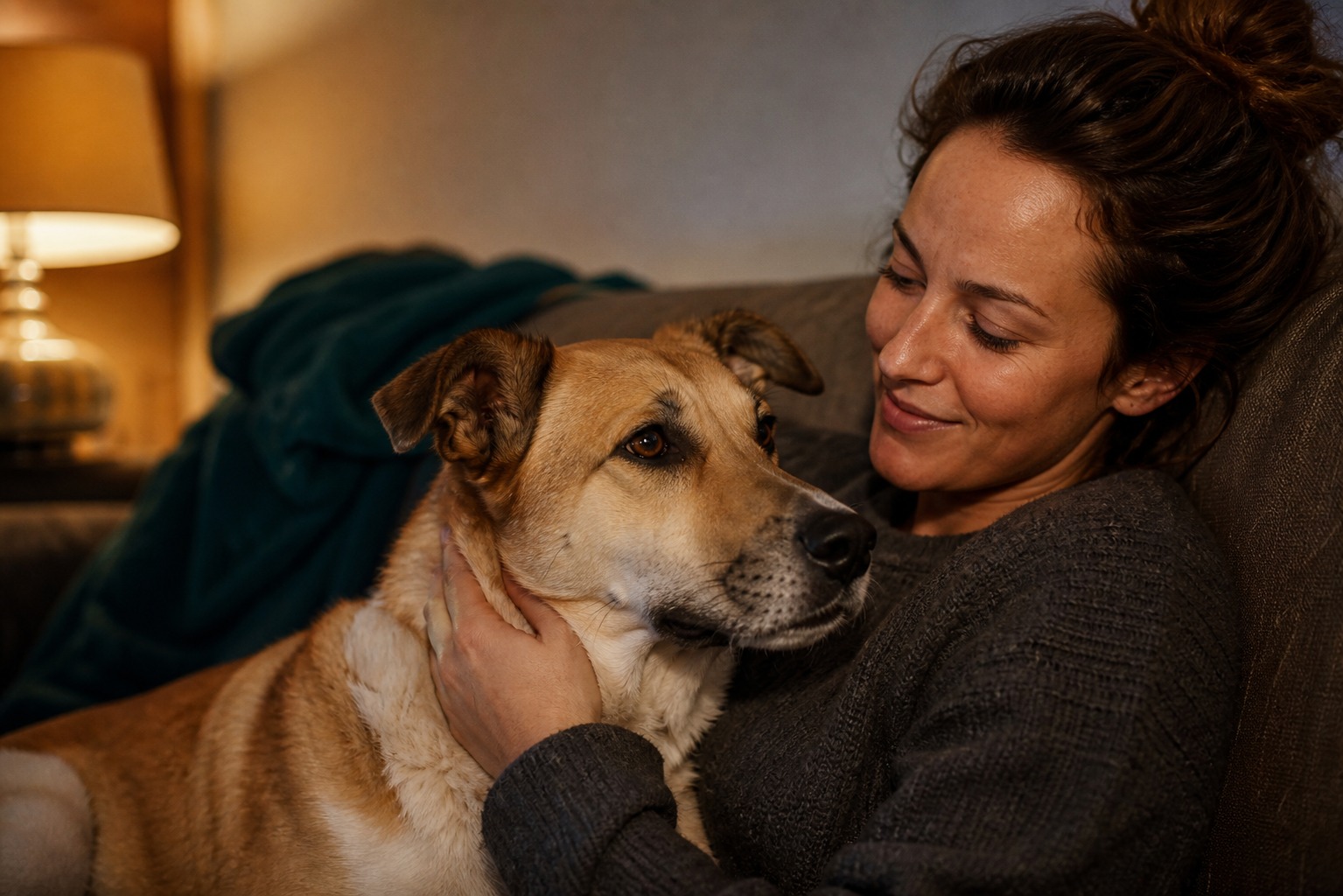
Most people adopt a rescue dog and immediately start doing things: long walks, new places, meeting the neighbors, “socializing.” The musician corook did all of that with their dog Cubby, and it made Cubby worse. What finally helped was the opposite, and it is one of the most useful things a nervous-dog owner can hear: sometimes the kindest, most effective thing you can do for a fearful dog is less.
Corinne Savage, who performs as corook, is the Nashville songwriter behind the aching breakup single “The Dog” and, with their partner Olivia Barton, the folksy hit “If I Were a Fish.” The two co-parent Cubby, a German Shepherd–Pit Bull mix and, by every stereotype, a dog who should be bold and pushy. She is neither. She is shy, sound-sensitive, low-energy, and content to do her own thing, and her turnaround from a panicking new rescue to a settled dog is a small master class in how fear actually works.
The problem: everything they did to help was making it worse
When corook and Olivia brought Cubby home, they pictured the classic new-dog life. “We loved the idea of a morning purpose, a built-in excuse to get out the door and walk,” corook says. Cubby wanted none of it. Walks held no appeal for her, and the racket of traffic and the constant motion of the city set her on edge. A trip outdoors could spiral into what resembled a full-blown panic attack.
“She would pull on her leash to the point of suffocating herself,” corook recalls. “Barely a few steps from home, she’d be straining with everything she had to get back inside.” They called animal behaviorists. Nobody had a clean answer, until a trainer suggested something counterintuitive: stop hand-feeding her, stop the forced walks, feed her from a bowl, and see what happens. “After that shift, she was completely okay. It turned out she just didn’t want constant new lessons piled on her. The minute we eased up, the trust and the bond followed.”
Why backing off worked: the behavior science
That story is not a fluke, and it is worth understanding, because the instinct to push a scared dog through their fear is extremely common and usually backfires.
Behaviorists distinguish between two very different ways of exposing a dog to something that frightens them. Flooding means forcing the dog to face the trigger at full intensity on the theory that they will “get used to it.” A daily walk down a loud city street, for a dog terrified of loud city streets, is flooding. It rarely produces calm. More often the dog either shuts down or escalates, and either way the trust between dog and owner erodes. Desensitization, the approach professionals actually recommend, does the reverse: it exposes the dog to a barely-there version of the trigger, kept below the level that overwhelms them, and pairs it with something wonderful until the association slowly flips from dread to “good things happen here.”
Cubby’s walks were flooding. Pulling them, and letting her eat and settle in a place she felt safe, was the fear equivalent of turning the volume all the way down. Her nervous system finally got the quiet it needed to register that home was safe.
When people tell me their rescue got worse the harder they worked, I’m usually relieved, because it means the fix is to stop, not to try harder. Fear doesn’t respond to willpower. It responds to feeling safe, and safe almost always means slower and smaller than the owner expects.
Two ideas that would have helped from day one
The 3-3-3 rule. Rescue dogs tend to move through rough phases: about three days of pure overwhelm and survival mode, about three weeks for a routine to take hold and a personality to peek out, and about three months before the dog truly feels at home and their real temperament shows. Counterintuitively, some fears surface after the first few weeks, not before. As the initial flood of stress hormones drops (sometimes called a cortisol crash), a dog who seemed shut-down and “easy” at first can start expressing more fear. That is not regression. It is a dog finally feeling safe enough to have feelings, which is roughly what corook describes seeing in Cubby.
Trigger stacking. Stress hormones do not vanish the instant a scary thing ends; they accumulate. A dog who handled the mail truck, the vacuum, and a stranger’s dog earlier in the day has a nervous system already primed, so the fourth or fifth small stressor, one that would normally be nothing, can tip them over. For a dog like Cubby, a single overwhelming outing could poison the whole day. Spacing triggers out and giving her real recovery time between them is as important as any single training session.
The dog who gave permission to rest
What makes Cubby’s story land is that corook got the lesson in both directions. They have lived with anxiety and depression for as long as they can remember, and they see both in Cubby: skittish, sound-sensitive, easily overwhelmed. The thing they have most in common, corook says, is Cubby’s ability to simply have a bad day for no reason.
“Some mornings she just calls it, like, not today, I’m skipping the whole routine and looking after me. And by the next day she’s dying to get outside again,” corook says. “Watching her do that, I think, man, why can’t I give myself the same grace? She reads her own needs perfectly and acts on them.” The same reduction in pressure that healed the dog turned out to be a permission slip for the person: it is okay to be sensitive, it is okay to rest, and accepting the animal (or the self) in front of you beats forcing it to become something else.
That acceptance runs through corook’s work. Within a month of adopting Cubby, a friend in a writing session asked, half-joking, who would get the dog if corook and Olivia ever split. They had not even had the conversation, and the sinking realization became “The Dog.” Writing it was sad, corook admits, because they already knew the answer: Cubby would go to Olivia, “two peas in a pod.” (They have not split. Cubby, notably, has claimed a beanbag in corook’s upstairs studio and will wander in to lie down while they work, sound-sensitive to a guitar but unbothered by booming speakers, on her own terms, as always.)
Adopting a dog together, corook says, brought them and Olivia closer, a sideways way of committing to each other by committing to the same small, anxious, deeply particular creature. When corook pictures home, they picture Cubby and Olivia, the chosen family they credit with a lot of their own healing.
If your rescue sounds like Cubby
The through-line is simple and evidence-backed. If a fearful dog is getting worse the more you expose them, that is a signal to reduce pressure, not add training. Shrink their world to what feels safe, let them decompress, keep triggers spaced out, and change fearful associations gradually rather than head-on. For a dog whose fear is severe (self-endangering leash-pulling, refusing to eat, panic at the door), loop in a certified professional dog trainer or a veterinary behaviorist rather than pushing through alone. The goal is not a dog who tolerates being overwhelmed. It is a dog who learns, slowly, that they were never in danger to begin with.
This piece touches on mental health. If you are struggling, please reach out to a professional or a trusted person in your life for support.
References
- American Kennel Club. “What Is Trigger Stacking? How to Avoid It in Dogs.” https://www.akc.org/expert-advice/training/how-to-avoid-trigger-stacking-in-dogs/
- Rover. “Dog Training Using Desensitization and Counter Conditioning.” https://www.rover.com/blog/dog-training-using-desensitization-and-counter-conditioning/
- Sniffspot. “The 3-3-3 Rule for Rescue Dogs: What to Expect.” https://www.sniffspot.com/blog/dog-training/the-3-3-3-rule-for-rescue-dogs
Dr. Chen is a small-animal veterinarian who leads health and safety coverage at The Pet Times. She writes and reviews the bulk of our illness, condition, and safety content, translating clinical guidance into clear, practical advice owners can act on at home.
Meet our experts ↗Keep reading
 TrainingThe Stuffed Kong Won't Save You: 7 Lies About Separation AnxietyDr. Amara Solis · 9 min
 TrainingThe One Dog Problem Where a Webcam Beats a Trainer in the RoomDr. Lena Park · 6 min
 TrainingYour Dog Isn't Aggressive at the Door. He's Scared, and the Door Makes It Worse.Dr. Mara Chen · 4 min
 TrainingYour New TV Is Half the Reason Your Dog Won't Stop Barking at ItDr. Nina Kohl · 8 min
 TrainingThe Algorithm Rewards Bad Dog Training. Here Are 10 Tells.Dr. Mara Chen · 7 min
 TrainingYour Dog Isn't Being Rude. He's Cornered.Dr. Amara Solis · 8 min