


That Online Service-Dog 'Certificate' Was Never Required. A Court Just Confirmed It
A federal appeals court confirmed there is no legal certification for service dogs, and that ruling quietly removes a barrier that priced disabled people out of the help they need.

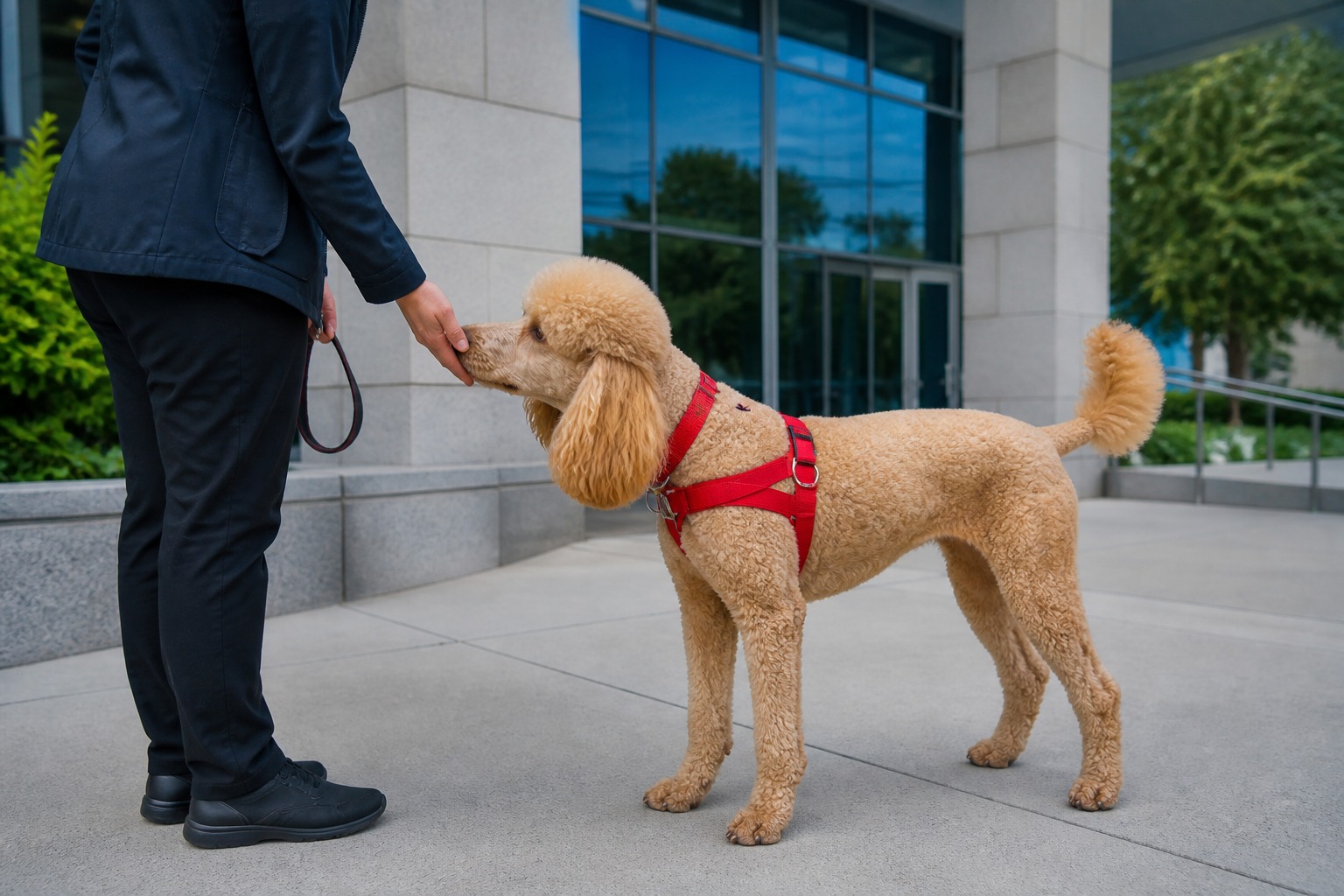
Search “service dog certification” and you will find a marketplace of official-looking registries selling certificates, ID cards, and vests, often for a fee. Here is the uncomfortable truth underneath all of it: none of those documents have ever carried legal weight. There is no federal service-dog certification, there never was, and a federal appeals court has now said so in a way that sets binding precedent.
That distinction matters more than it sounds. The ruling did not create a new right to skip certification. It confirmed that the certification requirement some businesses and even a lower court tried to impose was never lawful to begin with, and in doing so it removed a barrier that had been quietly pricing disabled people out of the help they depend on.
What the dogs actually do
For more than 500,000 Americans, a service dog is not a companion in the ordinary sense. It is medical equipment with a heartbeat. These dogs perform trained tasks tied directly to a person’s disability: reminding someone with diabetes to check their blood sugar, interrupting a compulsive behavior for a person with OCD, bracing a handler with a mobility impairment, or guiding someone who is blind. The work is specific, learned, and repeatable, which is the legal heart of what makes a dog a service animal at all.
The case behind the headline
The decision came in C.L. v. Del Amo Hospital, Inc., and the facts explain why it landed the way it did. The plaintiff, a speech-language pathologist with complex PTSD and severe anxiety, learned that a professionally trained psychiatric service dog could cost up to $15,000. So she did what the law has always allowed: she got a dog and trained it herself to perform the tasks she needed.
When that self-training was challenged, a 2019 federal district court ruled that service dogs had to be formally “certified.” On appeal, the U.S. Court of Appeals for the Ninth Circuit reversed that, in a unanimous three-judge decision, and held that the Americans with Disabilities Act (ADA) prohibits a certification requirement. It was the first appellate decision in the country to address training and certification standards for service dogs head-on, which is why it now functions as precedent rather than a one-off.
The three reasons the court gave
The opinion is worth understanding because it tells you what the law actually protects, not just what it forbids.
First, the ADA’s own regulations define a service animal as any dog individually trained to do work or perform tasks for a person with a disability, including a psychiatric disability. The definition turns on training, not paperwork.
Second, the court noted that service-dog registries have no uniform standard for what “certification” even means. Requiring it would force people to buy something with no agreed-upon definition, making access more expensive and less available, the opposite of what a civil-rights statute is for.
Third, the court tied it back to purpose. Congress passed the 1990 ADA to “promote independent living and economic self-sufficiency.” A pay-to-access certificate undercuts both, especially for the people the law was written to protect.
What this means for you in practice
If you have a disability and a dog trained to do disability-related work, you may train that dog yourself, and a business cannot lawfully demand a certificate, ID card, or registration to prove it. Under the ADA, staff at a business may ask only two questions: whether the dog is a service animal required because of a disability, and what work or task it has been trained to perform. They cannot require documentation, demand a demonstration, or ask about your diagnosis.
“The thing pet parents misread is that ‘no certification’ does not mean ‘no training,’” said Dr. Priya Nair, a veterinarian who works with assistance-dog handlers and advises The Pet Times. “The protection is for a dog that genuinely does a job. A vest off the internet does not make a service dog. Trained, reliable task work does.”
Two limits are worth keeping straight. The protection is for service dogs that perform trained tasks, not emotional-support animals, which have different and narrower legal standing in public spaces. And the self-training right comes with reasonable conditions: a service dog still has to be under control and housebroken, and a business can ask one to leave if it is out of control or not housebroken. The point of the ruling was never that anyone can declare any dog a service animal. It was that the people who genuinely need one should not have to buy a meaningless certificate to use it.
References
- United States Court of Appeals for the Ninth Circuit. “C.L. v. Del Amo Hospital, Inc.” (Opinion, March 30, 2021). https://cdn.ca9.uscourts.gov/datastore/opinions/2021/03/30/19-56074.pdf
- Harvard Law Review. “C.L. v. Del Amo Hospital, Inc.” https://harvardlawreview.org/print/vol-135/cl-v-del-amo-hospital-inc/
- U.S. Department of Justice. “ADA Requirements: Service Animals.” https://www.ada.gov/resources/service-animals-2010-requirements/
- ADA National Network. “Learn About the ADA.” https://adata.org/learn-about-ada
Marcus Webb writes about the gear, gadgets, and everyday choices that make life with a pet easier. His coverage runs from product picks to training and the causes worth paying attention to, always with an eye on what actually earns a place in your home.
Meet our experts ↗Keep reading
 LivingL.A. Just Slammed the Brakes on New Dog Breeding. Here's the Fight Behind It.James Okafor · 4 min
 LivingHe Kicked a Working Beagle Off the Ground. The Beagle Went Back to Work.Marcus Webb · 4 min
 LivingRetired War Dogs Come Home With the Same Wounds Their Handlers DoJames Okafor · 7 min
 LivingNobody Meant to Have 100 Dogs. That's How It Always Starts.Nina Vasquez · 5 min
 LivingThe Bigger Dog Always Loses in CourtDr. Mara Chen · 9 min
 LivingOne Rule for Every Dog, or None at All? Inside the AKC's Puppy-Mill FightJordan Ellis · 7 min