


Your Dog Has a Favorite Food. You're Probably Paying Them in Their Fourth.
A muffin tin, twelve foods, and a camera will tell you more about your dog's training than any class. Here's how to run the test, and the mistake that makes most people misread the result.

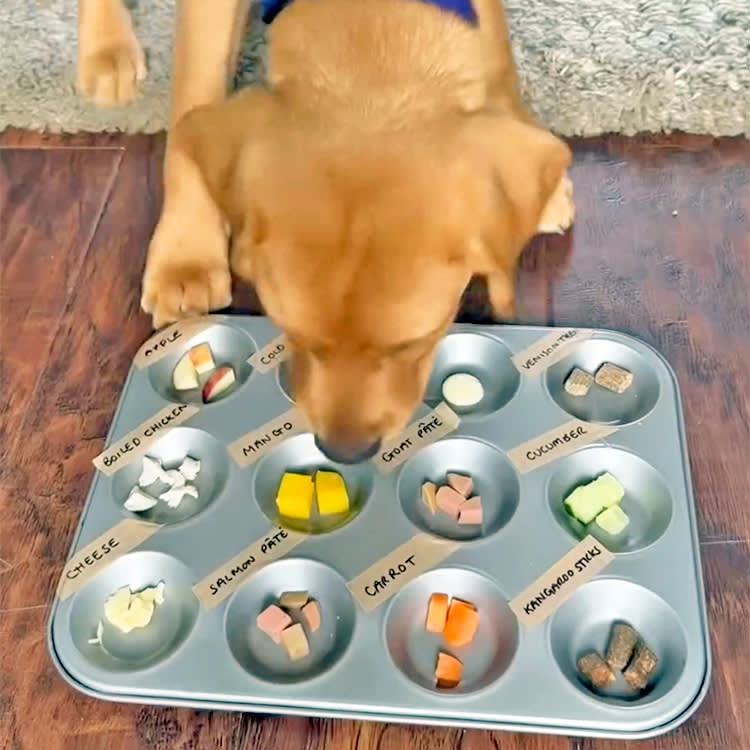
Ask most people what their dog’s favorite treat is and they’ll tell you with total confidence. Ask them how they know, and it turns out they’re guessing from the fact that the dog ate it.
Dogs eat almost everything. That tells you nothing. Eating is not a ranking.
And the ranking matters, because the entire economy of dog training runs on it. Every recall, every leave-it, every polite greeting at the door is a transaction, and you’re the one setting the price. If you’re paying in your dog’s fourth-favorite food and expecting your dog’s best behavior, you’re going to be disappointed in a way that has nothing to do with your dog’s character.
There’s a cheap, slightly ridiculous way to find out what you’re actually holding. You need a muffin tin.
The test
It went viral because it’s a good test, not because it’s clever. It’s been used by trainers and behavior researchers for years, in one form or another, and the muffin tin just makes it something you can do on a Tuesday.
Fill a twelve-cup muffin tin with a different dog-safe food in each cup. Small amounts. Mix cooked and raw if you like.
Then set up a phone at dog height, hit record, put the tin down, and step back.
That’s it. The camera is not a gimmick, it’s the entire methodology. You cannot watch a dog work a twelve-cup tin and accurately remember the order afterward. You’ll register what they ate most of and what they finished, both of which are the wrong data. And if you hover, your dog will keep checking your face for guidance and the result is contaminated before it starts.
Then you watch it back and write down the order. First cup, second cup, third cup. That sequence is your dog’s value ranking, and it’s usually a surprise.
What to put in the cups
Mix high-value and low-value on purpose. You’re not looking for a winner, you’re looking for a gradient.
Likely high value: cooked chicken or turkey, cheese, meat pastes and pâtés, oily fish, liver, hot dog. Fruit belongs here too for the significant number of dogs with a sweet tooth.
Likely low value: dry kibble, plain vegetables, most supermarket treats. That last one bothers people, and it should. Store-bought training treats are the default reward in most households and they very often turn out to be mid-tier at best. That mismatch is precisely the thing this test exposes.
One rule with teeth: don’t include something you know your dog dislikes. It’s tempting, as a kind of control condition. Don’t. A cup of something unpleasant can sour the whole activity, and worse, it can make your dog wary of the game and of you setting it up. This should be fun for both of you or it isn’t worth doing.
The mistake that ruins the result
Almost everyone runs this test on a hungry dog, because it seems obvious that a hungry dog will be motivated.
A hungry dog is a flat dog. They’ll hoover the tin left to right without discriminating, and you’ll learn nothing except that your dog is hungry.
Run it again when they’re not hungry. After a meal, or on a second tin right after the first. A well-fed dog is a picky dog, and picky is what you want. That’s when the preferences separate out and the ranking becomes legible.
This is the single most common failure of the test, and it’s why so many people conclude their dog “likes everything.”
Owners of Labradors and Beagles tell me their dog would work for cardboard, and they’re mostly right, and it’s mostly beside the point. The question isn’t whether your dog will take the treat. It’s whether the treat is worth more to them than the squirrel. That’s a much narrower margin, and it’s where the ranking earns its keep.
What to do with the answer
Pay by the difficulty of the job
This is the whole payoff. Once you have a ranking, you can price the work.
| Situation | What it costs |
|---|---|
| A sit in the kitchen | Kibble is fine. Genuinely. |
| Practising a new cue at home | Mid-tier: a decent commercial treat |
| Loose-leash walking on a quiet street | Mid-to-high |
| Recall away from a squirrel, a dog, or a smell | Your number one. Nothing less. |
| A vet visit, a nail trim, a thunderstorm | Your number one, and a lot of it |
The mistake most people make isn’t paying too little across the board. It’s paying the same across the board, so the currency has no signal in it. If a recall out of the park pays the same as a sit on the kitchen tile, your dog has no reason to try harder for the recall.
Ration the top of the list
Here’s the counterintuitive part: using your best treat every day will destroy it.
Value is relative and it habituates. A food that shows up in every training session stops being special within a few weeks, and you’ll find yourself quietly disappointed that the magic chicken doesn’t work anymore.
So: save the number one for the hard jobs. New environments, high distraction, anything scary. Use the mid-tier stuff for daily work. And retest every few months, because preferences shift, especially in food-motivated dogs whose top item has been overused.
Budget honestly
Your dog’s number one may be an expensive, messy, refrigerated thing you can’t realistically carry every day. That’s fine. Most dogs have several high-value items, and it’s entirely reasonable to pick the ones that are cheap and portable for daily use and reserve the crown jewel for the moments that need it.
You can also upgrade a cheap food by association: mix a handful of kibble in a bag with a few pieces of something excellent, seal it overnight, and the kibble takes on the smell. It’s not a substitute for the real thing, but it moves the needle.
And a use nobody thinks of
If your dog is on a prescription diet they clearly resent, the ranking tells you what to top it with to make the bowl palatable. Check with your vet first, because some prescription diets are therapeutic precisely because of what’s not in them, and a topper can undo the point of the food.
What newer research adds
Two things worth knowing, because they change how you interpret your results.
Preference is not the same as motivation. A dog can genuinely like cheese best and still not work for it in a distracting environment, because the distraction is worth more than any food. What the muffin tin gives you is a food ranking, not a universal value ranking. For some dogs, especially herding and working breeds, a toy or a burst of play outranks anything edible, and no muffin tin will ever tell you that.
If your dog aces the tin and still ignores you at the park, run the same experiment with rewards instead of foods. A tug rope, a tennis ball, a squeaker, a flirt pole, thirty seconds of chase. The winner might not be food at all.
And the value of a reward is context-dependent, not fixed. Research on reinforcer preference in dogs consistently finds that what a dog will work for shifts with arousal, hunger, familiarity, and how hard the task is. Which means your ranking is a snapshot, not a law. It’s still vastly better than the guess you were running on.
Bottom line
You’ve been paying your dog. You just haven’t been checking the exchange rate.
Spend twenty minutes, a muffin tin, and a phone, and you’ll find out what you’re actually holding. Then price the job accordingly, and stop wondering why the recall works in the kitchen and fails at the park.
References
- Feuerbacher, Erica N., and Clive D. L. Wynne. “Shut Up and Pet Me! Domestic Dogs (Canis lupus familiaris) Prefer Petting to Vocal Praise in Concurrent and Single-Alternative Choice Procedures.” Behavioural Processes, vol. 110, 2015, pp. 47–59. https://doi.org/10.1016/j.beproc.2014.08.019
- Riemer, Stefanie, et al. “Reinforcer Effectiveness in Dogs: The Influence of Quantity and Quality.” Applied Animal Behaviour Science, vol. 206, 2018, pp. 87–93. https://doi.org/10.1016/j.applanim.2018.05.016
- American Veterinary Society of Animal Behavior. “Position Statement on Humane Dog Training,” 2021. https://avsab.org/wp-content/uploads/2021/08/AVSAB-Humane-Dog-Training-Position-Statement-2021.pdf
- “Foods Toxic to Dogs.” ASPCA Animal Poison Control Center. https://www.aspca.org/pet-care/animal-poison-control/people-foods-avoid-feeding-your-pets
Not a substitute for your vet. Our guidance is educational. For urgent symptoms, contact a vet or emergency clinic right away. Editorial standards
Dr. Chen is a small-animal veterinarian who leads health and safety coverage at The Pet Times. She writes and reviews the bulk of our illness, condition, and safety content, translating clinical guidance into clear, practical advice owners can act on at home.
Meet our experts ↗Keep reading
 Product Picks7 Holiday Dog Treats That Actually Earn a Spot in the StockingSara Lim · 6 min
 FoodParmesan Won't Poison Your Dog. The Salt Math Will.Dr. Priya Nair · 7 min
 FoodMango Is Safe for Your Dog. The Skin Might Not Be Safe for YouDr. Priya Nair · 6 min
 FoodCan Dogs Eat Almonds? Why This Snack (and Most Nuts) Belongs to YouDr. Lena Park · 4 min
 FoodYour Dog Has a Sweet Tooth. That's Exactly the Problem.Dr. Nina Kohl · 7 min
 FoodOne Lick of Cool Whip Won't Hurt Your Dog. The Habit Will.Dr. Amara Solis · 6 min