


Your Dog's Trash Is Mostly Two Things. Everything Else Is a Rounding Error.
Zero-waste founder Lauren Singer swaps tennis balls off the court and cooks her dog's dinner. Ranked by what actually fills your bin, here are eight swaps, plus the poop-bag label that is quietly lying to you.

Affiliate disclosure. This article contains affiliate links. We may earn a small commission if you buy through a link, at no extra cost to you. How we handle recommendations.
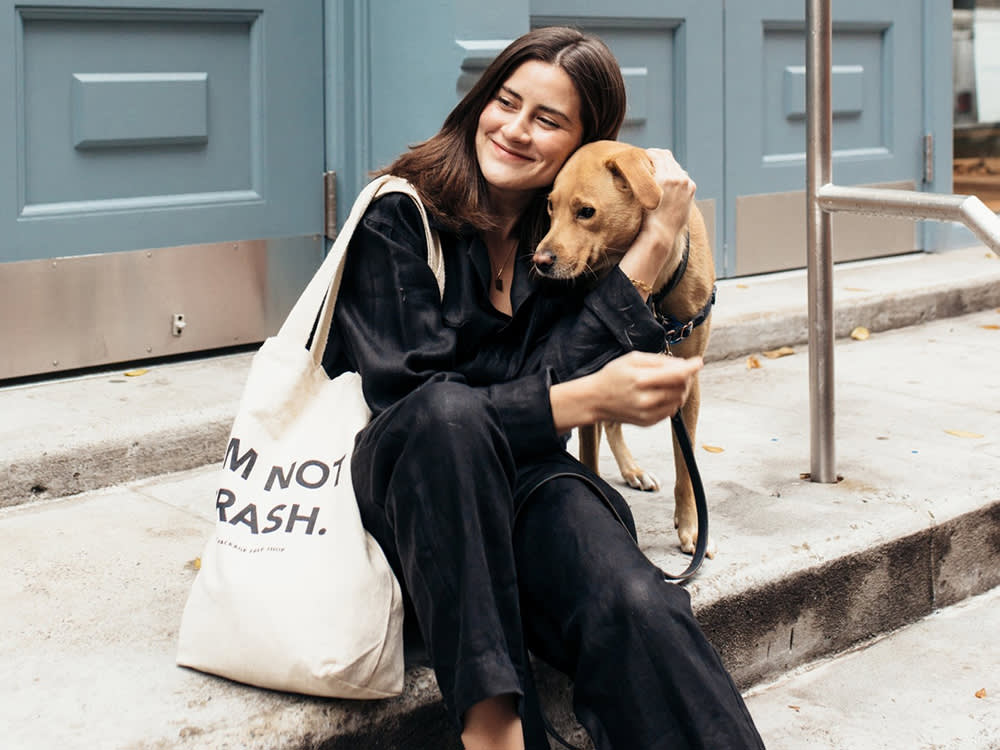
Every low-waste pet guide gives you the same undifferentiated list: bamboo bowls, thrifted toys, a beeswax something. It treats a $3 chew toy you replace twice a year as morally equivalent to the item you throw away three times a day, every day, forever.
It is not. Two categories account for nearly all of your dog’s waste footprint: poop bags and food packaging. Everything else in your bin is rounding error. So this list is ranked by volume, not virtue, and it starts where the trash actually is.
Lauren Singer is a useful guide here precisely because she has done the audit for real. The founder of Trash Is for Tossers and Package Free famously fit years of her own garbage into a jar, and then adopted a rescue named Rose and discovered that a dog fills a trash can with startling efficiency. What follows is what she actually changed, reordered by what actually matters, plus the label problem she is too polite to make a fuss about.
1. Poop bags: the thing you throw away 1,000 times a year
Two walks a day, one bag each, is roughly 700 bags a year, and that number does not care how good your bamboo bowl is.
Singer’s position is measured: bioplastic compostable bags are an imperfect answer, and she still takes them over the petroleum-based standard. Her own pick is Boba & Vespa, sold through Package Free, whose bags are built from maize flour plus vegetable oil.
Here is the part that almost nobody tells you. A compostable bag only composts if it reaches a facility that will take it, and almost none will take dog waste. Fewer than five percent of composting sites in the US accept pet waste at all, because of the pathogen risk to the finished compost. So a certified compostable bag that goes into a municipal green bin gets pulled out and landfilled, where it does roughly what a plastic bag does.
Which means the bag is only a real upgrade if you do one of these:
- Home-compost it, in a dedicated pet-waste system, separate from anything you will ever put on food crops.
- Live somewhere with a separate pet-waste collection stream. Singer’s Brooklyn composting program runs separate collections for pet waste, which is genuinely uncommon and absolutely worth calling your program to ask about.
Also, learn the two words. “Biodegradable” is a marketing term with essentially no regulation behind it in the US, and the FTC has previously gone after dog-waste-bag marketers for exactly that unqualified claim. “Compostable” at least points at a standard, ASTM D6400 for industrial composting or a home-compostable certification, which is a much harder bar. If a bag says biodegradable and nothing else, you are buying a word.
2. Food packaging: cook, or buy bigger
Singer’s answer is to cook. Every week she boils chicken and vegetables for Rose, which she says saves an enormous amount of packaging and a great deal of money. Her line on it: the dog eats the same food she would eat, and sometimes eats better than she does.
The honest caveat, because this is a health decision and not just a waste one: a home-cooked diet that is not formulated by a veterinary nutritionist will drift out of balance, usually on calcium, phosphorus, and a handful of vitamins, and the effects take months to show up. If you want to cook, do it with a formulated recipe.
“Home-cooked is a completely legitimate way to feed a dog, and it is also the easiest one to get quietly wrong,” says Dr. Lena Park. “Get the recipe balanced by someone who does this professionally, then cook it for the next ten years. The waste savings are real. The nutrient gaps are also real.”
If cooking is not happening, the next best move is unglamorous: buy the biggest bag your dog will get through before it goes stale, and check whether the brand runs a mail-back recycling program for its packaging. Bag size is the single highest-leverage packaging decision most people never think about.
3. Treats: the byproduct argument
Singer’s low-waste treat of choice is bully sticks. Her reasoning is that they are unpleasant to think about but genuinely a byproduct of the animal agriculture industry, so using them reduces overall waste rather than creating new demand. Rose loves them, and chewing helps with plaque.
The practical note nobody mentions: bully sticks are calorie-dense. A large one can carry a meaningful share of a small dog’s daily calories, so it is a treat, not an accessory.
4. Toys: go to the tennis court, with one caution
Instead of buying toys, Singer goes to the neighborhood tennis court. Players cycle through balls constantly and want newly inflated ones, so facilities tend to have piles of slightly deflated cast-offs. Not Wimbledon-ready, perfectly fine for fetch.
The caution the source doesn’t give you: tennis ball felt is abrasive. It picks up grit, and dogs who chew and carry tennis balls obsessively for years can grind down their molars, a pattern vets refer to as tennis ball mouth. Fetch is fine. A tennis ball as a dedicated all-day chew toy is not. If your dog is a chewer rather than a fetcher, use a rubber toy for chewing and save the free tennis balls for throwing.
Singer’s other toy strategy is to skip the toy entirely: rather than buying things Rose plays with alone, she takes her on walks and chases her around the park. Free, zero-waste, and better for both of them. After two years of being stuck inside, she has said her priority is getting them both out into nature, the trees, the dirt, the sand, the grass.
5. Beds: buy one washable thing
Rose’s bed is a Hunting Pony piece, built from linen and wicker, shaped like a small house. Singer’s reason for liking it is that it washes. Rose’s reason is that it is an enclosed hideout of her own.
The waste logic on beds is simple and it is about the cover, not the material: a bed with a removable, washable cover survives the incidents that send a non-washable bed to the curb.
6. Leashes and collars: leather over synthetic
Singer buys natural leather leashes and collars rather than synthetic ones, because leather eventually breaks down instead of sitting in a landfill forever. Durability is the underrated half of that argument. A leather leash that lasts a decade beats three nylon ones.
For clothes, Rose has a handmade jacket made from recycled materials for cold days, though Singer notes the dog would frankly prefer to be nude. When Rose outgrows a piece, Singer asks around her apartment building or donates it to a shelter rather than tossing it.
7. Pee pads: reusable, if you have the foresight
Singer got Rose in a hurry and did not have time to source a low-waste version, so the early days were a run of trashed disposable pads. With hindsight, she would go straight to a washable pad, a category Etsy is full of. Wash them separately, on hot.
8. Bathing and grooming: use your own soap
When Rose needs a wash, Singer typically uses the same liquid soap she uses herself. Castile soap is a plant-based option that works for people and pets, and it comes in refillable glass.
One caveat worth stating: a dog with diagnosed skin disease should be on a shampoo their vet chose, not a general-purpose one. For a healthy dog, plain castile is fine.
For brushing, she uses a hand-me-down FURminator. She is clear-eyed that the tool is plastic, and equally clear that it is extremely good at collecting fur, which then goes into the compost pile. Pet hair and nail clippings are compostable, which is a genuinely delightful fact and one of the few free wins on this list.
Where to actually start
Singer’s own advice is the right closer, and it is anti-heroic: begin with one small change and let the rest wait. Whichever of these categories empties first, replace it with the better version, and leave the rest alone until they do.
If you only do one, do the poop bags, and call your composting program before you buy them. That single phone call determines whether the upgrade is real or decorative.
References
- Federal Trade Commission. “FTC Charges Marketers of Dog Waste Bags With Making Deceptive Biodegradable Claims.” https://www.ftc.gov/news-events/news/press-releases
- Federal Trade Commission. “Green Guides.” https://www.ftc.gov/news-events/topics/truth-advertising/green-guides
- ASTM International. “ASTM D6400: Standard Specification for Labeling of Plastics Designed to be Aerobically Composted in Municipal or Industrial Facilities.” https://www.astm.org/d6400-23.html
- US Environmental Protection Agency. “Composting at Home.” https://www.epa.gov/recycle/composting-home
- American Veterinary Medical Association. “Selecting the Right Pet Food.” https://www.avma.org/resources/pet-owners/petcare/selecting-pet-food-your-pet
Nina Vasquez writes about life at home with pets and the relationships at the heart of it. Her work covers day-to-day living, people-and-pet stories, and the products that fit into a real household, with a warm, grounded take on everyday pet ownership.
Meet our experts ↗Keep reading
 Product Picks7 American-Made Pet Brands Worth Your Memorial Day DollarsLeila Torres · 6 min
 Product Picks'Pet-Safe' Bug Spray Isn't Pet Spray. Read That Before You Buy.Sara Lim · 7 min
 LivingPride Gear for You and Your Dog: 20 Picks That Give BackJordan Ellis · 10 min
 Product PicksA Designer Dog Collab Lives or Dies on a Hole in the BackSasha Ford · 6 min
 Product PicksHer Fleece Sparks $1,000 Bidding Wars. The Dog Version Is $165.Sara Lim · 5 min
 LivingWhy the Dog Pee Smell Keeps Coming Back (and the One Thing That Kills It)Nina Vasquez · 7 min