


'Pet-Safe' Bug Spray Isn't Pet Spray. Read That Before You Buy.
Wondercide's mosquito kit works, and we'd buy it again. But almost everyone misreads what it's for, and the misunderstanding is the dangerous part.

Affiliate disclosure. This article contains affiliate links. We may earn a small commission if you buy through a link, at no extra cost to you. How we handle recommendations.
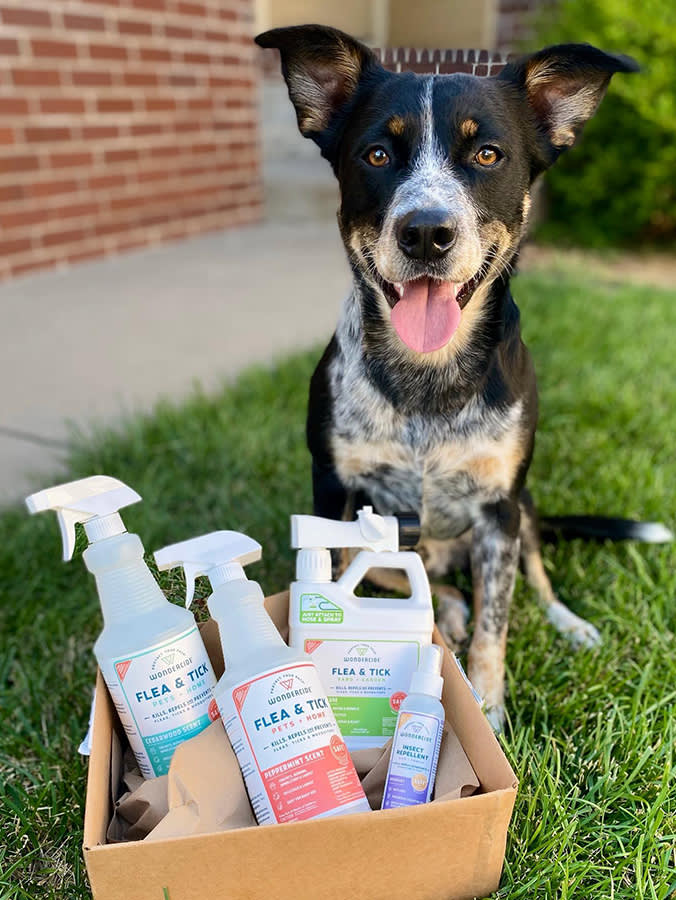
Here is the sentence that gets misread on every pet-safe pest product on the market:
“Safe to use around your pet” is not “safe to use on your pet.”
That distinction is doing an enormous amount of work, and it is the reason to read a label rather than a box. Wondercide’s Complete Control Mosquito Kit is a good product. We’d use it. But what it actually does is protect a space and a person, and if you buy it thinking you’re buying protection for your dog, you have bought the wrong thing and you may skip the thing that would have worked.
So: what it is, what it isn’t, and whether it’s worth $54.
What’s in the box
The kit is two products, not one.
A 32-ounce ready-to-use lawn treatment, which covers up to 5,000 square feet. It’s cedarwood-oil based, and it’s the piece doing the heavy lifting.
Two 4-ounce bug sprays, and these are for people, full stop. For your skin, before you go out.
Neither of those goes on the dog. Neither of them is a flea-and-tick treatment for an animal. Wondercide makes those separately, and confusing the bottles is the classic error.
The lawn spray comes in Cedarwood, Lemongrass, Peppermint, and Rosemary. If your yard is bigger than 5,000 square feet, there’s a concentrate you mix with water in the same 32-ounce bottle, which also means you’re not buying a new plastic sprayer every time. That’s a small thing and a genuinely good one.
Does it work?
Ours did, and the test was not subtle: treat the lawn a few hours before dusk, keep the dogs inside while spraying and until it settles, then go sit outside at the hour when the yard is normally uninhabitable.
The yard was dramatically less mosquito-y. It also smelled like cedar, which is a real perk nobody mentions. The human spray held up on walks about as well as the DEET spray it replaced.
One honest limit, and it’s an important one: the human spray is noticeably less impressive once you leave the treated lawn. In a treated yard, the whole system works. Out on an untreated trail at dusk, don’t expect the same performance you’d get from a conventional repellent. That’s the trade you’re making, and it’s worth knowing before you go camping with it.
Why cedarwood oil actually does something
This is not a scented-water situation, and the mechanism is more interesting than “bugs don’t like the smell.”
Cedarwood oil interferes with octopamine, a neurotransmitter that pheromone-driven insects like fleas, ticks, and mosquitoes depend on. Mammals don’t have an octopamine system, which is the basis of the “safe around pets and people” claim. Wondercide also argues that beneficial pollinators like bees and butterflies don’t rely on octopamine in the same way and aren’t affected by dried residue as directed.
The active ingredient list on the ready-to-use outdoor spray is public: cedarwood oil 12.63%, sesame oil 2.73%, sodium lauryl sulfate 1.09%. That is not a homeopathic dose. It’s a real concentration of a real active, which is why it smells like a lumber yard and why it does something.
The regulatory thing nobody explains
Wondercide’s products are not registered with the EPA, and the company says so plainly: it represents that the product qualifies for exemption from registration under FIFRA.
That’s the minimum-risk pesticide exemption, commonly called 25(b). It’s a category the EPA created for products made from a defined list of low-risk ingredients, mostly food-grade oils. Products in it skip federal registration.
Here’s the honest reading, in both directions:
- It does not mean the product is unsafe or unregulated. The ingredient list is constrained, and the exemption exists precisely because these actives are low-risk.
- It does not mean the EPA has verified that it works. Efficacy data isn’t reviewed. Nobody at a federal agency has checked the claims on the bottle.
So the evidence you have is the mechanism, the concentration, and your own yard. That’s a reasonable basis for a purchase. It is not the same as a registered product’s tested performance, and you should not let a “plant-based” label do more work in your head than it deserves.
The part that actually matters for your dog
Mosquitoes are not merely annoying to dogs. They are the transmission route for heartworm, and heartworm disease is expensive, dangerous, and in advanced cases fatal.
A repellent reduces bites. It does not eliminate them, and heartworm takes exactly one infected bite.
A pet-safe mosquito product is not a heartworm preventive and can never be one. If reading a review of a plant-based mosquito kit gives you any feeling of “we’ve got this covered now,” that is the feeling to distrust. Your dog’s heartworm protection is the monthly (or injectable) preventive your vet prescribes, year-round, and this kit is a comfort measure sitting on top of it.
“Every summer I meet an owner who has been diligently spraying the yard and quietly skipping the preventive, because the yard felt like the more natural choice,” says Dr. Amara Solis. “Fewer mosquitoes is a wonderful thing and it is not protection. One bite is the whole story with heartworm, and by the time you know it happened, you are looking at a treatment nobody wants.”
Where it came from
Wondercide exists because of a dog getting sick. Founder Stephanie Boone built the company after her own dog became ill, which she attributed to a combination of the flea-and-tick product her vet had recommended and the routine pest-control service treating her property. The patented essential-oil blend came out of that.
Whether that origin story influences your purchase is up to you, but it’s worth knowing that the “pet-safe” positioning isn’t a marketing afterthought. It’s the reason the company exists.
Should you buy it?
Buy it if: you have a yard you cannot use at dusk, you’re uncomfortable with conventional yard pesticides, you have pets or kids playing on the grass, and you’re willing to reapply through the season.
Skip it if: you’re looking for something to put on your dog (buy Wondercide’s pet-specific flea-and-tick spray instead), you need serious repellency in untreated wilderness, or you want a set-and-forget solution.
Never treat it as: heartworm protection.
Applied honestly, within its actual job description, it’s one of the few “natural” pest products we’d spend our own money on twice.
Shop it
- Wondercide Complete Control Mosquito Kit — $54, direct from Wondercide (yard treatment plus two human repellents)
- Wondercide Ready-to-Use Outdoor Pest Control Spray, 32 oz — the yard component on its own
- Wondercide Insect Repellent for People, Cedarwood, 2-pack of 4 oz — the human sprays on their own
- Wondercide Outdoor Pest Control Concentrate, 32 oz — for yards over 5,000 sq ft, and less plastic
What’s new since this was written
Two things worth updating.
First, the regulatory picture has become a live conversation rather than fine print. Plant-based pest products sold under the 25(b) exemption have drawn increasing scrutiny precisely because “EPA-exempt” reads to shoppers like “EPA-approved,” and it is closer to the opposite. Nothing about that makes cedarwood oil less effective. It does mean the burden of proof sits with your own yard, not with a federal reviewer.
Second, the mosquito problem is not shrinking. Warming temperatures continue to extend mosquito season at both ends, which means the “one treatment in June” model no longer matches reality in much of the country. Plan for reapplication across a longer stretch of the year than you used to, and plan for year-round heartworm prevention regardless of what your yard smells like.
References
- “Complete Control Mosquito Kit with Natural Essential Oils.” Wondercide. wondercide.com
- “Ready-to-Use Outdoor Pest Control Spray.” Wondercide (active ingredient statement). wondercide.com
- “Minimum Risk Pesticides Exempt from FIFRA Registration.” U.S. Environmental Protection Agency. epa.gov
- “Heartworm Basics.” American Heartworm Society. heartwormsociety.org
Common questions
Does a mosquito repellent replace heartworm prevention?
No, and this is the part worth being blunt about. Heartworm is transmitted by mosquitoes, and no repellent, natural or chemical, is a substitute for a vet-prescribed heartworm preventive. Fewer bites is not zero bites, and one bite is all it takes.
Is it EPA-approved?
No, and it doesn't have to be. Wondercide's essential-oil formulas qualify for FIFRA's minimum-risk exemption, often called 25(b), which means the EPA doesn't require registration and hasn't reviewed efficacy data. It's a regulatory category, not a safety rating in either direction.
How long does the yard treatment last?
Expect to reapply. Wondercide's own guidance for an active problem is two applications within 2 to 10 days, and rain resets the clock. Treat it as a maintenance job across mosquito season, not a one-and-done.
Sara Lim leads our Product Picks coverage, testing and comparing the things pets and their owners actually use. From everyday essentials to home-and-style finds, she focuses on honest, useful recommendations rather than hype.
Meet our experts ↗Keep reading
 LivingYour Dog's Trash Is Mostly Two Things. Everything Else Is a Rounding Error.Nina Vasquez · 8 min
 Product Picks6 Eco Cat Swaps That Don't Feel Like a SacrificeSara Lim · 5 min
 Living"Eco-Friendly" Cat Gear Is Mostly a Sticker. 6 Swaps That Aren't.Nina Vasquez · 8 min
 Living'Recycled' Is Doing a Lot of Work on That Label. 8 Pieces That Earn It.Leila Torres · 6 min
 Product PicksThe Escape-Proof Collar Shelters Swear By Comes From a Town of 400Nina Vasquez · 5 min
 Product Picks'Natural' Pet Care Is a Word Nobody Checks. Read the Back of the Bottle.Dr. Amara Solis · 7 min