


"Eco-Friendly" Cat Gear Is Mostly a Sticker. 6 Swaps That Aren't.
Your cat's footprint is almost entirely litter, and almost nobody talks about it. Here's what actually moves the needle, and the green claims that are doing nothing.
Affiliate disclosure. This article contains affiliate links. We may earn a small commission if you buy through a link, at no extra cost to you. How we handle recommendations.
Most sustainable pet shopping guides are a list of nice objects with the word “bamboo” in them. Yours is not the problem.
If you want to know where a cat’s environmental footprint actually sits, the answer is boring and enormous: it is the litter box. Everything else, the toy, the collar, the bowl, is a rounding error you buy once. The litter is a thing you buy again every three weeks for eighteen years, and it is the only part of your cat’s life that generates industrial-scale material flow in both directions, mined in and landfilled out.
Americans send an estimated two million tons of cat litter to landfill every year, most of it clay that will still be there long after the cat and the person are both gone.
So this list is organized by leverage. The first swap matters more than the other five put together. Then there is a section on the green claims that are quietly doing nothing, which is the part you actually needed.
The swap that counts
1. Get off strip-mined clay
Check it on Amazon ↗ — $25
Conventional clumping litter is sodium bentonite, and it is strip-mined. That means scraping off soil, rock, and vegetation to reach the clay beneath, which permanently reshapes the landscape, displaces wildlife, and sends runoff into local water. Pet waste absorbents are a genuinely significant slice of U.S. bentonite demand, not a niche use. After extraction the clay is kiln-dried, an energy-hungry step usually running on natural gas.
And then it does not break down. Ever.
Sustainably Yours is a corn-and-cassava clumping litter, which is the key phrase: it clumps like clay, so you are not asking yourself or your cat to accept worse performance for virtue. That matters more than any other spec, because a plant litter your cat refuses to use is a plant litter that ends up in the bin with a bag of clay next to it.
If your cat is fussy, switch slowly. Mix a quarter of the new litter into the old, hold for a week, then a half, then three-quarters. Cats reject sudden substrate changes, and a litter-box protest is a bigger environmental event than the litter ever was.
One critical caveat that applies to every plant litter on the market: do not flush it, even if the bag says you can. Cat feces can carry Toxoplasma gondii, and the oocysts survive wastewater treatment. Flushed cat waste has been implicated in T. gondii infection in wild marine mammals, including California sea otters. Scoop it, bag it, bin it.
The five that are worth doing anyway
Stop the wasteful water habit
A cat with a fountain drinks more, and a cat who drinks more is a cat with a lower risk of the urinary and kidney problems that define feline old age. The environmental case is oblique but real: the highest-footprint thing that happens to most cats is chronic illness, which means years of prescription food, packaging, medication, and clinic visits.
It also, in the more immediate sense, stops your cat from staging a protest in the bathtub because the still bowl is beneath her.
Replace the filters on schedule and wash the reservoir. A biofilm-lined fountain is worse than a clean bowl.
Grow the thing she is going to chew anyway
A cat who has grass will chew grass. A cat who has no grass will chew the pothos, and a large number of common houseplants are toxic to cats.
Grown at home from organic seed, it is untreated, it costs almost nothing per harvest, and the whole thing composts when it is done. It is also the rare “sustainable” purchase where the sustainable version is the cheap version, because you are growing the product rather than shipping it.
Keep it in rotation. Two trays, one growing, one being eaten, and you are never in the gap where she goes back to the philodendron.
Buy the toy she’ll actually kill
Here is the quiet truth about cat toys: your cat prefers the box. Most cats are not discriminating about their prey substitutes, which means the sustainable choice, a recycled or natural-fiber toy over injection-molded plastic, costs you nothing in enjoyment.
This one is straw and catnip, and it is the right shape and weight for the bat-and-chase reflex. The plastic crinkle-mouse she loses under the sofa in ten minutes was never delivering more joy than this. It was just louder about it.
Skip the bath, keep the wipes
Cats groom themselves and most of them should never be bathed. A brush handles the majority of what a cat needs. Wipes cover the rest: the outdoor cat coming in, the senior who has stopped reaching her back end, the long-haired cat with an incident.
Fragrance-free is not a preference, it is the point. Cats are unusually sensitive to added fragrance and to a number of ingredients that are fine on dogs, and a scented wipe on an animal who is about to lick every inch of herself is a dosing decision, not a grooming one.
Put a recycled collar on her, with a breakaway
Made from recycled bottles and cork cloth, which is exactly the right category for a cat accessory: the material is post-consumer, and the object is small, cheap, and long-lived.
The non-negotiable feature is not the recycled content, though. It is the breakaway buckle, which releases if the collar snags. A cat who climbs is a cat who will eventually catch her collar on a branch, a fence, or a piece of furniture, and a collar that does not release is a strangulation risk. Never put a fixed-buckle dog collar on a cat.
This is a Petco house brand and is not available on Amazon.
The green claims that are doing nothing
This is the section the original version of this list needed and did not have.
“Biodegradable” bags, mostly. The word is close to meaningless on packaging, because there is no requirement that it happen on any particular timescale or in any particular environment. The word that means something is compostable, certified to ASTM D6400 or equivalent. And even then: almost no municipal composting program accepts pet waste, so a certified compostable bag full of cat feces goes into the same landfill as a plastic one, where the anaerobic conditions mean it will not meaningfully break down either. Buying a green bag is not wrong. It is just not the environmental action you think you took. The litter is.
“Natural” as a safety claim. It is not a regulated term and it tells you nothing about toxicity. Some essential oils marketed as natural cat care are genuinely hazardous to cats, whose livers lack an enzyme pathway that most mammals use to clear certain compounds. Tea tree oil in particular has a well-documented record of poisoning cats. Natural is not a synonym for safe, and in cats it is sometimes the reverse.
Bulk-buying as virtue. Buying nine hundred of something is only a win if you use nine hundred of it. Bulk purchases of anything with a shelf life, wipes, food, treats, are one of the most common ways well-intentioned households generate waste.
“The sustainability question people ask me is about packaging, and the one that matters is about the litter box,” says Dr. Lena Park. “A cat who is comfortable using a plant-based litter, and whose waste is bagged rather than flushed, has done more than a whole cupboard of eco-labeled accessories.”
What newer research adds
Two things are worth knowing since this list was first assembled.
Plant-based clumping litters have gotten substantially better, and that is not a marketing line. The first generation of corn, wheat, and paper litters clumped badly and tracked everywhere, which is why so many people tried them once and went back. Current formulations clump firmly enough that the switch no longer feels like a sacrifice, and cat acceptance, the variable that actually determines whether a green product stays in the house, is much higher.
Second, the case against flushing has hardened. The link between Toxoplasma gondii from cat feces and infection in wild marine mammals is now well documented in the literature, and it applies to flushable-labeled litters too. If you take one thing from this article, make it that one: scoop, bag, bin. The bag is the least of it.
References
- U.S. Geological Survey, “Mineral Commodity Summaries: Clays (Bentonite).” https://www.usgs.gov/centers/national-minerals-information-center/clays-statistics-and-information
- Conrad, P. A., et al. “Transmission of Toxoplasma: Clues from the study of sea otters as sentinels of Toxoplasma gondii flow into the marine environment.” International Journal for Parasitology, 2005. https://pubmed.ncbi.nlm.nih.gov/16143336/
- ASTM International, “D6400: Standard Specification for Labeling of Plastics Designed to be Aerobically Composted in Municipal or Industrial Facilities.” https://www.astm.org/d6400-23.html
- Bischoff, K., & Guale, F. “Australian tea tree (Melaleuca alternifolia) oil poisoning in three purebred cats.” Journal of Veterinary Diagnostic Investigation, 1998. https://pubmed.ncbi.nlm.nih.gov/9576358/
- Cornell Feline Health Center, “Feeding Your Cat” and “Lower Urinary Tract Disease.” https://www.vet.cornell.edu/departments-centers-and-institutes/cornell-feline-health-center
Nina Vasquez writes about life at home with pets and the relationships at the heart of it. Her work covers day-to-day living, people-and-pet stories, and the products that fit into a real household, with a warm, grounded take on everyday pet ownership.
Meet our experts ↗Keep reading
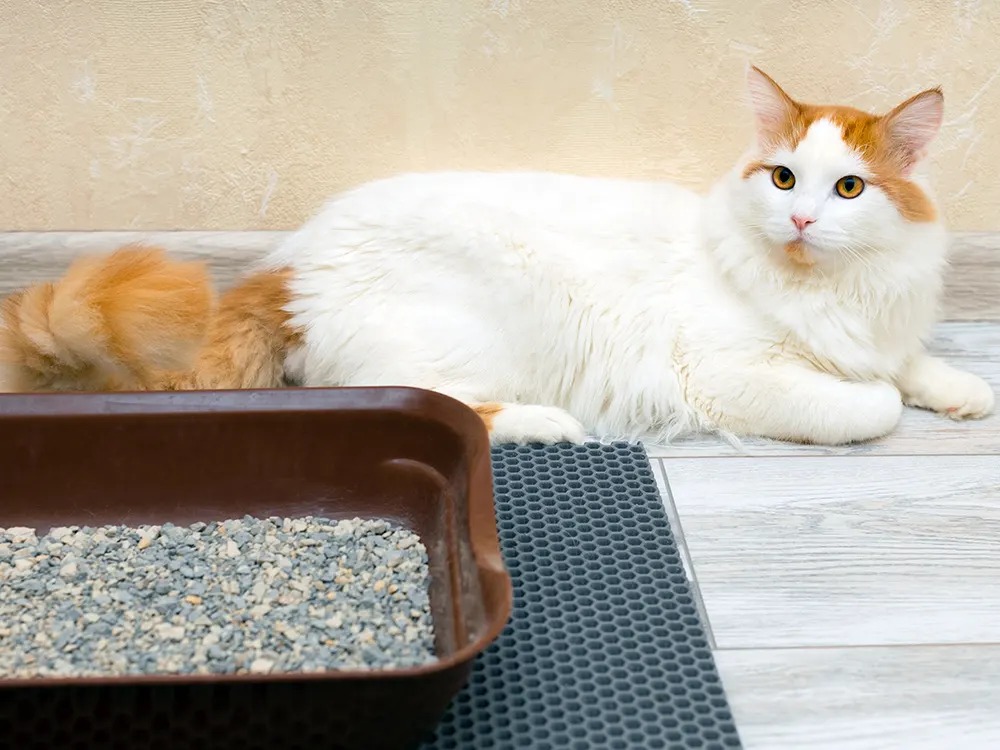 Product PicksLitter Tracking Ends at the Mat. 8 That Actually Trap the MessSara Lim · 7 min
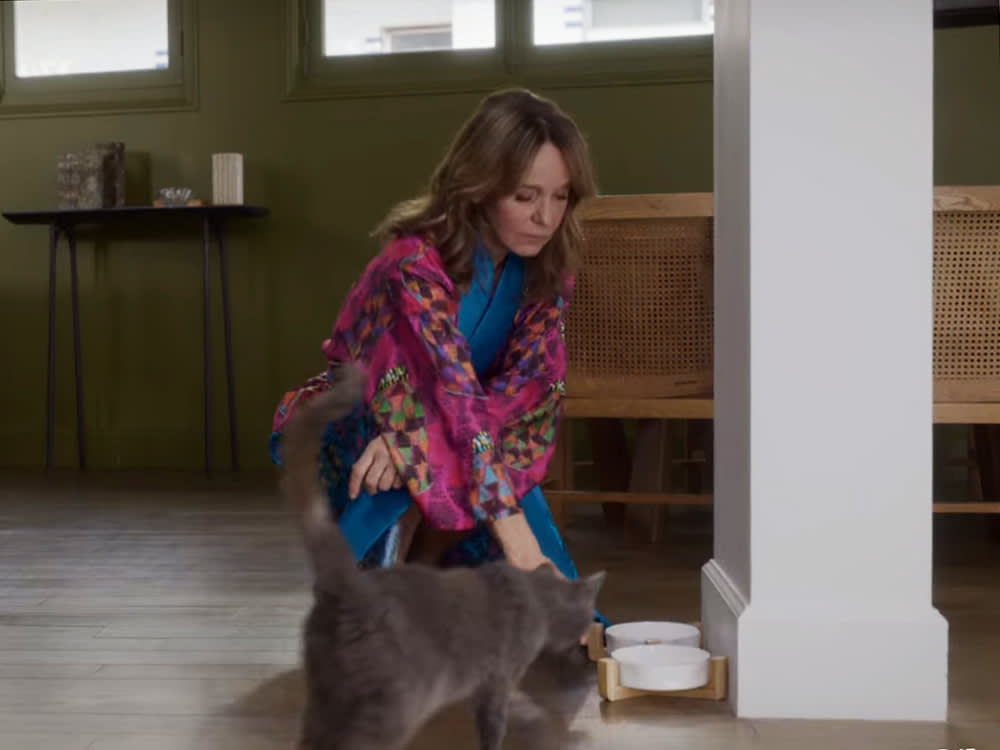 LivingYou Can't Buy Sylvie's Cat Bowl From Emily in Paris. Here's How to Nail the Look.Leila Torres · 3 min
 Product Picks'Pet-Safe' Bug Spray Isn't Pet Spray. Read That Before You Buy.Sara Lim · 7 min
 Product Picks7 American-Made Pet Brands Worth Your Memorial Day DollarsLeila Torres · 6 min
 Health & WellnessA Blind, Paralyzed Cat Isn't a Tragedy. It's a Setup Problem.Dr. Nina Kohl · 7 min
 Product PicksYour Cat Does Not Care About the Lid. 8 Boxes That Actually Fight Odor.Sara Lim · 10 min