


A Designer Dog Collab Lives or Dies on a Hole in the Back
Sandy Liang's six-piece collection with Little Beast ran $88 to $149 and looked like the runway. The reason it works has nothing to do with the color story, and one piece in it needs a safety warning.

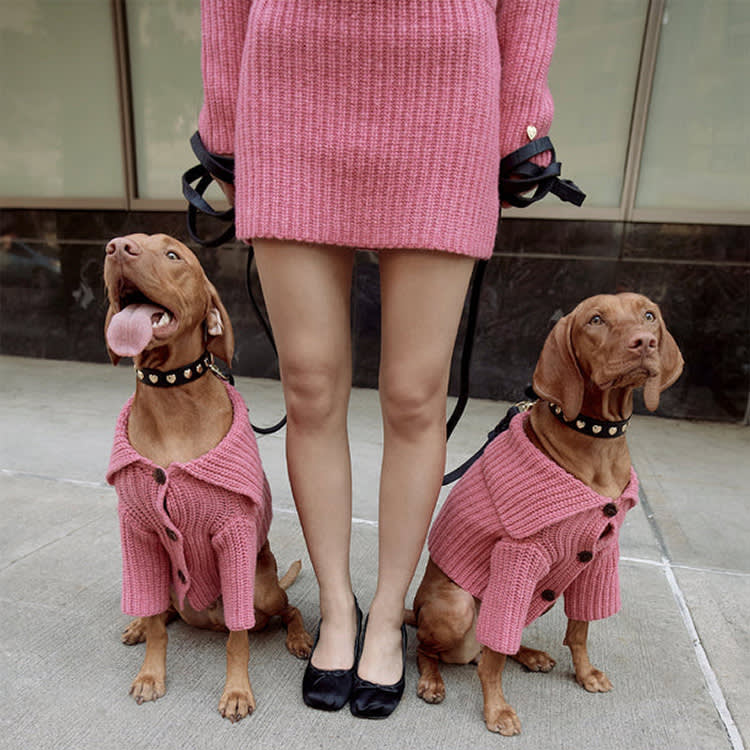
Every designer dog collection gets judged on the wrong thing. People look at the color, the silhouette, whether the tiny coat is a convincing miniature of the big one. Then they buy it, put it on the dog, clip the leash to the collar underneath it, and discover that the leash now runs under a layer of knitwear and the whole garment torques sideways on the first pull.
There are three details that decide whether dog clothing is clothing or a costume, and none of them photograph well:
- A leash port. A reinforced opening at the back that lets a harness or collar ring come through the garment. Without it, the leash goes under the coat, and the coat becomes a rope.
- A closure that survives a dog. Something the dog cannot back out of, and that you can operate one-handed while the dog spins.
- Somewhere to put the bags. This sounds like a joke. It is not. A pocket sized for a couple of plastic baggies is the difference between a coat you use and a coat you admire.
Which is a long way of saying that the Sandy Liang x Little Beast collection is worth studying, because it passed the test that most of the category fails.
What was in it
Six pieces, priced from $88 to $149, riffing on items from Liang’s Fall 2023 collection. The greatest hits:
The Lil Grass Fleece. The one that matters. It is a dog-scale version of Liang’s Grass Fleece, with white floral patches, and, crucially, two things almost nobody bothers with: a reinforced opening in the back panel so a leash can clip straight through, and a small zip pocket, sized to hold a couple of green plastic baggies and nothing else. That is the entire thesis of this article, executed in one garment. A designer who puts a bag pocket on a dog coat has watched someone walk a dog.
The Lil Bommy Puffer. A canine-sized version of the red Bommy Puffer (and its matching pants) that walked Liang’s New York Fashion Week runway in February 2023. Puffers are the easiest category to get right thermally and the easiest to get wrong mechanically, since the loft eats the harness.
The Lil Mulled Cardigan, in carnation pink or hojicha. Chunky knit wool, with human equivalents, cropped cardigans and matching skirts, sold on Liang’s own site and in her Lower East Side store. This is the one with the safety asterisk. More on that below.
The Lil Rivetto Collar. Vegetable-tanned Italian leather with gold-plated iron studs and hardware.
The Fiji Tote. Heavy-duty canvas, a big floppy bow on the side, and a pink fleece-wrapped bottom insert for stability and coziness.
The one that needs a warning label
The cardigan has buttons. The collar has studs.
“Buttons, studs, and small hardware are exactly the objects I pull out of dogs’ stomachs,” says Dr. Ravi Mehta. “The dog does not chew the sweater because they hate the sweater. They chew it because it is on them and they are bored, and then a button is gone and nobody saw it happen. A garment with hard fittings is a supervised garment. It comes off when the dog is home alone, and it comes off in the crate.”
That is not a knock on the collection. It is true of every knit with a hard fastener, from a $149 designer cardigan to a $12 one. But dog clothing is sold with a photograph and no instructions, so: check the buttons before every wear, take the sweater off when you are not in the room, and if your dog is a chewer, buy the fleece instead of the knit.
The tote deserves its own line. It is a beautiful bag with a padded bottom, and it is not a carrier. It is not crash-tested, it does not secure to a seat belt, and it will not contain a dog who decides to leave. Use it the way it was designed, for a small dog you are carrying a short distance, and use a proper crash-tested crate or carrier in a car.
How the collab happened, which is the good part
Little Beast is a Brooklyn dog brand built on three things it says out loud: high style, sustainability, and manufacturing kept small and family-run. Its founder, Jisu Kim, was a fan of Liang’s, noticed she had a very cute dog, and did the least fashion-industry thing imaginable: she reached out cold, with the stated goal of getting Liang’s dog into Little Beast.
Liang wrote back, and by Kim’s telling she could not have been warmer. She even mailed over pieces from her own line. Then years went by. The two of them finally sat down together at Liang’s studio, talked for hours about anything that was not business, and it was only on the way out that Kim floated the idea of working together. Liang said yes right there.
There is a version of this story that gets told as networking. It is not. It is a founder in an unglamorous category asking for something with no leverage, and then waiting two years. The collection exists because somebody sent the email.
Why the dog piece has to be harder than the human piece
Liang’s clothes are nostalgic and girly and modern and minimal all at once, the kind of thing fashion editors and the Hadid sisters buy, and there is a genuine collectability to them. Translating that to a dog is not a matter of scaling the pattern down.
A human garment has one job: fit a body that stands upright, moves predictably, and can tell you when the sleeve is too tight. A dog garment has to fit a body with four moving limbs, a chest deeper than it is wide, and no ability to complain, while surviving mud, rain, a leash under load, and a dog who may decide to eat it.
That is why the leash port and the pocket are the tell. They are the details you only add if you have accepted that the dog is going to be used as a dog.
Liang is a dog person herself, she posts her dog Tim (also Timmy, also Tam) on her brand’s Instagram, so the attention paid to how a leash actually attaches is not an accident.
Before you buy any designer dog piece, run this
- Is there a leash port, or does the harness go underneath? If underneath, plan to size up and expect the coat to shift.
- Any buttons, studs, beads, or bows? Then it is supervised-wear only.
- Do they publish a chest girth measurement, or only a weight range? Weight is not shape.
- Can you get it on a wriggling dog with one hand? If it takes two people, it will live in a drawer.
- What happens when it is wet? Wool and canvas are not equivalent to a technical shell.
Pass all five and the price is a taste question. Fail the first two and it does not matter how good it looks.
What’s new since this was written
The designer-dog collab has gone from a novelty to a normal part of a fashion brand’s calendar, and the good news is that the mechanics have improved along with the marketing. Leash ports are close to standard now on anything above the cheapest tier. Bag pockets are still rare, and still the fastest way to tell whether a designer has ever actually walked the dog they are dressing.
What has not changed is the hardware problem. Buttons, studs, and decorative hardware on dog clothing remain a genuine foreign-body risk, and no amount of vegetable-tanned Italian leather makes an ingested stud less of an emergency. Buy the nice thing. Take it off when you leave the room.
References
- Little Beast. Sandy Liang x Little Beast.
- Sandy Liang. Official site.
- Vogue Runway. Sandy Liang Fall 2023 Ready-to-Wear.
- Harper’s Bazaar. Sandy Liang on building a downtown uniform.
- American Veterinary Medical Association. Foreign body ingestion in pets.
- Center for Pet Safety. Crate and carrier crash-test certification.
Sasha Ford is a certified cat behaviour consultant who has worked with shelters, catteries, and private clients across the country. They review all feline behaviour content at The Pet Times, with expertise in multi-cat households, indoor enrichment, and stress-related disorders.
Meet our experts ↗Keep reading
 Product PicksTwinning With Your Dog Is a Science. Here Are 10 Pairings That Prove It.Nina Vasquez · 7 min
 Product PicksShinola Made a Dog Collection, and It's Almost Too Nice for the DogSasha Ford · 4 min
 Product Picks7 Pieces of Dog Gear That Won't Wreck Your Living RoomSara Lim · 6 min
 LivingWhy the Dog Pee Smell Keeps Coming Back (and the One Thing That Kills It)Nina Vasquez · 7 min
 Product PicksThe Bridgerton Dog Collection Was Supposed to Sell Out. Two Years Later, It's Still Here.Leila Torres · 5 min
 Product PicksThe Pet Brand That Started on a Napkin and 411 Safety TestsLeila Torres · 6 min