


Her Fleece Sparks $1,000 Bidding Wars. The Dog Version Is $165.
Sandy Liang shrank her cult Checkers Fleece down to dog size and called it the Lil Fleece. The interesting part isn't the price. It's the line in the product description that tells you whether it will fit your dog at all.

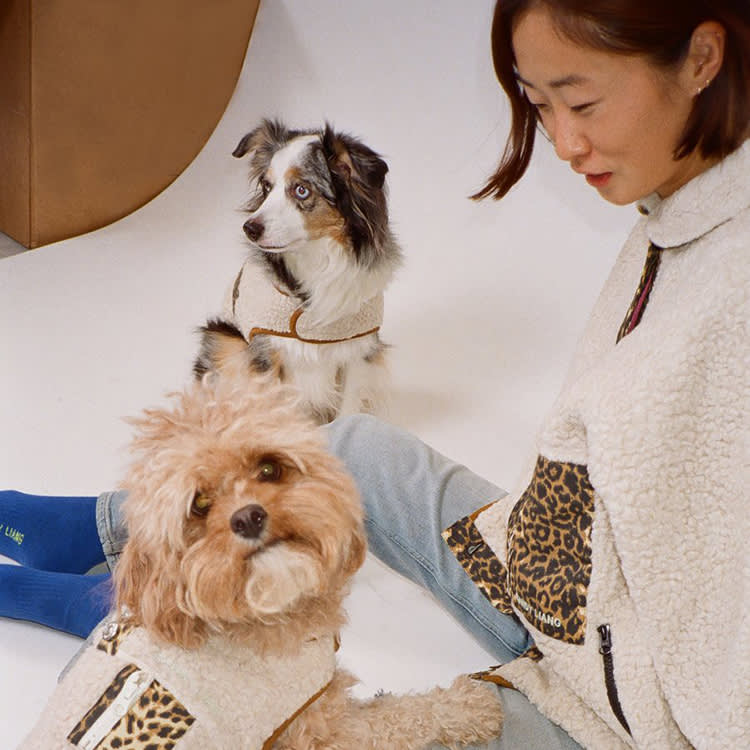
The Checkers Fleece is the piece that made Sandy Liang a household name in a very specific household: the downtown New York one, where the coat sells out, then reappears on eBay, where it has been known to touch $1,000 in a bidding war. New, it is $525.
The dog version is $165.
That is not a typo, and it is not quite the bargain it looks like either. The Lil Fleece is a real, tailored garment, not a novelty. It is spun from the same oatmeal-colored Italian wool as the human fleece, with the leopard-print pocket detail and trim intact, and it is cut for dogs from eight to 65 pounds.
Read that last part again, because it is the whole story.
Eight to 65 pounds is an enormous promise
One jacket, sized across a range that runs from a Chihuahua to a Golden Retriever. That is not unusual in dog apparel, and it is exactly where most dog apparel fails. Weight is a terrible proxy for shape. A 30-pound Corgi and a 30-pound Whippet are the same number and completely different animals: one is a long tube on short legs, the other is a deep chest on stilts. A jacket that fits one will gape, ride up, or bind on the other.
So before you spend $165, or $30, on anything your dog wears, get three numbers with a soft tape measure:
- Chest girth. The widest part of the ribcage, just behind the front legs. This is the number that actually decides fit, and it is the one people skip.
- Back length. Base of the neck (where a collar sits) to the base of the tail. A coat that runs past the tail interferes with squatting, which your dog will resent in a way you will notice.
- Neck. Where a collar sits, snug but with two fingers underneath.
Then check them against the brand’s actual size chart, not the weight range on the tag. If a brand only publishes weight, that tells you something about how much fit work they did.
The other test is mechanical, and it takes ten seconds in the store or in your hallway: can your dog take a full stride, sit, and lie down without the garment shifting? Watch the front legs. Most badly cut dog coats bunch in the armpits, and a dog who is being chafed under the elbow will not tell you, they will just stop wanting to go outside.
Which dogs actually need a coat
Fashion is a fine reason to buy something. But there is a real functional case here, and it is narrower than the pet-apparel aisle implies.
“Most healthy, thick-coated dogs are carrying their own jacket already, and adding one does nothing except make us feel useful,” says Dr. Nina Kohl. “The dogs who genuinely benefit are the thin-coated ones, the very small ones, puppies, seniors, and dogs who are sick or underweight. For those dogs, a coat in real cold is not a costume. It is thermoregulation.”
Rough triage, then:
- Buy the coat: short, single-coated breeds (Greyhounds, Whippets, Pit Bull types, Boxers, most terrier crosses with thin coats), toy breeds, puppies, seniors, and any dog recovering from illness or a heavy clip.
- Skip the coat: double-coated northern breeds, thick-coated working dogs, and any dog who is visibly happier in the snow than you are.
- Watch for the tell: shivering, lifted paws, a hunched back, a dog who stalls at the door and turns around. That is not stubbornness. That is a dog telling you the temperature.
And a coat is not a car heater. It buys you a comfortable walk, not an unlimited one.
The unglamorous part: it is wool
Italian wool is why the Lil Fleece feels like a garment instead of a pet product. It is also why it is a commitment. Wool that has been rolled in a wet park, dragged along a salted sidewalk, and slept on is going to need care, and it will not survive the treatment most dog clothes get, which is “hot wash, hot dry, repeat.”
Practical version: brush the dog out before the coat goes on, so you are not grinding shed hair into the fibers. Spot-clean rather than washing the whole thing. Follow the care label, which for a wool-and-leopard-trim piece almost certainly means cold, gentle, and no dryer. Salt is the real enemy in winter, so rinse the hem when you get in.
If that sounds like too much for a dog who body-slams into puddles, buy a technical shell for the mud and save the wool for the days you both want to look good. Nobody is grading you.
The matching-owner question
Liang’s Lil Fleece was designed as a shrunken version of a coat she already sells to humans, which puts it squarely in the matching-with-your-dog genre, a genre that has produced some crimes.
The reason this one mostly gets away with it: it is not a novelty print or a cartoon of a garment. It is the same fabric and the same details, cut for a different body. That is the line. Matching works when both pieces would be fine on their own and reads as a stunt when the dog’s version only exists to be photographed next to yours.
Liang, for what it is worth, has an Australian Shepherd named Timtam, which explains the amount of attention paid to a leash-friendly, actually-wearable cut rather than a doll costume.
What’s new since this was written
Designer dogwear stopped being a joke while nobody was looking. The Lil Fleece was an early, high-visibility example of a designer treating a dog garment as a garment, and the category has since filled with real collaborations, real fabrics, and real prices.
Which raises the bar rather than lowering it. When a dog coat cost $22 and looked it, nobody expected a size chart. At $165, ask for one. Ask for chest girth and back length in inches, ask how the coat handles the front legs, and ask what happens to the fabric after a wet winter. A brand that has thought about fit will answer all three without blinking. A brand that has only thought about the photo will send you back to the weight range on the tag.
References
- Sandy Liang. Official site.
- American Veterinary Medical Association. Cold weather animal safety.
Sara Lim leads our Product Picks coverage, testing and comparing the things pets and their owners actually use. From everyday essentials to home-and-style finds, she focuses on honest, useful recommendations rather than hype.
Meet our experts ↗Keep reading
 Product PicksTwinning With Your Dog Is a Science. Here Are 10 Pairings That Prove It.Nina Vasquez · 7 min
 Product PicksShinola Made a Dog Collection, and It's Almost Too Nice for the DogSasha Ford · 4 min
 Product Picks7 Pieces of Dog Gear That Won't Wreck Your Living RoomSara Lim · 6 min
 Product PicksThe Pet Brand That Started on a Napkin and 411 Safety TestsLeila Torres · 6 min
 LivingYour Dog's Trash Is Mostly Two Things. Everything Else Is a Rounding Error.Nina Vasquez · 8 min
 Product PicksA Trend Forecaster Reads Your Shopping. Her Best Dog Advice Isn't About Trends.Nina Vasquez · 6 min