


Your Dog Doesn't Need Another Puzzle. They Might Need the Opposite.
Treat puzzles rev dogs up. Lick toys wind them down. The Ubbe is built for the second job, and knowing which one you're buying is the whole decision.

Walk into any pet store and the enrichment aisle is one long argument for making your dog work harder. Puzzles, dispensers, sliders, snuffle mats: all of them sold on the same promise, which is that a tired brain equals a calm dog.
It is half true, and the half it gets wrong is why a lot of people end up with a dog who is more wound up after enrichment than before it.
Problem-solving toys are stimulants. Licking toys are sedatives. They sit next to each other on the shelf and do opposite jobs to your dog’s nervous system, and once you know which one you actually need, the buying decision makes itself.
Up Dog’s Ubbe is a licking toy. Here is when that is the right answer, and when it isn’t.
Two toys, two nervous systems
Up Dog is a Seattle company that got known for the Odin, a treat-dispensing puzzle with a minimalist look that held dogs’ attention for long stretches without a squeaker in it. It works the way a puzzle works: the dog manipulates the object, kibble comes out, the dog gets a hit of success, the dog tries harder. That loop is exciting by design. Excitement is the mechanism.
Which is great, right up until you use it on a dog who is already over-aroused. Then you have handed an anxious animal a slot machine.
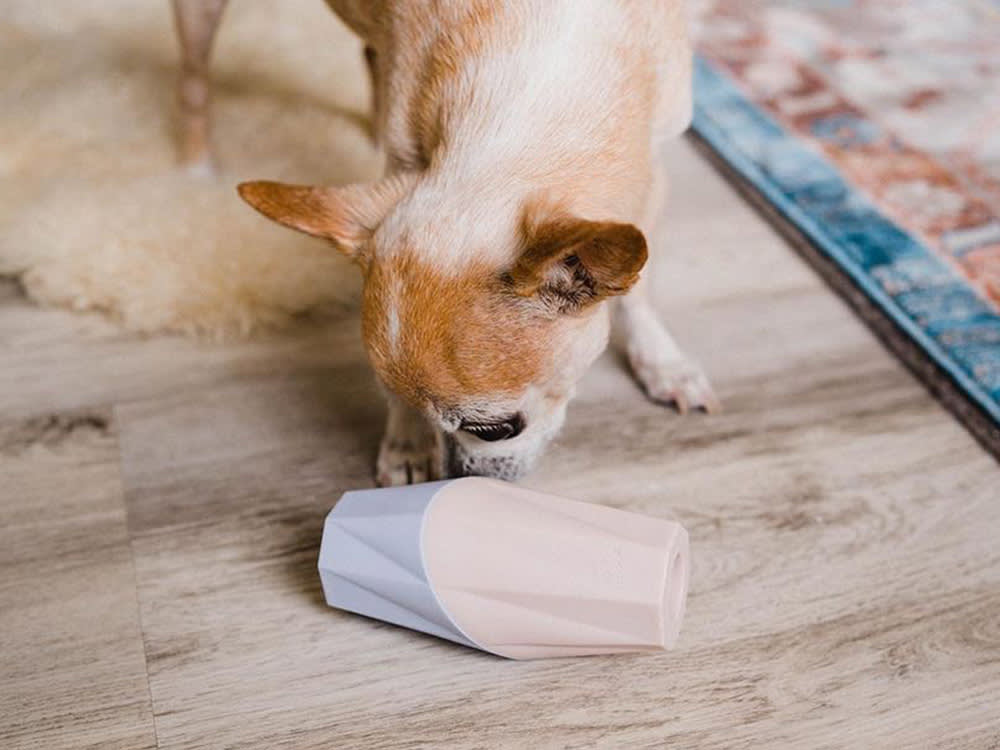
The Ubbe is the other tool. You do not fill it with kibble. You fill it with something wet and spreadable, wet food, peanut butter, yogurt, whipped cream, and set it on the floor. Your dog rolls it, flips it, and works their tongue into it, and what they are doing is not solving anything. It is repetitive, rhythmic, and slow.
That distinction matters more than any spec on the box. Sustained licking is a self-soothing behavior. It occupies the mouth, slows the breathing, and tends to bring a dog down. This is why lick mats have quietly become standard advice for nail trims, thunderstorms, and crate training, and why a puzzle feeder is exactly the wrong thing to hand a dog in those moments.
When to reach for which
Reach for the lick toy (the Ubbe, or a lick mat) when the goal is calm:
- crate training, especially the first weeks
- a dog who cannot settle when you are on a call or working
- storms, fireworks, or a noisy building
- distraction during grooming, nail trims, or ear cleaning
- winding down after a walk, rather than after a nap
Reach for the puzzle (the Odin, or a dispenser) when the goal is occupation:
- a bored, under-stimulated dog with energy to burn
- slowing down a fast eater at mealtime
- a rainy day when the walk got cut short
- a dog who needs a job and does not have one
Freeze it, and the lick toy becomes a much bigger tool. Load it, put it in the freezer, and the ten-minute activity becomes a thirty- or forty-minute one. That is the single most useful thing anyone will tell you about this category, and no packaging says it.
The Ubbe, specifically
Design. It comes in a pastel colorway Up Dog calls Ethereal Sky, and it looks less like a dog toy than like something you would put on a shelf on purpose. That is a real feature if your dog’s toys currently live in a basket you hide when guests arrive.
Fill. Built for liquid and semi-liquid food rather than kibble. Wet food, peanut butter, yogurt, pumpkin, whipped cream. The dog rolls and flips it, chasing the food around the interior with their tongue.
Cleaning. It is detachable, which is the whole ballgame. Anyone who has tried to excavate dried peanut butter from a one-piece rubber toy with a bottle brush knows exactly why. It is also dishwasher safe, top rack recommended.
Material. TPR, thermoplastic rubber, a blend of rubber and plastics. Non-toxic and free of BPA, phthalates, and latex. Sturdy enough to be aimed at destructive players.
Giving back. Up Dog donates a portion of proceeds from every Ubbe sold to the Humane Society, as it does with the Odin.
What we would check before buying
A few things the marketing will not tell you, applicable to any lick toy:
Match the fill to the dog, not the toy. Peanut butter is calorie-dense and it adds up fast in a dog who gets one every day. Plain, unsweetened yogurt, pumpkin puree, or your dog’s own wet food are lighter options. And check the peanut butter label for xylitol, which is lethal to dogs and still turns up in “no sugar added” spreads.
Subtract it from dinner. A daily lick toy is a meal component, not a bonus. If you do not subtract it, you have bought a weight-gain device with a nice colorway.
Supervise the serious destroyers. “Ideal for destructive players” is a claim about the material, not a guarantee. A dog who is determined to shred rubber will eventually shred rubber. Watch the first few sessions, and retire any toy that starts losing pieces.
Do not buy it for a dog who needs the other thing. If your dog is bored out of their mind and physically under-worked, a lick toy is a nice ten minutes and not a solution. That dog needs a walk, a sniffari, or a puzzle, and no amount of yogurt is a substitute for a job.
What newer research adds
The lick-toy-as-calming-tool idea started as trainer folklore and is now on considerably firmer ground.
The best-supported piece is the enrichment-and-mood link: work on canine scent and foraging activities has found that dogs given regular opportunities to use their noses and forage for food become measurably more optimistic on cognitive bias tests, the standard way researchers ask an animal whether it expects good outcomes or bad ones. Enrichment is not just occupation. It appears to shift emotional state.
The specific licking mechanism is less studied than the internet implies, and it is worth being honest about that. What is well established is the flip side: compulsive, obsessive licking is a symptom, not a hobby. A dog who licks surfaces excessively, licks their own paws raw, or cannot stop is telling you something, and the differential includes gastrointestinal disease, pain, allergies, and anxiety. Research has repeatedly found underlying medical causes in dogs presented for excessive surface-licking behavior.
So the rule is simple. A lick toy is something your dog enjoys for twenty minutes and then walks away from. If your dog cannot walk away from licking, that is not a toy problem. That is a vet appointment.
References
- Duranton, C., & Horowitz, A. (2019). Let me sniff! Nosework induces positive judgment bias in pet dogs. Applied Animal Behaviour Science, 211, 61–66. https://www.sciencedirect.com/science/article/abs/pii/S0168159118304802
- Bécuwe-Bonnet, V., Bélanger, M.-C., Frank, D., Parent, J., & Hélie, P. (2012). Gastrointestinal disorders in dogs with excessive licking of surfaces. Journal of Veterinary Behavior, 7(4), 194–204. https://www.sciencedirect.com/science/article/abs/pii/S1558787811001274
- U.S. Food and Drug Administration. Xylitol and your dog: danger, paws off. https://www.fda.gov/consumers/consumer-updates/xylitol-and-your-dog-danger-paws
- Up Dog Toys. The Ubbe. https://updogtoys.com/
Common questions
What's the difference between a lick toy and a treat puzzle?
A treat puzzle rewards problem-solving with a payout: your dog works, food falls out, and arousal goes up. A lick toy rewards sustained, repetitive licking with a slow, continuous payout, which tends to settle a dog rather than excite them. Same category on the shelf, opposite effects on the nervous system.
What can I put in the Ubbe?
It is designed for wet or spreadable food, not kibble. Wet food, peanut butter, plain yogurt, pumpkin puree, whipped cream. If you want to load dry kibble, that is what a dispensing puzzle like the Odin is for.
Is it safe for a heavy chewer?
It is made of TPR, a rubber-and-plastic blend, and it is free of BPA, phthalates, and latex. The material is sturdy and intended for destructive players. That said, no toy is indestructible; supervise a serious chewer and retire any toy that starts coming apart.
How do I clean it?
It comes apart, which is the whole reason to prefer it over a one-piece toy you can never get the peanut butter out of. It is also dishwasher safe, top rack recommended.
Sasha Ford is a certified cat behaviour consultant who has worked with shelters, catteries, and private clients across the country. They review all feline behaviour content at The Pet Times, with expertise in multi-cat households, indoor enrichment, and stress-related disorders.
Meet our experts ↗Keep reading
 Product PicksYour Dog Isn't Bored. They're Underemployed. 8 Puzzles That Fix It.Tom Hadley · 11 min
 TrainingYour Dog's Favorite Toy Isn't a Toy. It's a Coping Tool, and You Can Use It.Dr. Amara Solis · 7 min
 TrainingStop Handing Your Dog a Boring Kong. Stuff It Like This.Dr. Amara Solis · 7 min
 TrainingOne in Three Toy-Obsessed Dogs Couldn't Calm Down. That's the Number That Matters.Dr. Ravi Mehta · 8 min
 Product PicksSmart Pet Gear, Sorted by the Problem It Actually SolvesMarcus Webb · 8 min
 TrainingYour Dog Is Bored, Not Heartbroken. Build These 7 Activity Stations.Dr. Nina Kohl · 7 min