


Your Dog's Favorite Toy Isn't a Toy. It's a Coping Tool, and You Can Use It.
The mangled stuffie your dog carries everywhere is doing real emotional work. Here's why they pick the one they pick, the vet-visit hack that uses it, and the line where devotion turns into a problem.

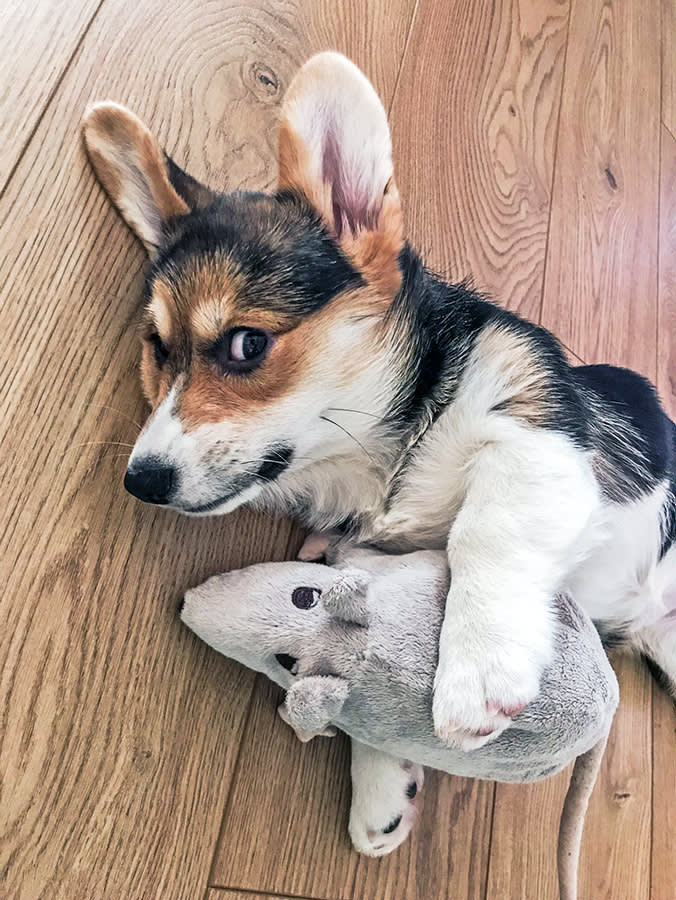
Every dog person knows one. The dog who waits by the washing machine while the stuffed tiger goes through a cycle. The dog who mourns for three days when the carrot plushie is at the repair shop, meaning the kitchen table, meaning grandma with a needle. The dog who appears to believe, with total conviction, that a squeaky lamb is his child.
The instinct is to find this funny, and it is. But that toy is not a joke to the dog, and it is not a toy in any sense you would recognize. It is doing a job. It is regulating an animal’s nervous system.
And once you see it that way, you can put it to work.
What the attachment actually is
The best comparison is not a possession. It is a child’s blanket.
A favorite object becomes an emotional anchor: a fixed, reliable thing that makes an unpredictable world feel more manageable. It lowers fear, anxiety, and stress, and it does this consistently enough that the dog will actively seek it out when things get hard. Behaviorists point out that the attachment tends to form when a toy or blanket enters a dog’s life during a sensitive developmental stage, usually puppyhood, and the positive associations get soldered in.
So a dog carrying a wrecked stuffie around the house is not being cute. They are self-soothing with the only tool they own.
That reframing matters, because it changes what you do with it.
When an owner tells me their dog has one specific toy they cannot be without, my first thought is not that it is sweet. It is that the dog has handed me a lever. That object reliably lowers this animal’s arousal. There are very few things in a dog’s life that do that on demand. Once you know what it is, you can deploy it in exactly the moments the dog is going to need it most.
Why that one, though
The mystery of the selection is a real one. Some dogs pick a lovingly detailed plush duck. Others pick a shapeless, unidentifiable object that the household has stopped attempting to name.
Several things push the choice:
Timing. A toy introduced during a formative window, especially in puppyhood, carries an emotional weight that a toy introduced at four years old struggles to match.
Instinct. Breed drives shape preference. Dogs with high prey drives often gravitate toward squeaky, fluffy toys that behave like something to be caught. Herding-bred dogs often prefer toys they can chase and corral.
Size and build. Small breeds tend toward small, soft toys they can nest with in bed.
Texture and sound. This is the underrated one. A toy that feels soft and yielding has a nurturing, almost maternal quality in the mouth. Some dogs will knead a plush toy exactly as a cat makes biscuits. Add a honking or squeaking sound and you get the head-tilt, and the dog is fully captured.
And, honestly, you. Dogs read your enthusiasm. A toy you are visibly delighted by, that you engage with, that you make a fuss over, becomes a toy the dog engages with more. Engagement with a person is intrinsically rewarding for a dog, so your excitement is part of the toy.
Which explains a great deal about why the same handful of toys become universal. The famous lamb-shaped plush that has colonized every dog household in America was originally created as a puppet by the entertainer and ventriloquist Shari Lewis, for the television show Captain Kangaroo, in 1956. It carries decades of human nostalgia. The dogs do not know that. We do, and we buy it, and we are thrilled when they love it, and they notice that we are thrilled.
A favorite toy is a collaboration.
The vet-visit hack
This is the practical payoff, and it is the best thing in this article.
Bring the toy to the vet. Secretly.
Not visibly, not in the dog’s mouth on the way in. Hidden. In a bag, in a purse, handed off at the front desk. The dog does not know it is there.
Then, after the exam, after the needle, after the indignity, produce it.
What you have built is a genuine reward at the exact moment the dog most needs the day to end well, from an object with proven power to lower this specific animal’s stress. Dogs who go through this look, reliably, deeply confused and deeply pleased.
The variant that works even better for some dogs: let them carry it in and hold it through the whole exam. Plenty of vets will happily work around a dog with a stuffed lamb clamped in its jaws, because a dog holding its lovey is a dog who is easier to examine.
Extend the logic anywhere the dog struggles: car rides, thunderstorms, a first night in a new house, the crate, a stay somewhere unfamiliar. You have a portable anxiolytic. Use it.
Where devotion becomes a problem
Almost always, a favorite toy is a healthy, positive thing. Occasionally it is a symptom, and it is worth knowing the difference.
The signal to watch for is displacement: the toy stops being a comfort and starts crowding out normal life.
The fine version: the dog wants to bring the toy on every walk. The dog sleeps with it. The dog carries it to greet you. All of that is normal and lovely.
The version to raise with your vet: the dog will not eat, will not go outside to eliminate, will not engage in normal daily activities without the toy. Or you see obsessive, repetitive behaviors around it, compulsive licking, chewing, or carrying that the dog cannot seem to stop and does not appear to enjoy.
At that point the toy may not be the source of the comfort so much as a coping mechanism for something else, often stress, boredom, or a separation-related problem. Compulsive disorders exist in dogs, and while this presentation is rare, it is real. If the toy has become a condition of the dog functioning rather than a source of pleasure, that is a conversation with your vet, not a training article.
The test is simple: does the toy make the dog’s world bigger, or smaller?
Choosing a toy that might become the one
You cannot force this. Dogs choose, and often they choose the object you least expected. But you can improve the odds.
Colors matter, and not the way you think. Dogs are not colorblind, they are dichromatic, seeing mostly in blues and yellows. A vivid blue or yellow toy is genuinely more visible to a dog than a red one, which will read as a muddy brownish shape against grass. If you want a toy to pop, buy blue.
Texture is a real variable. Squeaky, crinkly, crackly, plush, rubbery. Offer variety and watch which one the dog returns to. That is data.
Match it to the life stage. Puppies tend to want soft plush. Adult dogs often need something more durable, plus interactive toys that engage them mentally. Senior dogs frequently prefer plush and lightweight, something easy to carry around.
And keep a backup. This is the single most practical piece of advice here. If your dog has a genuine lovey, buy a second one now, while it is still in production. Toys get discontinued. Toys get lost on a hike. A backup, ideally introduced early so it smells like home and is not obviously an imposter, is cheap insurance against a genuinely bad week.
What newer research adds
The direction of thinking on this has moved away from “dogs like toys” and toward the recognition that certain objects function as attachment items with measurable regulatory effects, in a way that has a family resemblance to how comfort objects work for young children.
That framing is why the vet-visit trick keeps showing up in practice rather than in theory: clinicians noticed that dogs holding a familiar object tolerate handling better. It is also why the current guidance on separation-related distress so often includes a familiar-smelling item, not because the object is magic, but because scent and texture are the two channels through which a dog’s world becomes recognizable and therefore safe.
The reasonable takeaway is neither to dismiss the stuffed lamb nor to sentimentalize it. It is to recognize that your dog has, entirely on its own, found a thing that reliably makes it feel better, and to treat that as the useful clinical information it is.
Their lives are short. If a five-dollar plush makes a bad day survivable, that is not indulgence. That is medicine with a squeaker in it.
References
- American Veterinary Society of Animal Behavior. “Position Statement on Puppy Socialization.” (On sensitive developmental periods.) https://avsab.org/resources/position-statements/
- Neitz, J., Geist, T., and Jacobs, G. H. “Color vision in the dog.” Visual Neuroscience, vol. 3, no. 2, 1989, pp. 119–125. https://www.cambridge.org/core/journals/visual-neuroscience
- Overall, K. L., and Dunham, A. E. “Clinical features and outcome in dogs and cats with obsessive-compulsive disorder: 126 cases (1989–2000).” Journal of the American Veterinary Medical Association, vol. 221, no. 10, 2002, pp. 1445–1452. https://avmajournals.avma.org/
- Cornell Richard P. Riney Canine Health Center. “Separation anxiety.” https://www.vet.cornell.edu/departments-centers-and-institutes/riney-canine-health-center/canine-health-information
Dr. Solis is a board-certified veterinary dermatologist with over twelve years of clinical experience. She advises on skin conditions, allergies, and grooming practices that affect coat and skin health. All dermatology and allergy content at The Pet Times is reviewed by her team before publication.
Meet our experts ↗Keep reading
 TrainingYour Dog Doesn't Love the Squeak. They Love Making It Stop.Dr. Ravi Mehta · 7 min
 Product PicksYour Dog Isn't Being Bad. He's Bored. 13 Puzzle Toys That Fix ItSasha Ford · 8 min
 TrainingYour Dog Isn't Rejecting Your Gift. They're Finishing a Hunt.Dr. Nina Kohl · 7 min
 TrainingYour Dog Isn't 'Bad With Toys.' Nobody Taught Them the Game.Dr. Lena Park · 7 min
 TrainingYour Dog Is Bored, Not Heartbroken. Build These 7 Activity Stations.Dr. Nina Kohl · 7 min
 TrainingThe Cheapest Fix for a Bored, Destructive Dog Lives in Your FreezerSasha Ford · 6 min