


The Cheapest Fix for a Bored, Destructive Dog Lives in Your Freezer
A frozen stuffed rubber toy turns your dog's dinner into a 45-minute job, and it heads off the boredom behind a lot of household chaos. Here's why freezing it changes everything, when to hand it over, and how to stuff one so your dog actually wins.

Affiliate disclosure. This article contains affiliate links. We may earn a small commission if you buy through a link, at no extra cost to you. How we handle recommendations.
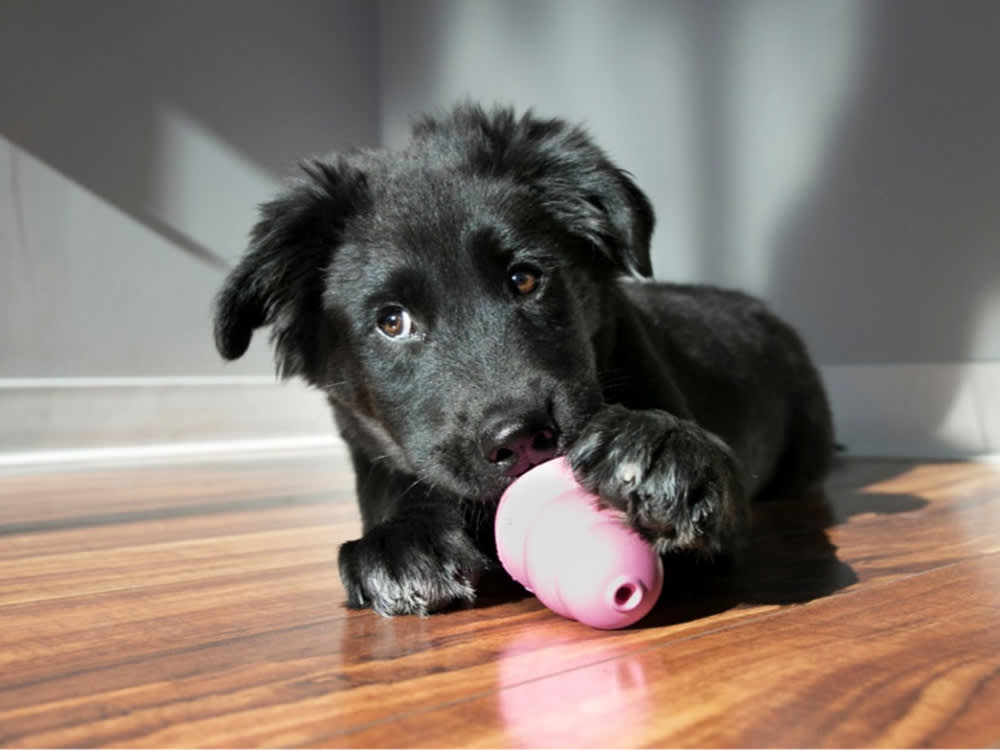
Most of what people call misbehavior in dogs is really just an unmet need wearing a disguise. The chewed baseboard, the frantic greeting, the restless pacing at four in the afternoon, a huge share of it traces back to a dog with more mental energy than the day has given them anything to do with. That is exactly the gap a frozen stuffed rubber toy fills, and it does it for a few dollars. After years of training dogs, this is the single tool I recommend most, because nothing else delivers this much calm for this little effort.
The trick is not the toy itself. It is what freezing it does, and when you choose to hand it over.
Why freezing is the whole point
A stuffed rubber toy already beats a food bowl, because working food out of a puzzle is far more satisfying to most dogs than hoovering it up in fifteen seconds. It engages the chewing and licking that so many dogs are wired to crave, it makes them solve a problem, and it holds their attention on one task for a good while.
Freeze that same toy and every one of those benefits stretches. The food comes out slowly, so a two-minute snack becomes a thirty- or forty-five-minute project. The dog has to problem-solve longer, work their mouth harder, and stay with a single focused task, which is genuinely tiring in the good way that a walk is tiring. You are not just feeding your dog. You are giving them a job that occupies both their body and their brain.
The real magic is in the timing
Here is where a frozen toy stops being a snack and becomes a training tool: you can use it to head off trouble before it starts, instead of scrambling to fix it after.
Watch your dog for a few days and you’ll notice the trouble is predictable. Lots of dogs hit a bored, fidgety patch in the late morning and once more toward evening, and those slumps are when much of the chewing, barking, and general nuisance tends to happen. Hand over a frozen toy just ahead of those slumps and you’ve replaced the misbehavior with an activity before it ever occurs.
The same logic works for greetings. If your dog loses their mind when visitors arrive, have a frozen toy ready and give it to them right before the guest comes in. A dog already blissfully absorbed in a frozen treasure is far less likely to launch into an over-the-top welcome, and that’s better for everyone, including the guest. One caveat: if your dog tends to guard food or prized objects, set them up with their toy in a crate or a separate room when people come over, just to be safe.
People think of a stuffed toy as a way to keep a dog busy, and it is, but the real skill is using it on purpose, before the moment you’re dreading. Give it thirty seconds before the doorbell instead of thirty seconds after the jumping starts, and you’ve trained a calmer greeting without saying a word. Timing turns a chew toy into a behavior tool.
How to stuff one so your dog actually succeeds
Stuffing a rubber toy is like any kitchen task: no single right way, just techniques that make it work better. The one rule that matters most for beginners is to make early attempts easy. A toy packed solid and frozen stiff can be too hard for a novice to crack, and a frustrated dog will quit on the whole idea before they discover how great it is. You want early wins.
Start with the surface. For the first few frozen toys, smear just the inside surface with peanut butter, cream cheese, or canned food. Or fill it three-quarters of the way, freeze that, then add easy soft food in the last quarter right before serving so your dog gets something immediately.
Keep it upright while you work. Stand the toy in a cup or glass, big opening up, and squeeze the sides to widen the hole when you’re loading in larger pieces or spooning in the sticky stuff.
Build it in layers. Plug the small bottom hole first with something both leak-proof and irresistible, a bite of steak or chicken, a bit of cheese, or peanut butter, so filling doesn’t fall out and your dog stays interested to the last lick. Then a layer of canned food to bind everything, then small treats, then more canned food, and some kibble if you’re using it as a meal. Cap it off with a long, hard treat sticking out of the top so your dog is hooked and rewarded from the first second.
Then freeze, and adjust the difficulty. Freeze it solid. Packed loosely, it’s an easier, faster puzzle; packed tight, it lasts much longer. Start loose while your dog is learning and tighten the challenge as they get good at it.
What newer research adds
This isn’t just trainer folklore. The broader field of feeding enrichment, giving animals their food through foraging and problem-solving instead of a bowl, has steadily accumulated evidence that it lowers stress behaviors and supports better welfare across species, from shelter dogs to zoo animals. In practical terms, that backs up what dog people have long noticed at home: a dog who has to work for at least some of their food tends to be calmer and less destructive than one who doesn’t. A frozen stuffed toy is simply one of the easiest ways to build that foraging work into an ordinary day.
The bottom line is the one I keep coming back to: these toys have made my own days easier precisely by making my dogs’ days richer. Stock a few in the freezer, and they can do the same for yours.
A classic stuffable rubber toy is inexpensive, dishwasher-safe, and comes in sizes and firmness levels to match your dog.
References
Sasha Ford is a certified cat behaviour consultant who has worked with shelters, catteries, and private clients across the country. They review all feline behaviour content at The Pet Times, with expertise in multi-cat households, indoor enrichment, and stress-related disorders.
Meet our experts ↗Keep reading
 Product PicksYour Dog Isn't Being Bad. He's Bored. 13 Puzzle Toys That Fix ItSasha Ford · 8 min
 TrainingYour Dog's Favorite Toy Isn't a Toy. It's a Coping Tool, and You Can Use It.Dr. Amara Solis · 7 min
 TrainingYour Dog Doesn't Love the Squeak. They Love Making It Stop.Dr. Ravi Mehta · 7 min
 Product PicksInteractive Dog Toys Are Enrichment, Not Entertainment: Pick by Your Dog's Drive (10 Tested)Sara Lim · 14 min
 TrainingStop Handing Your Dog a Boring Kong. Stuff It Like This.Dr. Amara Solis · 7 min
 TrainingYour Dog Isn't Rejecting Your Gift. They're Finishing a Hunt.Dr. Nina Kohl · 7 min