


Your Dog Understands About 165 Words. How You Say Them Matters More
We narrate our whole lives to our dogs. How much lands? More than you'd guess, and less than you hope. The real story is that tone and body language outrank vocabulary almost every time.

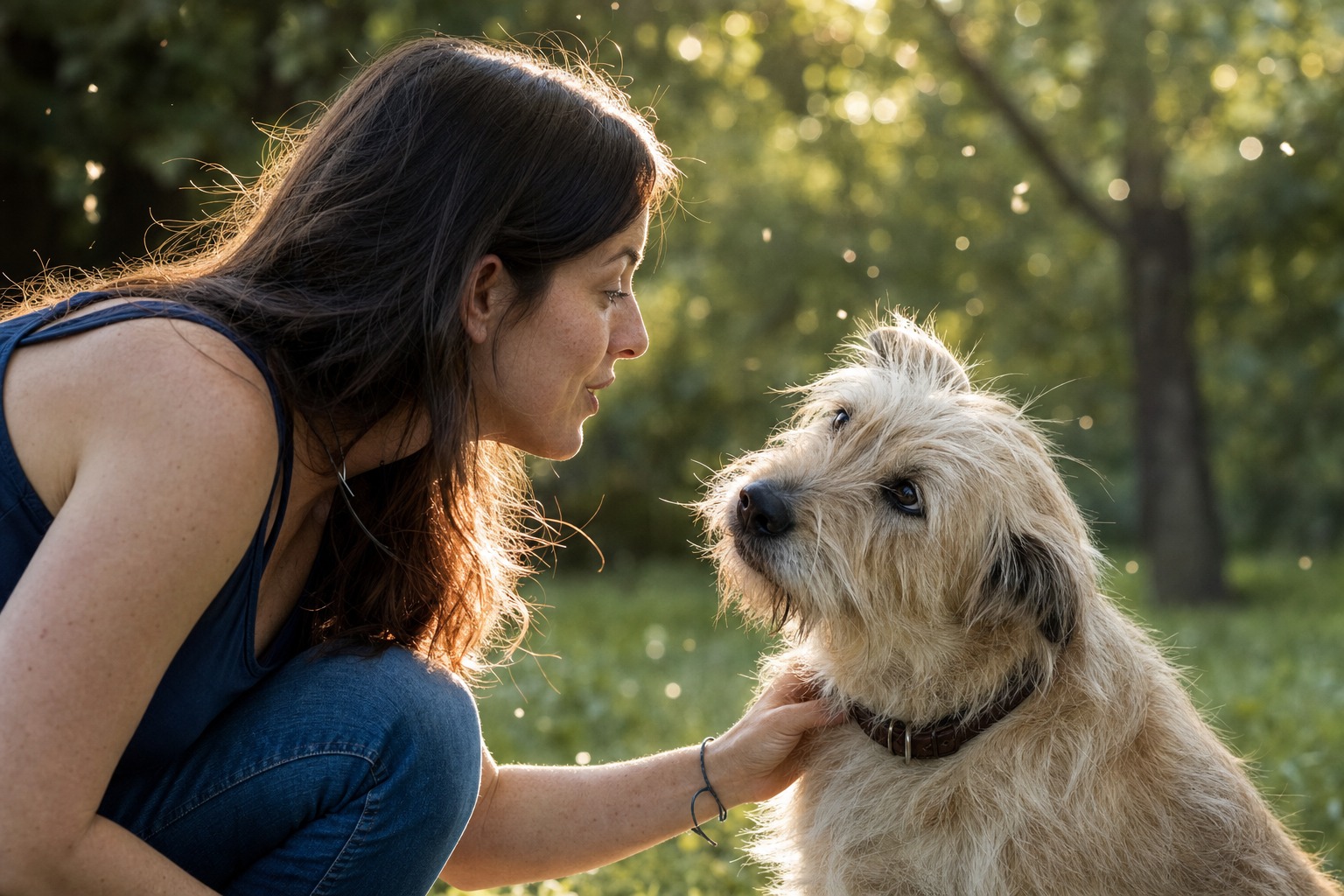
Hang around a dog park long enough and you’ll catch someone mid-monologue with their dog. “Five more minutes and then we head home, deal?” Or the exasperated “no, I already fed you, stop looking at me like that.” The dog, of course, offers no rebuttal. And yet the human keeps going, because talking to our dogs like they’re in on the conversation is one of the small joys of loving one.
But underneath the fun is a real question worth answering: how much of this are they actually getting? The honest answer sits in a satisfying middle. Dogs understand more than skeptics assume and less than doting owners hope, and, crucially, most of what they “understand” isn’t your words at all. It’s how you say them. Vocabulary is the small part. Tone and body language are where your dog is really reading you.
They learn our language a lot like toddlers do
Dogs don’t arrive knowing what any of our sounds mean, but they start decoding us astonishingly fast, within weeks of opening their eyes as puppies. The most useful mental model isn’t a person fluent in a language; it’s a baby growing into one. A dog’s grasp of human communication tracks closer to a toddler’s than an adult’s, and that comparison explains a lot.
A big part of my job is gently lowering expectations, because people genuinely believe their dog follows the plot. It’s much more like living with a bright toddler. They’re motivated, they’re reading you constantly, and their whole question is basically ‘what’s in this for me?’ That’s not a knock on dogs. Toddlers are sharp and engaged, and so are dogs.
That self-interest is the engine. Dogs work to decode us because decoding us gets them things they want, and there’s nothing wrong with that. It’s exactly why the words they learn best are the ones attached to good outcomes.
Tone and body language beat vocabulary
Dogs communicate with each other mostly through their bodies and the pitch of the sounds they make, so those are the channels they’re scanning in us, too. The proof is almost funny: you can say something insulting in a warm, sing-song voice and your dog will wag happily, because they’re responding to the melody, not the meaning. (For the record, your dog is a perfect angel and deserves only kind words.)
The flip side matters more. When you come home and your dog gives you the guilty look, it’s tempting to read it as an admission that they know they shredded the pillow. They don’t. Dogs aren’t wired for that kind of cause-and-effect reasoning across time. What they’re actually reading is your body in that moment: thinned lips, narrowed eyes, a tense forward lean, clipped words. They assemble all of that and conclude you’re unhappy right now. You’ll often get the very same “guilty” face when you walk in tense from a bad day and the pillows are perfectly intact. The look is a response to you, not a confession.
They really do know some words
None of this means words are meaningless. The average dog understands somewhere around 100 to 200 words, and breed plays a role in the ceiling. The famous outlier was a Border Collie named Chaser, who learned the names of more than 1,000 objects, a feat most dogs won’t match but which shows the upper range is real.
For the typical dog, the words that stick are the ones wired to rewards. “Walk” and “outside” land because they reliably predict something wonderful. That’s also why simply repeating “sit” at an untrained dog does nothing: the dog first has to learn that lowering their rear produces a treat, and only later that doing it on the word itself is what pays. The word is a bridge to a payoff, and the bridge takes repetition to build.
There’s a catch that trips up a lot of owners, though. Dogs are poor at generalizing. A puppy who nails “sit” in the kitchen may look at you blankly when you ask for it at the park, because to them the cue was tangled up with that one location. The fix is to practice the same cue in many different places, indoors and out, until the dog understands the word applies everywhere, not just by the treat drawer.
So how should you talk to your dog?
The practical upshot is refreshingly simple: keep it calm and even. Dogs respond better to a steady, neutral voice than to a loud or angry one, and if you stay relaxed, your dog is more likely to stay relaxed too. That doesn’t mean going robotic. It means keeping the big emotional spikes to a minimum so your dog can actually tune in to what you’re trying to say rather than bracing against your intensity.
And it’s worth remembering the relationship runs both ways. Dogs put real effort into reading us, while we tend to be sloppy translators of them, treating every bark as the same generic noise when in fact barks are as varied as our own sentences. Getting even a little more fluent in dog, learning to read the ears, the tail, the weight shift, pays off in a better relationship whether your dog is brand new or a decade in. A good illustrated guide to canine body language is a genuinely worthwhile investment for exactly that reason.
What newer research adds
Here’s the part that would’ve sounded like science fiction not long ago: we now have brain-wave evidence that dogs can hold a mental picture of an object when they hear its name. In a 2024 study published in Current Biology, researchers fitted 18 dogs with non-invasive EEG electrodes, played an object’s name, then showed the dog either the matching object or a mismatched one. The dogs’ brains reacted differently to the mismatch, a pattern strikingly similar to what we see in humans and widely accepted as a sign that the word triggered a real expectation of the object.
In plain terms, when your dog hears “ball,” at least some dogs appear to conjure an actual mental representation of a ball, not just an automatic behavior. Even more interesting, the researchers noted this ability seems to be inborn rather than the product of special training. It doesn’t overturn anything above, your dog is still a toddler reading your tone more than your grammar, but it’s a lovely piece of evidence that behind those attentive eyes, a few of your words are landing more deeply than we ever had proof of before.
References
- Boros, Marianna, et al. “Neural Evidence for Referential Understanding of Object Words in Dogs.” Current Biology, 2024. Link
- Pilley, John W., and Alliston K. Reid. “Border Collie Comprehends Object Names as Verbal Referents.” Behavioural Processes, 2011. Link
- Chin, Lili. Doggie Language: A Dog Lover’s Guide to Understanding Your Best Friend. Link
Dr. Chen is a small-animal veterinarian who leads health and safety coverage at The Pet Times. She writes and reviews the bulk of our illness, condition, and safety content, translating clinical guidance into clear, practical advice owners can act on at home.
Meet our experts ↗Keep reading
 TrainingSome Dogs Learn Words by Eavesdropping. Scientists Just Proved It.Marcus Webb · 5 min
 TrainingYour Dog's Joy Sends 86,000 People to the ER Every YearDr. Nina Kohl · 8 min
 TrainingYour Dog Pictures the Ball When You Say 'Ball.' There's Now Proof.Dr. Ravi Mehta · 5 min
 TrainingFreezing While Your Dog Dawdles? Stop Begging and Set the SceneJordan Ellis · 8 min
 LivingThe ADA Has No Breed List. Your Landlord's Insurance Does.Dr. Priya Nair · 6 min
 TrainingYour Dog Sniffs You at the Door Because You're the Evening NewsLeila Torres · 5 min