


It's Illegal to Cook a Dog in a Car. In Most States, It's Still Illegal to Save One.
Two maps govern a dog dying in a parked car: where it's a crime to leave them, and where you're allowed to break the window. They barely overlap, and the gap between them is where the dog is.

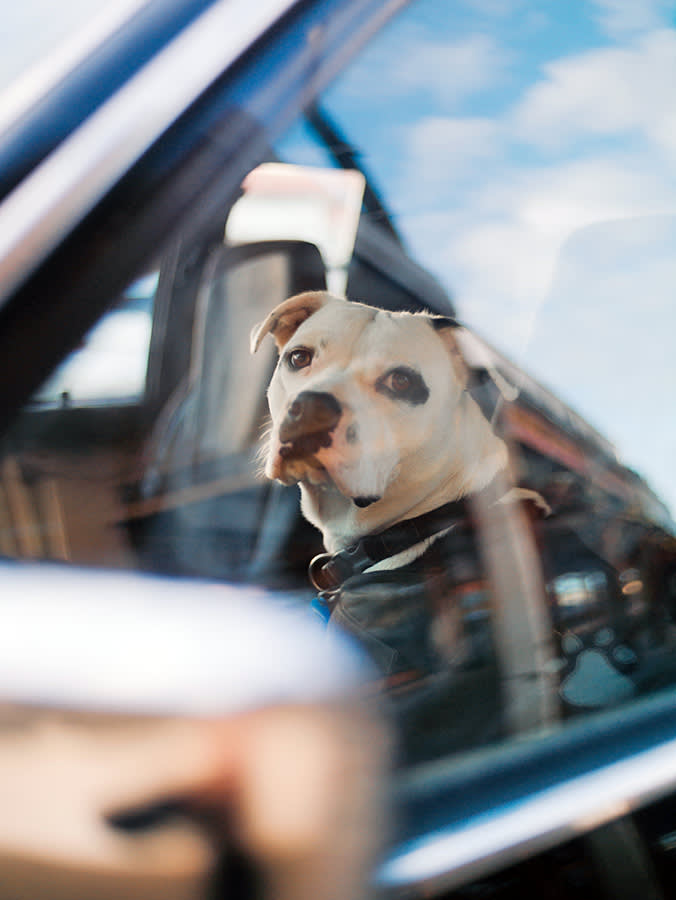
There are two maps of the United States that matter when a dog is panting in a locked car in a parking lot, and almost nobody has looked at both.
The first map is where it’s illegal to leave the dog there. That map is fairly generous now. The second map is where you are allowed to break the window and get the dog out without being sued for the glass. That map is much smaller.
The states where those two maps fail to overlap are the strange, cruel middle of American pet law. West Virginia and New Jersey are the clearest examples: in both, leaving an animal in a car under dangerous conditions is against the law, and in neither does a person who rescues that animal get any protection for doing it. The act is a crime. Stopping the crime is on you, legally and financially.
That’s the gap. Understanding which side of it you’re standing on takes about ninety seconds, and it’s the difference between helping a dog and helping a dog while exposed.
The physics, which are worse than people think
The reason this is an emergency rather than an inconvenience is that a parked car is not a room. It’s a solar collector.
At 72 degrees Fahrenheit outside, the inside of a car reaches 116 degrees within an hour. That’s a pleasant spring day producing lethal heat.
At 80 degrees, the interior hits 99 degrees in ten minutes. Ten minutes is the exact length of the errand people tell themselves is safe. It is the errand. That’s the point.
Cracking the windows does very little, because the mechanism is radiant heat trapped by glass, not stale air. And a dog has almost no way to shed it. Dogs don’t sweat across their skin the way we do; they dump heat by panting, which works by evaporating moisture off the tongue and airway. In a hot, humid, enclosed box, there is nowhere for that moisture to evaporate to. The cooling system fails precisely when the dog needs it most, and once core body temperature climbs past about 105 or 106 degrees, the damage begins: to the gut lining, the kidneys, the clotting system, and the brain.
“People imagine heatstroke as a dog who gets very hot and then cools down. It isn’t,” says Dr. Ravi Mehta. “It’s a multi-organ event. I’ve had dogs walk into the clinic looking almost normal and start bleeding internally six hours later, because the gut barrier failed while they were still in the car.”
What the toll actually is
Real numbers, because the abstraction lets people off the hook.
In 2024, PETA counted 111 animals who died of heat-related causes and 388 who were rescued from dangerous heat. Those are the cases that were documented well enough to count, which means they are a floor, not a ceiling. Most hot-car deaths do not produce a news story or a police report.
And these are not exotic scenarios. They’re an errand, a rescheduled meeting, a line at the pharmacy that was longer than expected, a friend who stopped to chat. Nobody in these stories set out to kill their dog.
Map one: where it’s illegal to leave them
The line a driver crosses is not “left the dog in the car.” It’s “left the dog in conditions that put the animal’s life at risk.” What counts varies by state, and the list is broader than heat alone: extreme temperature, inadequate ventilation, no food or water, and, yes, extreme cold. Winter hot-car law is real, and almost nobody discusses it.
Nineteen states attach some legal consequence to leaving an animal in a dangerous vehicle.
Eight of them write it into statute as a misdemeanor outright: Arizona, Delaware, Illinois, Minnesota, Nevada, New Hampshire, North Carolina, and West Virginia.
California reserves the misdemeanor for a repeat offense, or for a case where the animal was gravely injured. New Hampshire escalates further: a second conviction there becomes a felony.
A larger group handles it through fines or civil infractions, including Colorado, the District of Columbia, Maine, Maryland, Massachusetts, New Jersey, New York, North Dakota, Rhode Island, South Dakota, Vermont, and Washington.
And in states with no specific vehicle statute at all, a person can still be charged under general animal cruelty law on a case-by-case basis. “My state doesn’t have a hot car law” is not a defense anyone should be relying on.
Map two: where you’re allowed to do something about it
Here is where it narrows sharply.
Fourteen states extend civil immunity to an ordinary bystander, not merely to police or first responders, who breaks into a car to free a trapped animal. Immunity means you cannot be sued for the broken glass. The fourteen: Arizona, California, Colorado, Connecticut, Florida, Indiana, Kansas, Louisiana, Massachusetts, Ohio, Oregon, Tennessee, Vermont, and Wisconsin.
Indiana carves out an exception worth knowing. A rescuer there is still on the hook for half the cost of the damage.
And in West Virginia and New Jersey, as noted, the law punishes the person who left the animal and protects nobody who saves it.
Everywhere else, the law is silent, and silence is not permission.
The conditions attached to immunity, which people blow constantly
Even in the 14 states, immunity is not automatic. It is conditional, and the conditions are specific enough that a well-meaning rescuer can lose the protection by accident.
The requirements, which vary slightly by state but cluster tightly, generally look like this: you must reasonably believe the animal is in imminent danger; the vehicle must be locked, with no other reasonable way in; you must contact 911 or law enforcement before you break in; you must use no more force than necessary; and you must stay with the animal until officers arrive.
Read that list again with an eye toward how a person actually behaves in a parking lot when a dog is dying. They break the glass first. They don’t call. They take the dog to their own car, with the air conditioning on, because that’s the humane instinct. And in doing so they have satisfied none of the conditions and forfeited the immunity they were counting on.
If you are going to do this, do it in order. Call first. Then break. Then stay.
The step almost everyone skips
Before any of this, there’s a move that resolves a surprising share of these situations in under five minutes, and it is not dramatic enough for people to reach for it.
Go into the nearest store and have them page the owner.
Take the plate number, the make, and the model to a manager and ask for an announcement over the PA. In a strip mall, a grocery store, or a big-box parking lot, the owner is almost always inside, and they are almost always horrified. This is the Humane Society of the United States’s own first recommendation, and it is first for a reason: it’s faster than the police, it costs nothing, and it ends with a dog in a moving car with the air conditioning on.
Call animal control or the police in parallel, not after. If the owner can’t be found and you’re in an immunity state, you then have a decision to make, and you’ll be making it having already done the two things that protect both you and the dog.
What’s new since this was written
The legal landscape has moved, and it has moved in the right direction.
The Animal Legal & Historical Center at Michigan State University, which maintains the authoritative tracking of these statutes, now counts 32 states plus the District of Columbia with laws addressing companion animals left unattended in parked vehicles. That’s a substantial expansion from the picture most people carry in their heads, and it means the odds that your state has something on the books are now better than even.
What has expanded much more slowly is the rescuer-immunity side. That map is the one that still leaves most of the country in a gray zone, and it’s the one worth checking before summer rather than during it. Look up your own state on the Animal Legal & Historical Center’s table. It takes two minutes, and the two minutes are much better spent now than in a parking lot with a rock in your hand.
The rule that survives every jurisdiction: the car is never fine, the errand is never quick enough, and the only reliable protection is that the dog isn’t in there in the first place.
References
- Animal Legal & Historical Center, Michigan State University. “Table of state laws that protect animals left in parked vehicles.” Link
- Animal Legal & Historical Center, Michigan State University. “Maps of states that have laws to protect animals in parked cars.” Link
- The Humane Society of the United States. “What to do if you see a pet in a parked car.” Link
- American Veterinary Medical Association. “Pets in vehicles.” Link
- PETA. “Animals suffering and dying in hot cars.” Link
- American College of Veterinary Emergency and Critical Care. “Heatstroke in dogs.” Link
Not a substitute for your vet. Our guidance is educational. For urgent symptoms, contact a vet or emergency clinic right away. Editorial standards
Dr. Nair is a veterinarian focused on diet and feeding. She covers everyday nutrition, treats, and the many "can they eat this?" questions owners ask, grounding each answer in what is actually safe and sensible for dogs and cats.
Meet our experts ↗Keep reading
 Health & WellnessThe Flea Product That Sends Cats to the ER: Advantage vs. AdvantixDr. Lena Park · 7 min
 Health & WellnessThe Go-Bag Won't Save Your Pet. Training Will.Dr. Priya Nair · 7 min
 Health & WellnessThe Holiday Decorations Most Likely to Land Your Pet in the ERDr. Mara Chen · 8 min
 Health & WellnessThe Pain Cream in Your Medicine Cabinet Can Kill a Cat Who Never Touched ItDr. Ravi Mehta · 4 min
 Health & WellnessA Rabid Bat Turned Up in Pasadena. The Fix Is Almost Boring.Dr. Ravi Mehta · 5 min
 Health & WellnessYour Hair Treatment Can Kill Your Cat. The Bottle Isn't the Problem.Dr. Nina Kohl · 8 min