


Why Dog Pee Keeps Coming Back, and the Pantry Fix That Ends It
Dog urine isn't like other stains. It leaves uric acid crystals that reactivate every time the air gets humid, which is why the smell returns. Here's the natural method that handles it, plus when only an enzyme cleaner will do.

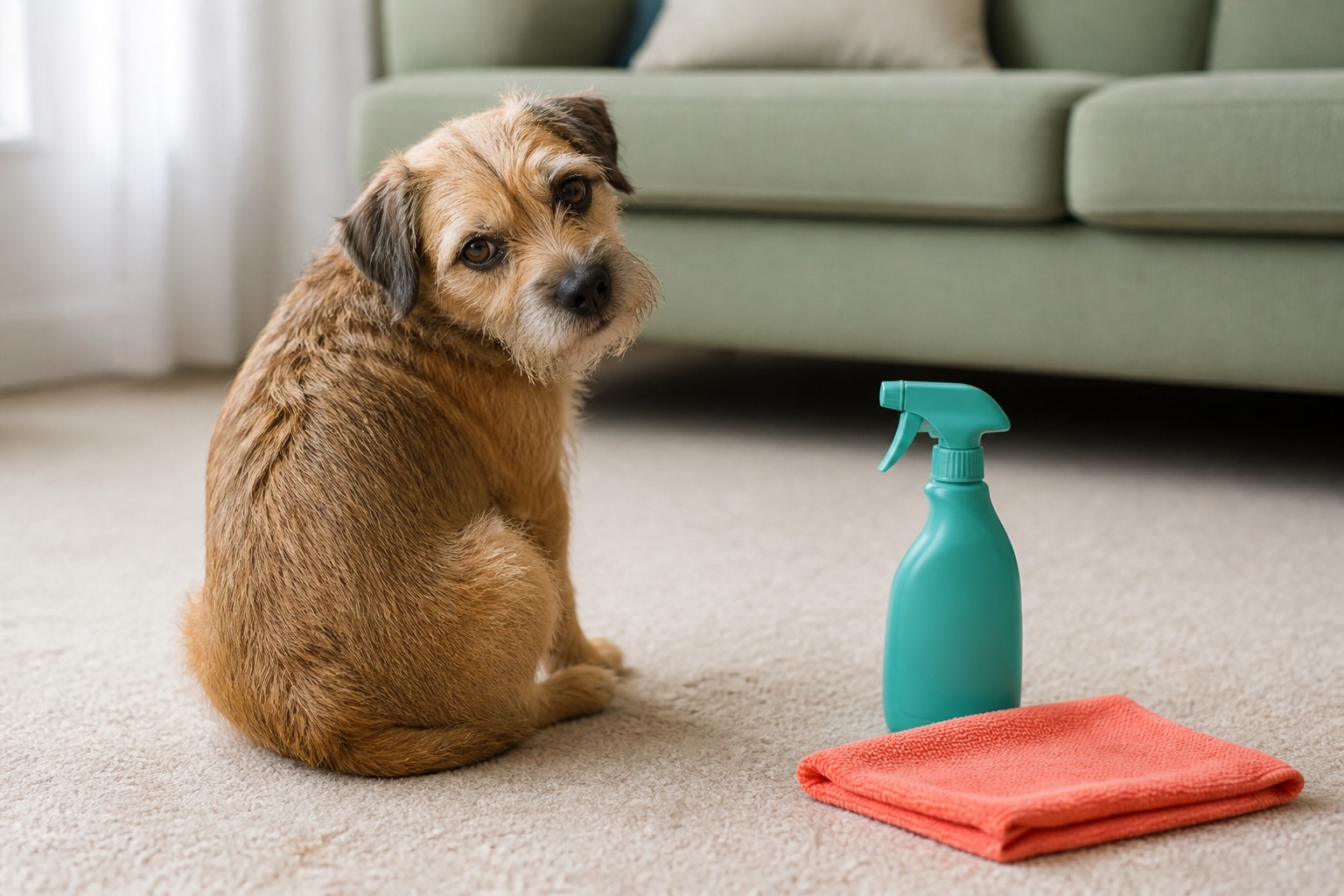
Most stains are a one-time event. You clean them, they are gone. Dog pee is different, and understanding why is the whole key to actually getting rid of it. When urine dries, it leaves behind uric acid crystals bound into the carpet fibers. Those crystals are not water-soluble, so a normal cleaning does not remove them, it just clears the parts around them. Then, every time the air gets humid, they reactivate and release that unmistakable ammonia smell all over again. That is why the spot you “cleaned” last month smells again on a muggy day, and why your dog keeps returning to re-mark a place you thought was handled.
So the goal is not to cover the smell. It is to break down the crystals. The good news is that a fresh accident, caught quickly, never gets to the crystal stage, and you can handle it with three things already in your pantry. For older stains, you will need one extra tool. Let us take both.
The pantry method for fresh accidents
This homemade remover also handles mild everyday messes like spaghetti sauce, cleans and deodorizes without leaving residue, and skips the questionable chemicals in some store-bought sprays. Keep a premixed batch in a spray bottle for speed, and always test it on an out-of-the-way patch first to be sure it will not discolor your carpet. Above all, treat any urine spot as fast as you can, because the clock is what turns a wipeable puddle into a set-in crystal problem.
What you’ll need
- Paper towels or cloth towels (paper towels tend to work best)
- White vinegar
- Water
- Baking soda (plus time for it to absorb)
- A vacuum
Step 1: Blot, don’t rub
Find the soaked area and act fast. Blot the spot with a paper towel. Rubbing spreads the urine and drives it deeper, so pat rather than scrub. Swap in a fresh towel once the old one stops absorbing, and keep going until the spot is fairly dry and little comes up.
Step 2: Apply the vinegar solution
Mix equal parts water and white vinegar, soak the area, and let it sit five minutes, then scrub hard to work it deep into the fibers. Straight vinegar for the worst spots. The soak does two jobs: it cuts the stain and re-wets it so you can lift out all the urine. Vinegar neutralizes the ammonia smell, which is exactly why it helps in the moment, though it is worth knowing vinegar does not dissolve the uric acid crystals themselves. For a fresh accident there are no crystals yet, so this is enough. For an old one, it is not, which is the whole reason the next section exists.
Step 3: Sprinkle baking soda, then wait
While the spot is still wet, sprinkle baking soda over it, pour a little vinegar solution on top, and let it fizz. Rub it into the fibers with a gloved hand or brush, then leave it until completely dry, which might take overnight or a day or two depending on how much solution you used and how warm your home is. Vacuum thoroughly once it is bone dry.
Rinse out the residue
One step people skip: rinse. Leftover cleaner residue holds onto smells and can make them worse over time, which is why professional cleaners always finish with a rinse. Do the same.
When only an enzyme cleaner will do
If you have blotted, vinegared, and baking-soda’d a spot and the smell still comes back, you are dealing with uric acid crystals, and you have hit the limit of the pantry method. This is not a failure of technique. It is chemistry. Enzymatic cleaners are formulated for exactly this: the enzymes digest the proteins and uric acid that vinegar cannot touch, neutralizing the odor at its source instead of masking it. Saturate the spot the way the label directs, give the enzymes time to work (they need contact time, so do not rush it), and let it air dry. This is also the single best way to stop a dog from re-marking, because you are finally removing the scent beacon they have been responding to.
The trick for finding hidden stains
You cannot treat what you cannot find, and dried urine is invisible in ordinary light. An inexpensive UV black light solves this. Darken the room, sweep the carpet with the light, and old urine glows a dull yellow-green. Mark each spot with a bit of tape, then treat them with an enzyme cleaner. Pairing a black light with an enzyme cleaner is the reliable way to break the cycle of a dog re-marking stains you did not even know were there.
Dried-on stains, step by step
For a stain that has already set, the vinegar method still helps, it just needs more effort, and you will likely finish with an enzyme cleaner.
- Scrape up solids first. More relevant for vomit or poop than pee.
- Re-moisten and blot. Rewet the area with water, then blot as you would a fresh stain.
- Apply a baking soda paste. Mix baking soda with water, apply, let it sit, then lift with a dry towel to pull odor and residue.
- Finish with enzymes if any smell lingers after drying.
What actively makes it worse
A few common instincts backfire, and knowing them saves you from setting a stain permanently:
Do not use a steam cleaner. Heat bonds the proteins in urine to the carpet fibers, making the stain and smell essentially permanent. This is the single most common way people accidentally lock in a stain.
Skip ammonia-based cleaners. Urine already contains ammonia, so an ammonia cleaner smells like a fresh accident to your dog and can actually invite them to re-mark the spot.
Give baking soda time, but do not expect it to fix crystals. It is a fine surface deodorizer, but sprinkling it on an old subfloor-deep stain will not reach the crystals causing the smell.
When to call in the pros, or the vet
If urine has soaked through to the padding or subfloor, home methods often cannot reach it, and the odor can become nearly impossible to remove without professional water-extraction cleaning or, in bad cases, replacing the affected carpet and pad.
There is also a behavioral angle worth taking seriously. If your dog keeps peeing on the carpet, and you have ruled out an unfound stain they are re-marking, there may be an underlying health issue such as a urinary tract infection. Talk to your vet about whether a urinalysis or other tests make sense, because repeat accidents are sometimes a medical signal, not a training one.
References
- Craun, Kaitlyn, et al. “Environmental Chemical Exposures in the Urine of Dogs and People Sharing the Same Households.” Journal of Clinical and Translational Science, vol. 5, no. 1, 2020. https://doi.org/10.1017/cts.2020.548
- Yadav, S.N., et al. “Urinalysis in Dog and Cat: A Review.” Veterinary World, vol. 13, no. 10, 2020, pp. 2133–2141. https://doi.org/10.14202/vetworld.2020.2133-2141
- Colorado State University Extension. “Dog Urine Damage on Lawns: Causes, Cures and Prevention.” https://cmg.extension.colostate.edu/Gardennotes/553.pdf
Common questions
What's the fastest way to get dog urine out of carpet?
Act immediately. Blot up the liquid with a paper towel, then apply the vinegar-and-water solution before the stain has a chance to set and the crystals form.
Does dog urine permanently stain carpet?
It can if you don't treat it quickly. The acids and pigments in urine bond with carpet fibers over time. Prompt cleaning, ideally finished with an enzymatic cleaner, prevents lasting damage.
Why can I smell pee but can't find it?
Dried urine is invisible in normal light but glows under a UV black light. Darken the room, scan the carpet with a cheap black light, mark the spots, and treat them with an enzyme cleaner.
Sara Lim leads our Product Picks coverage, testing and comparing the things pets and their owners actually use. From everyday essentials to home-and-style finds, she focuses on honest, useful recommendations rather than hype.
Meet our experts ↗Keep reading
 LivingMalamute or Husky? One of Them Will Redecorate Your House FasterDr. Nina Kohl · 8 min
 Health & WellnessYou Dog-Proofed the Yard and Forgot the SkyDr. Mara Chen · 6 min
 TrainingSix Weeks of Crate Rest Will Break You Both. Give the Dog a Job Instead.Dr. Nina Kohl · 8 min
 Health & WellnessThe 'Hypoallergenic' Dog Is a Myth You Can MeasureDr. Amara Solis · 7 min
 Health & WellnessDogs Proved They Could Smell COVID. Then We Barely Used ThemDr. Ravi Mehta · 5 min
 LivingYour Senior Dog Isn't Slowing Down. He's Bored.Dr. Nina Kohl · 8 min