


Dogs Proved They Could Smell COVID. Then We Barely Used Them
Trained dogs detect COVID with accuracy rivaling PCR, sometimes 48 hours sooner. The science was never the hard part. The real story is why a working diagnostic tool sat on the sidelines, and what happened next.

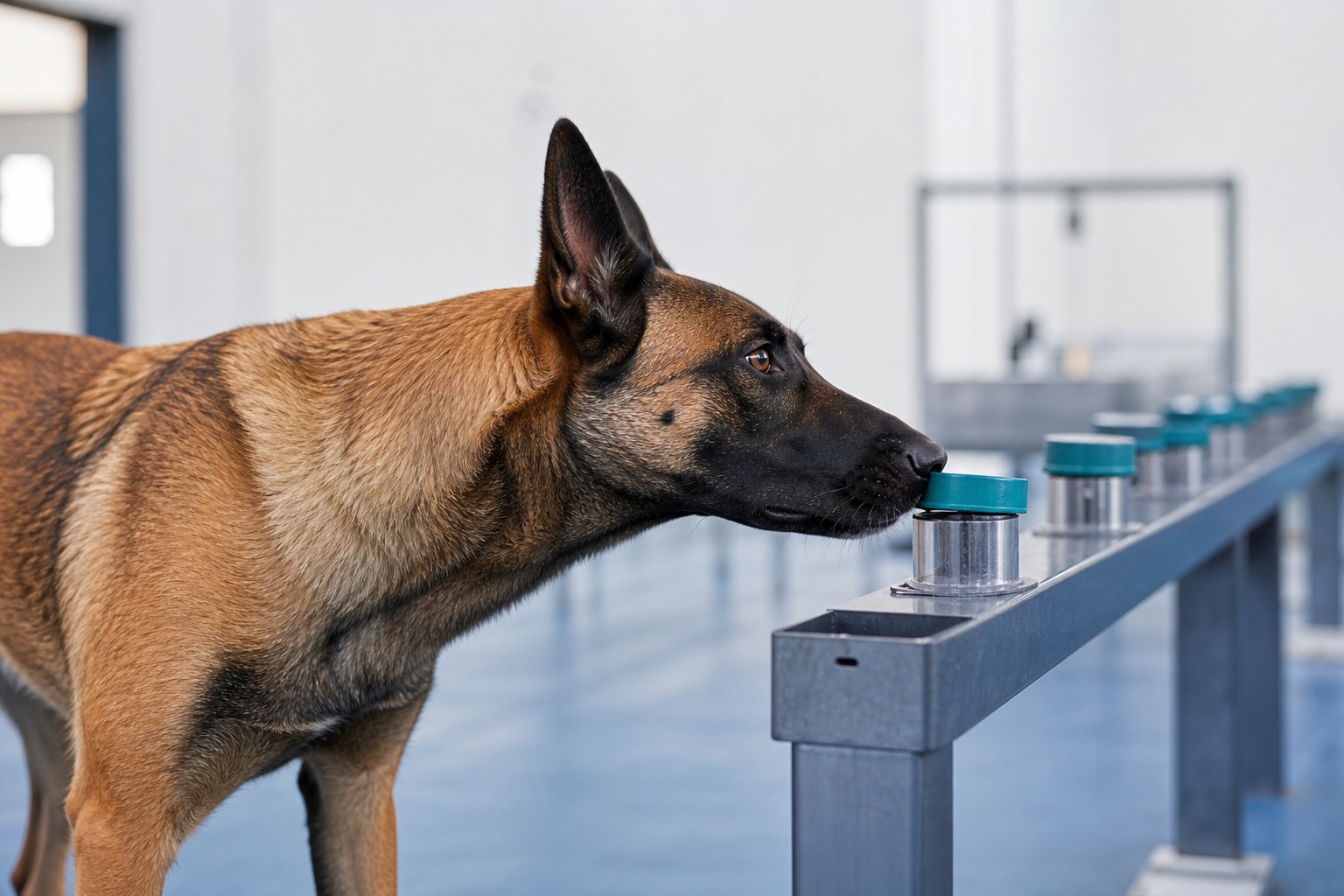
Here is the strange thing about COVID-sniffing dogs: the science worked almost immediately, and we still mostly did not use them. That gap, between a proven capability and an unused one, is the actual story. It is easy to get caught up in the wonder of a dog detecting a virus from a foot away, and the wonder is real. But the more revealing question is not “can they?” It is “they can, so why aren’t they at the airport?” The answer says less about dogs and more about how institutions decide what counts as a legitimate test.
Start with what was proven, because it is genuinely striking. A study in PLOS One reported that dogs correctly identified COVID-positive human sweat samples with 97 percent accuracy across 335 people, and flagged all 31 asymptomatic cases in a group of 192. Other work described dogs beating the PCR test outright, catching infection in asymptomatic patients a full 48 hours before swabs did, with results delivered in seconds. Detection dogs are not a party trick. They are a fast, non-invasive, remarkably accurate screening instrument.
Those numbers are right in line with what I’d expect from a well-trained scent-detection dog. High sensitivity, high specificity, and a collection process about as non-invasive as it gets. The biology was never the bottleneck.
What the nose is actually doing
The mechanism is the same one behind dogs detecting cancer, diabetes, and oncoming seizures. In each case the dog is most likely picking up volatile organic compounds, the chemical byproducts of changes happening inside a sick body. The dog does not know it is “COVID.” It knows a scent signature, trained to an alert.
Think of it as recognizing a chord rather than naming each note. Infection changes the body’s chemistry in a patterned way, and the dog learns the pattern, not any single molecule. If the alert is accurate and repeatable, we can put it to work without a full ingredient list. When the alert keeps being right, the nose has earned the benefit of the doubt.
If detecting something microscopic from a distance sounds implausible, it underestimates the instrument at the end of a dog’s snout, capable of registering the equivalent of a teaspoon of sugar in an Olympic pool. COVID did add real complications: it was new, people responded to it in wildly different ways, and that variability made it harder to train a dog against every version of the signature. There was also a risk PCR does not carry, that a dog directly inhaling infected samples could catch the virus itself, a genuine consideration for any program.
The gap between “it works” and “we use it”
So if the accuracy was there, what stopped deployment? Not the biology. The obstacles were institutional and logistical, and they are worth naming because they explain a pattern much bigger than COVID.
First, reliability in a chaotic real-world setting demands far more training than a lab study. The five or six weeks used in the research is nowhere near enough for a dog to stay accurate inside a crowded airport full of competing scents, sights, and sounds; high-distraction environments drag down focus and, with it, accuracy. A realistic deployment looks less like a dog roaming a terminal and more like a canine-staffed screening station in a quiet, isolated space, sampling from travelers who then wait for results.
Second, and more decisively, proving a dog can do the job is a completely different thing from getting handlers and dogs cleared to operate in a public-health capacity. This is exactly why cancer-detection dogs, despite accuracy often cited in the 80-to-95-percent range, are almost never used clinically. The capability has existed for years. The institutional permission has not.
Nobody serious ever proposed retiring the lab test; PCR is quick and it works. The dogs were always meant to be the layer in front of it, sweeping crowds and flagging the handful of people who ought to go get swabbed. The goal was never to swap out PCR. It was to catch infection faster and get an earlier warning. The science delivered that. The system just wasn’t built to accept it.
What happened after this piece ran
The years since have made the point sharper, not softer. Real-world field trials went ahead in exactly the settings experts predicted. At Helsinki-Vantaa Airport, screening dogs reached about 92 percent accuracy on incoming passengers. At Miami’s airport, a program reported accuracy near 99 percent. A large systematic review and meta-analysis pulled together dozens of studies and concluded that trained dogs can be a fast, low-cost screening layer, though not a replacement for laboratory testing, precisely the “augment, don’t replace” role laid out above. And the same scent-detection science has kept expanding: recent work has trained dogs to detect Parkinson’s disease from skin swabs with sensitivity around 80 percent and specificity as high as 98 percent, and multi-cancer breath-detection studies have continued to report strong results.
The throughline holds. The canine nose is one of the most heavily studied, repeatedly proven, and underused diagnostic instruments we have. The barrier was never whether it works. It was whether we would let it.
So should you train your own dog to sniff out COVID? Almost certainly not. There are far better uses of that remarkable nose, from detecting an oncoming seizure to supporting someone through PTSD, and those applications ask the dog to help one person it loves rather than screen a terminal full of strangers.
References
- Grandjean, Dominique, et al. “Diagnostic Accuracy of Non-Invasive Detection of SARS-CoV-2 Infection by Canine Olfaction.” PLOS One, 2022. https://doi.org/10.1371/journal.pone.0268382
- Kantele, Anu, et al. “Scent dogs in detection of COVID-19: triple-blinded randomised trial and operational real-life screening in airport setting.” BMJ Global Health, 2022. https://gh.bmj.com/content/7/5/e008024
- Rooney, Nicola J., et al. “Trained dogs can detect Parkinson’s Disease.” University of Bristol / Journal of Parkinson’s Disease, 2024. https://www.bristol.ac.uk/vet-school/news/2025/detection-dogs.html
Dr. Mehta is a board-certified veterinary nutritionist who evaluates pet food formulations, ingredient quality, and the science behind dietary trends. He writes and reviews all nutrition content at The Pet Times, including our food rankings and feeding guides.
Meet our experts ↗Keep reading
 Health & WellnessTwo Goldens, One Name: The Field vs. Show Difference Nobody Warns You AboutDr. Mara Chen · 6 min
 Health & WellnessThe Eclipse Won't Freak Your Dog Out. You Might.Dr. Priya Nair · 5 min
 LivingThe Best Walk for Your Dog Is the Slowest OneSasha Ford · 6 min
 TrainingSix Weeks of Crate Rest Will Break You Both. Give the Dog a Job Instead.Dr. Nina Kohl · 8 min
 LivingBefore You Bring Your Dog to the Cookout, Answer 8 Honest QuestionsTom Hadley · 9 min
 Health & WellnessBath Day Wrecks Your Back Because You're Doing It in the Wrong RoomLeila Torres · 6 min