


The Best Walk for Your Dog Is the Slowest One
Rushing your dog around the block is the opposite of what their body needs. Letting the nose lead is real decompression, backed by heart-rate data, and it resets you too.

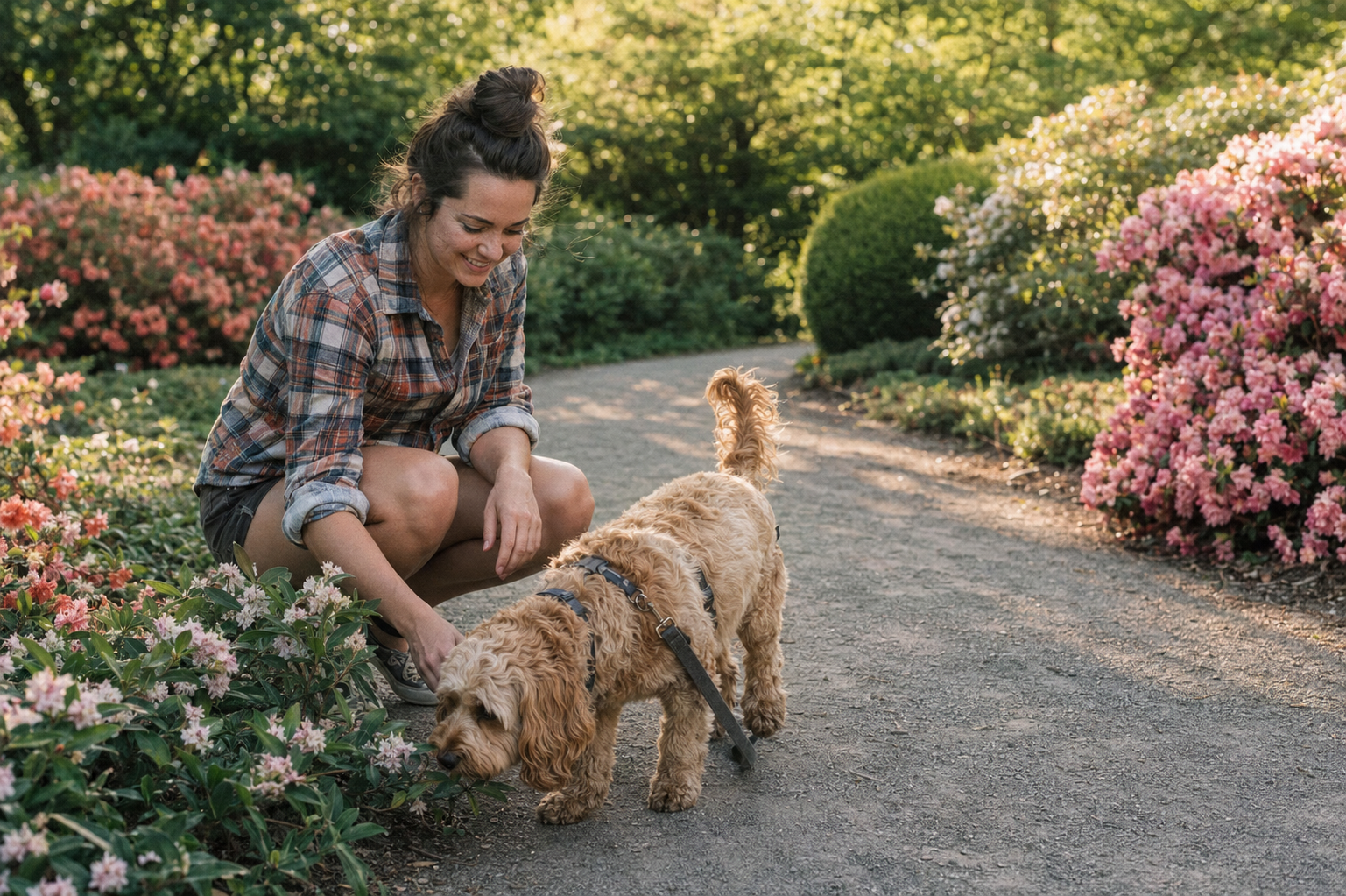
Most of us walk our dogs the way we run errands: pick a loop, keep it moving, get home. The dog, meanwhile, keeps stopping to bury its face in a patch of grass, and we keep tugging it along. It turns out we have the whole thing backward. The slow, sniff-heavy, seemingly aimless walk is not the dog wasting your time. It is the version of the walk that actually does your dog the most good, and there is now solid science explaining why.
No matter the season or where you live, every walk offers a world of shapes, colors, and, for your dog, an overwhelming library of smells. The trick to a genuinely restorative outing is not distance or pace. It is tuning in, letting the nose lead, and coming along for the ride.
Let the nose set the pace
Left to their own devices, most dogs want to linger and take an environment in fully. When we hustle them from point to point, we cut that exploration short, and we may be trading their calm for low-grade stress. The counterintuitive truth is that a short walk spent sniffing everything beats a long walk spent marching.
This is where the science gets genuinely interesting. Sniffing is not just entertainment for a dog; it is physiological decompression. When a dog settles into a real sniffing session, its heart rate drops, and researchers have found that the more a dog sniffs, the more that rate falls, a sign the calming, “rest and digest” side of the nervous system is switching on. That is why a dog so often comes back from a slow, nose-driven walk looking mellow and satisfied rather than wired.
“People think a tired dog means a long run, but scent work exhausts a dog in a completely different, calmer way,” says Dr. Amara Solis. “A good sniffing walk shifts a dog into a lower-arousal state. You’re not just burning energy, you’re actively settling the nervous system, which is exactly what an anxious or over-amped dog needs most.”
There is a mental payoff, too. In a 2019 study, dogs enrolled in nose-work classes became measurably more optimistic on a cognitive-bias test, essentially, more inclined to expect good outcomes. Give a dog a job for its nose and you are not just tiring it out; you may be nudging its whole outlook in a sunnier direction.
And here is the quiet bonus for you. When you slow down enough to let your dog investigate, you notice things too. The next time your pup is nose-deep in a hedge, look up and take in your own surroundings. People are often surprised by what they find just by pausing and looking around. Dogs, as it happens, make excellent mindfulness teachers, if you let them lead.
Take a different route
Your own street always has something new when you approach it with curiosity, but genuinely new places do more. Get past the default backyard fetch session and seek out fresh routes, parks, and short trails to keep your dog mentally stimulated.
New places also feed a specific feeling worth chasing: awe, that humbling wash of feeling you get near something huge or hard to fully take in. Awe has been linked in research to greater happiness and lower stress, so mixing up your route is not only good for your dog’s brain, it is good for your own mood.
Try a walk built around your senses
Shinrin-yoku, loosely “forest bathing,” is the Japanese practice of walking slowly and deliberately through woodland while deliberately opening up all five senses. It has been linked to outcomes ranging from lower stress to stronger immune markers, and the calm it produces appears to extend to dogs as well.
You do not need a forest or a program. Just slow down on your next walk through any place with trees. Drop the destination. Make the whole goal to notice the landscape together, the way light filters through the canopy, the shifting smells of the trees, the sounds layered under the quiet. You will likely find your dog reveals angles of the place you would have walked right past.
While you are at it, notice your own breathing. If it is shallow or ragged, take a few slow belly breaths, letting the exhale run about twice as long as the inhale. As you loosen up, you may sense a small pause at the top and bottom of each breath. Rest in that pause. Let thoughts drift by without trying to force your mind quiet.
Or make it a social hike
If a slower pace is not your speed, a proper hike can be just as rewarding, and doing it with other dogs and their people can make the healthy habit far easier to stick with. Part of the appeal is watching your dog love it: the more you get out and stay active alongside others, the better you tend to feel, and dogs are not so different.
A few practical guardrails before you head out:
- Check that the trail is dog-friendly. Apps like AllTrails usually flag this.
- Pack a dog first-aid kit and roughly double the food and water you expect the two of you to get through, as a buffer.
- Respect the heat. Use extra caution when it is hot, and plan around the coolest parts of the day.
- Stay on the path. Encourage your dog to keep to the designated trail so you are not trampling native plants or disturbing wildlife. That off-trail photo is not worth the damage.
- Guard against ticks every single time, in every season, and do a thorough check afterward.
Ultimately, any walk becomes memorable once you stop treating it as a chore to complete and start treating it as time to explore the world beside your favorite companion. Feeling a little humbled and inspired by what is around you is just an extra layer on something already pretty great: a walk with your dog.
References
- Duranton, C., and A. Horowitz. “Let Me Sniff! Nosework Induces Positive Judgment Bias in Pet Dogs.” Applied Animal Behaviour Science, vol. 211, 2019, pp. 61–66.
- “The Value of Sniffing: A Scoping Review of Scent Activities for Canines.” Applied Animal Behaviour Science, 2024.
- Hansen Wheat, C., et al., and related work on canine scent enrichment and arousal.
- Li, Q. “Effect of Forest Bathing Trips on Human Immune Function.” Environmental Health and Preventive Medicine, vol. 15, no. 1, 2010, pp. 9–17.
Sasha Ford is a certified cat behaviour consultant who has worked with shelters, catteries, and private clients across the country. They review all feline behaviour content at The Pet Times, with expertise in multi-cat households, indoor enrichment, and stress-related disorders.
Meet our experts ↗Keep reading
 LivingThe Only People Who Should Own a Husky Walk 11 Miles a DayMarcus Webb · 7 min
 LivingYour Dog Sleeps Pressed Against You. The Night That Changes Is the One to Notice.Dr. Amara Solis · 7 min
 Health & WellnessNobody Prepares You for Your Dog Getting Old. Start Here.Dr. Lena Park · 8 min
 Health & WellnessYour Old Dog Doesn't Want to Rest. Their Brain Wants a Puzzle.Dr. Nina Kohl · 6 min
 TrainingSix Weeks of Crate Rest Will Break You Both. Give the Dog a Job Instead.Dr. Nina Kohl · 8 min
 LivingThe Doodle Was Sold to You on Three Promises. The Data Backs None of ThemDr. Mara Chen · 9 min