


The Doodle Was Sold to You on Three Promises. The Data Backs None of Them
Hypoallergenic, healthier, low-maintenance. That is the pitch that moves a $5,000 puppy. A 2024 study of nearly a million dogs found designer crossbreeds are no healthier than the purebreds they came from, and the coat you paid for is a coin flip.

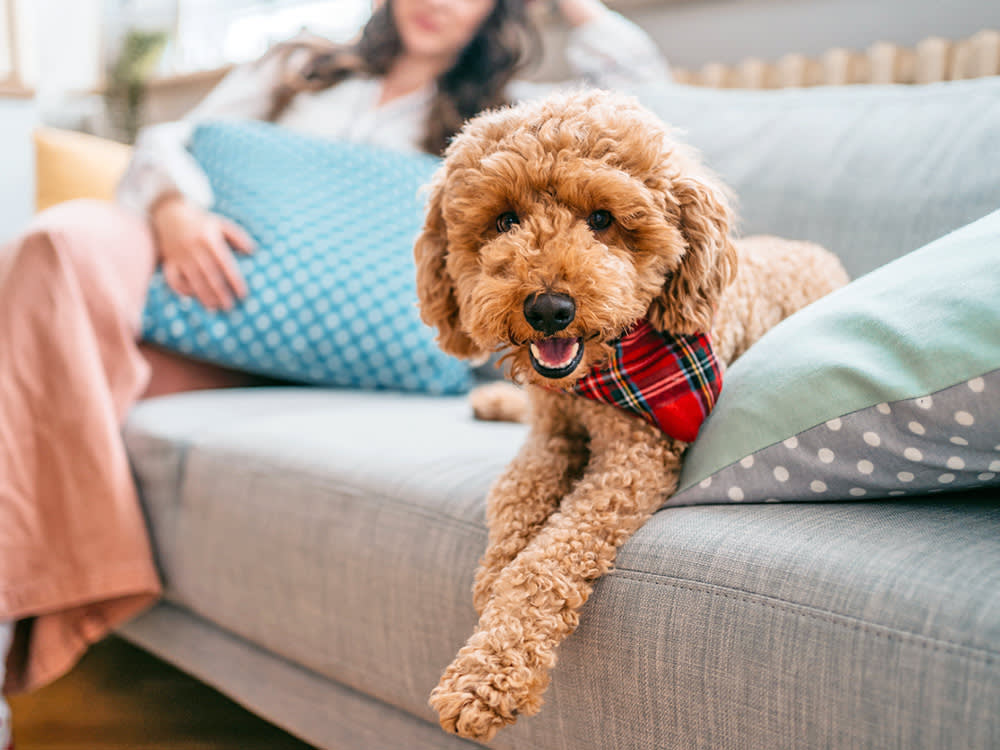
Somebody is about to spend $5,000 on a puppy because of three sentences: it will not trigger your allergies, it will be healthier than a purebred, and it will be an easy family dog.
Not one of those sentences is a fact. Each is a probability, and the odds are worse than the price implies.
This is not an argument against your dog. If there is a Doodle asleep on your couch right now, she is wonderful and this article changes nothing about her. It is an argument about what buyers are being told at the point of sale, because the gap between the pitch and the biology is where the heartbreak lives: the surrendered two-year-old, the sedated shave-down, the family that discovered its hypoallergenic dog sheds.
First, a Doodle is not a breed
A Doodle is not a purebred anything, and cannot be. Poodles have been crossed with other dogs for as long as there have been Poodles, and until 1989 the results were called mutts. That year an Australian guide dog trainer named Wally Conron bred a Poodle to a Labrador so that a blind woman could have a working guide dog her husband’s allergies could tolerate, and the Labradoodle got a name. Conron spent the rest of his life saying he regretted it.
Nearly four decades later the category has metastasized. Poodles have been crossed with Golden Retrievers, Schnauzers, Corgis, Cane Corsos, and essentially anything else with four legs, producing Goldendoodles, Schnoodles, Corgipoos, and a long tail of coinages. No kennel club recognizes any of them, which is not a slight, it is a description. Recognition requires a standard, and a standard requires that breeders agree on what the dog is supposed to be and then prove their dogs against it. Decades in, that has not happened. What has happened instead is a lot of first-generation crossing: one Poodle, one whatever, repeat.
That detail is the key to everything below.
Promise one: hypoallergenic
No dog is hypoallergenic. Not the Poodle, not the Doodle, not the hairless breeds. The allergens that make people miserable are proteins in dander, saliva, and urine, and every dog produces all three. A low-shedding coat can genuinely help, because less loose hair means less allergen distributed around your house. That is a meaningful difference in degree, not a difference in kind.
The trouble is that low-shedding is not what you are buying with a first-generation cross. You are buying a lottery ticket on it.
Coat type is inherited. In an F1 cross (one Poodle parent, one non-Poodle parent) the puppies can land anywhere on the spectrum between the two, and littermates routinely land in different places. One pup gets the tight Poodle curl. His brother gets a Golden Retriever’s coat that drops hair on every soft surface you own. Breeding a Doodle back to a Poodle (an F1b) tightens the odds toward curl, and breeding Doodle to Doodle over generations while selecting hard for coat tightens them further. Most of the market is not doing that. Most of the market is still making F1s.
So the honest version of the sentence is: this puppy may shed very little, may shed quite a lot, and nobody can tell you which at eight weeks.
Promise two: healthier
This is the one that deserves to die, because it is the one with real data against it.
The belief is called hybrid vigor: mix two gene pools, dilute the inherited disease, get a sturdier dog. It is intuitive. In 2024, researchers ran it against the largest relevant dataset anyone has assembled, using the UK’s VetCompass primary-care records to compare Cockapoos, Labradoodles, and Cavapoos against the purebred breeds they descend from across dozens of common disorders.
The result: in 86.6 percent of the health comparisons, there was no statistically significant difference at all. The designer crossbreeds had higher odds for 7.0 percent of disorders and lower odds for 6.4 percent. Essentially a wash, with a slight tilt in the wrong direction.
In plain terms, crossing a Poodle with a Retriever does not launder the health problems out of either one. Doodles inherit risk from both sides of the family, and in clinics we see exactly that: hip and elbow dysplasia, allergic skin disease, progressive retinal atrophy, and ear infections, chronically, endlessly, ear infections. A floppy ear packed with dense curling hair is a warm, humid, poorly ventilated tube, which is an excellent description of a place bacteria and yeast would like to live.
None of that is an argument that Doodles are unhealthy dogs. It is an argument that they are ordinary dogs, carrying ordinary risk, sold at an extraordinary price on a promise of unusual health.
Hybrid vigor is real in population genetics, but it is not a coupon you can redeem at a breeder’s kitchen table. What protects a puppy is not the mix, it is whether both parents were screened for the things their breeds actually get. Ask for the hips, the elbows, and the eyes in writing, or assume they were never checked.
Promise three: low-maintenance
The coat that does not shed is the coat that does not release anything, including the hair it has already grown. That hair does not fall on your floor. It stays on the dog and it tangles.
A neglected Doodle coat mats down to the skin, and matting is not a cosmetic problem. Mats tighten, pull the skin, cut off airflow, hide moisture, and produce sores underneath. By the time it is bad, the coat cannot be brushed out, and the dog goes under sedation to be shaved down to stubble. Groomers see this constantly, and the dogs are frequently under three years old, owned by people who were told this coat was easy.
A weekly once-over with a brush will not keep this coat out of trouble. A curly or wavy Doodle coat needs to be worked through to the skin several times a week with a slicker and a comb, plus a professional groom roughly every six to eight weeks, which in most of the country runs $90 to $150 a visit. Budget for it before the puppy comes home, because the alternative is a shave-down.
Then there is the engine. Poodles are working dogs. So are Retrievers, and Schnauzers, and Aussies. Cross two working breeds and you get a smart, energetic animal who becomes destructive when bored, not because he is badly behaved but because he was built to have a job and you gave him a sofa. Goldendoodles bring the Retriever’s motor. Bernedoodles bring the Bernese stubbornness. This is normal dog stuff, and it is a great deal of work, and it is the opposite of what “low-maintenance family dog” promises.
The variable that actually predicts your dog
Not the mix. The breeder.
Because there is no standard and no governing body, the Doodle market has almost no floor, and the money is very good. A great deal of what looks like a professional breeding program is a website, a mission statement, and a photographer. Before a deposit leaves your hands:
- Health testing, on paper. Hips, elbows, eyes, and the breed-relevant genetic panels, for both parents, with certificate numbers you can look up. “Vet checked” is not health testing.
- The mother, in person. See her, with the litter, in the place they live. A breeder who will only meet you in a parking lot is telling you something.
- Where the pups actually grow up. Puppies raised in a house, around noise and floors and people, arrive better wired than puppies raised in an outbuilding.
- A contract with a return clause. Serious breeders take the dog back, for life, no matter what. It is the single most reliable sign that someone is not just moving inventory.
- A limit on how much they produce. Multiple litters, multiple crosses, always available, no waitlist. That is a business, not a program.
- Honest talk about the coat. A breeder who guarantees a non-shedding, hypoallergenic F1 puppy is either uninformed or lying. Both are disqualifying.
You do not have to buy one at all
Doodles are so desirable that some shelters have resorted to dressing their smooth-coated dogs in curly wigs, a joke that is also a scream for help. A Doodle who lands in a shelter rarely waits more than a day or two, which means the shelter dogs sitting for months are the ones whose only failing is a smooth coat.
If you want this dog, the crosses end up in rescue in real numbers, and there are breed-specific rescues that specialize in exactly them. An adopted adult Doodle also solves the biggest unknown in this entire article: you can see the coat, you can see the size, you can see the temperament, and the people who have been living with him for six weeks can tell you what he is actually like at 6 a.m.
The breed label is a marketing category. The dog in front of you is the only real thing in the transaction.
What newer research adds
The strongest evidence on this question is recent. The 2024 VetCompass analysis published in PLOS One is the first large-scale look at whether designer crossbreeds are healthier than their parent breeds, and its answer is essentially no: no meaningful difference across the large majority of disorders studied, with the crossbreeds slightly more likely to have higher odds than lower ones.
Earlier work from the same group found something equally useful about buyers. People acquiring designer crossbreeds were more likely than purebred buyers to have gotten the puppy without seeing the mother, and more likely to have paid a deposit before ever meeting the litter. The health story and the sales story turn out to be the same story.
If you take one thing from the data, take this: the money you would spend on the promise of hybrid vigor buys you nothing. The money you spend on a breeder who screens both parents buys you a great deal.
References
- Wallis, C., et al. “The doodle dilemma: How the physical health of ‘Designer-crossbreed’ Cockapoo, Labradoodle and Cavapoo dogs’ compares to their purebred progenitor breeds.” PLOS ONE, 2024.
- Packer, R.M.A., et al. “How much is that doodle in the window? Exploring motivations and behaviours of UK owners acquiring designer crossbreed dogs (2019-2020).” Canine Medicine and Genetics, 2022.
- Burke, D. “Labradoodle Creator Says the Breed Is His Life’s Regret.” The New York Times, September 25, 2019.
Dr. Chen is a small-animal veterinarian who leads health and safety coverage at The Pet Times. She writes and reviews the bulk of our illness, condition, and safety content, translating clinical guidance into clear, practical advice owners can act on at home.
Meet our experts ↗Keep reading
 LivingThe Only People Who Should Own a Husky Walk 11 Miles a DayMarcus Webb · 7 min
 Health & WellnessYour Old Dog Doesn't Want to Rest. Their Brain Wants a Puzzle.Dr. Nina Kohl · 6 min
 LivingMalamute or Husky? One of Them Will Redecorate Your House FasterDr. Nina Kohl · 8 min
 TrainingSix Weeks of Crate Rest Will Break You Both. Give the Dog a Job Instead.Dr. Nina Kohl · 8 min
 Health & WellnessThe Real Threat to an Old Dog Isn't Age. It's a World That Keeps Getting Smaller.Dr. Ravi Mehta · 8 min
 LivingThe Best Walk for Your Dog Is the Slowest OneSasha Ford · 6 min