


Homemade Cat Food Looks Healthier Than a Can. The Missing Ingredient Can Be Fatal.
Cooking for your cat isn't the hard part. Getting a diet that's actually complete is, and the nutrient most home recipes leave out can quietly cause blindness and heart failure.

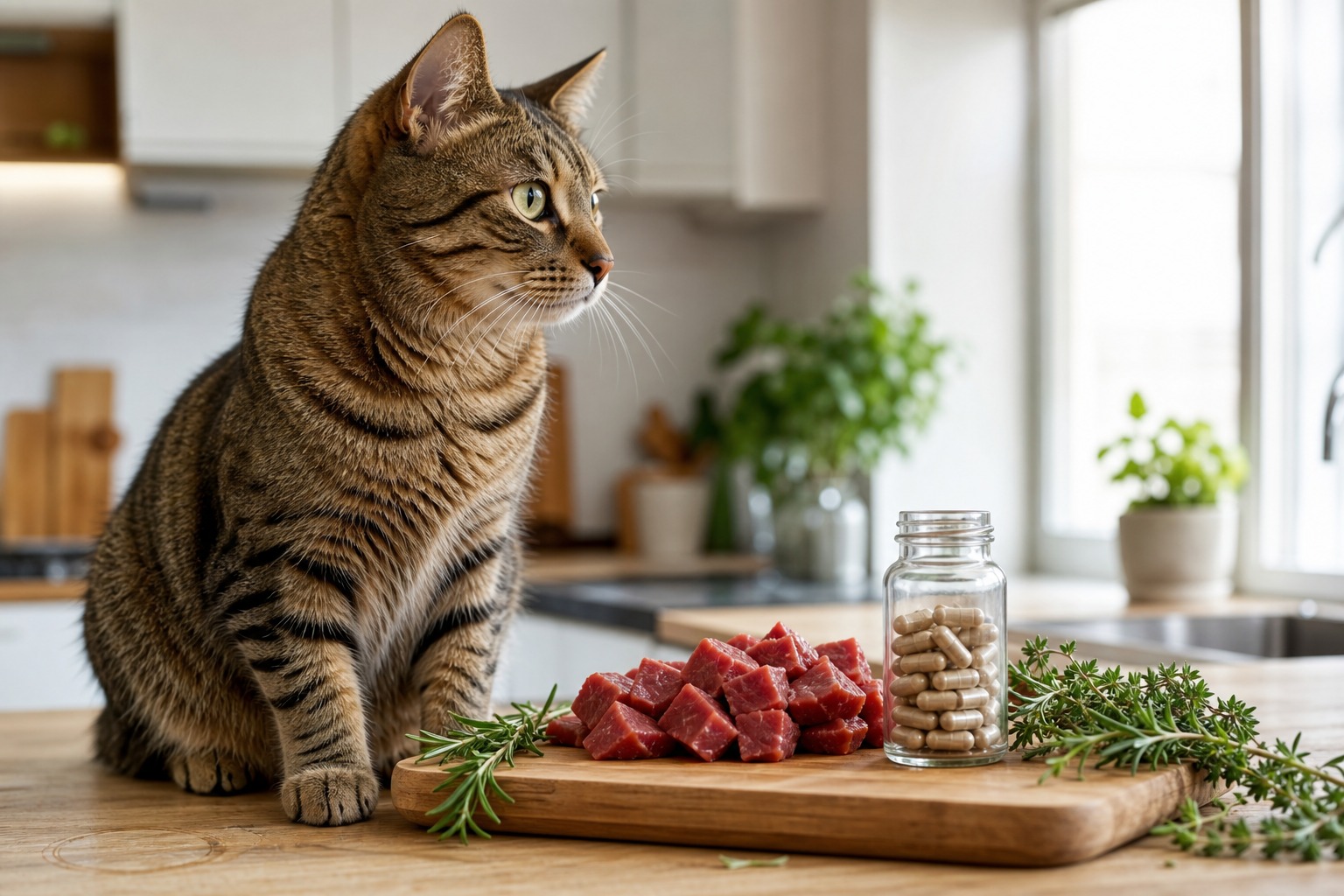
A bowl of gently cooked chicken looks, to a human eye, obviously healthier than a scoop of processed pellets or a can of paste. That instinct is exactly the trap. When people move their cat to home-cooked food, the thing that hurts the cat is almost never the part they can see, the meat, the freshness, the care. It’s the part they can’t: the specific nutrients a cat needs that a plate of real food doesn’t automatically contain.
Homemade cat food can absolutely be a good choice. Some cats genuinely thrive on it, and owners often turn to it for good reasons, especially when a cat is managing a chronic illness and they want tight control over every ingredient. But the honest version of the advice isn’t “homemade is healthy” or “homemade is dangerous.” It’s this: a homemade diet is only as good as its formulation, and a diet that’s off can fail silently for months before you’d ever notice. So before you preheat anything, it’s worth understanding what actually makes a cat’s food complete, and what happens when it isn’t.
Cats are not small, furry people (or dogs)
The starting point is that cats are obligate carnivores. That’s not a lifestyle label; it’s a hard metabolic fact. Their bodies are built to run on animal protein, and a nutritious feline diet has to deliver the right balance of several things at once: protein from meat or fish, specific amino acids, healthy fats, vitamins, minerals, and water. Those can come from a range of sources, from beef and salmon to certain vegetables, oils, and supplements, but the balance is the whole game.
Just as important is what you leave out. A number of everyday human foods are toxic to cats and have no place in their bowl, including raisins, grapes, onions, garlic, tomatoes, nuts, and the artificial sweetener xylitol. It’s also wise to go easy on fillers like corn, rice, and soy, and other simple carbohydrates, which cats digest poorly and which can irritate the gut. This is why the standing recommendation is to build any recipe with a veterinarian or a veterinary nutritionist rather than a search engine, tailored to your specific cat’s needs.
The nutrient that makes this urgent: taurine
If there’s one word that separates a safe homemade cat diet from a dangerous one, it’s taurine. Taurine is an amino acid that cats, unlike dogs and humans, largely cannot manufacture in their own bodies. They have to eat it, and they have to eat enough of it, consistently.
When they don’t, the consequences are severe and, crucially, delayed. Taurine deficiency causes dilated cardiomyopathy, a form of heart failure in which the heart muscle stretches and weakens, and it causes irreversible degeneration of the retina that can end in permanent blindness. The reason this is so dangerous in a homemade context is the timeline: a taurine-deficient cat can look and act completely normal for a long stretch, in some cases up to two years, while damage accumulates out of sight. By the time symptoms appear, some of it can’t be undone. A commercial food labeled “complete and balanced” has taurine engineered in. A bowl of home-cooked meat does not, unless you deliberately put it there.
What newer research adds
This isn’t a hypothetical worry, and the data on it is sobering. When researchers published an evaluation of home-prepared maintenance recipes for cats in the Journal of the American Veterinary Medical Association, they analyzed 114 different recipes and found that not a single one met all of the established nutrient recommendations. Recipes written by non-veterinarians, and recipes that skipped supplement-type ingredients, fared the worst. Nearly four out of five of the recipes, about 79 percent, didn’t include a dedicated taurine supplement at all.
The shortfalls weren’t limited to taurine, either. The recipes commonly came up short on choline, iron, thiamine, and vitamin E, among others, nutrients whose deficiencies carry their own health consequences over time. The takeaway isn’t that people who cook for their cats are careless. It’s that “looks like a balanced meal” and “is a balanced feline diet” are two entirely different standards, and the gap between them is invisible without formulation. This is the single strongest argument for running any homemade plan past a veterinary nutritionist before it becomes your cat’s daily food.
Cooking and storing it safely
Assuming you’ve got a properly formulated recipe, the mechanics are straightforward, but they matter. Home-cooked cat food, like any fresh food, has a short shelf life, roughly five days in the refrigerator. The practical move is to cook in larger batches and portion the extra into the freezer, thawing servings as you need them.
Don’t rush the switch. Cats are famously suspicious of new food, and an abrupt change invites both a hunger strike and an upset stomach. Plan on transitioning over about two weeks: start by mixing in around 25 percent of the new food with their current diet, then gradually shift the ratio until they’re fully switched. Going slow gives their digestive system, and their opinions, time to adjust.
When it works, it can work well
None of this is meant to scare you off. A carefully built homemade diet, or even a partly homemade one, does wonders for some cats. Owners who make the switch thoughtfully often report real, visible payoffs: more energy, smaller and less frequent stools, glossier coats, and even improved numbers on routine bloodwork. Those benefits are exactly why people go to the trouble.
The difference between the cats who thrive and the ones who quietly get sick is almost never the cooking. It’s whether someone made sure the invisible nutrients were there.
Owners always ask me if home cooking is good or bad for cats, and it’s the wrong question. The question is whether the recipe is complete, because a cat can’t tell you it’s missing taurine until the damage is already done. Cook for your cat if you want to. Just build the recipe with a nutritionist first, and never assume real meat equals a real diet.
If your cat’s appetite or energy ever shifts suddenly, on any diet, that’s a reason to call your vet rather than wait it out. And any homemade plan should be a conversation with your veterinary team, not a solo project. The care you’re bringing to the kitchen is real. Point it at the nutrients your cat can’t see, and it pays off.
References
- Wilson SA, et al. “Evaluation of the nutritional adequacy of recipes for home-prepared maintenance diets for cats.” Journal of the American Veterinary Medical Association, 2019;254(10):1172.
- Cornell Feline Health Center: Feeding Your Cat
- AAHA: Homemade Pet Food Guidance
- Tufts Petfoodology: What You Need to Know About Taurine
Not a substitute for your vet. Our guidance is educational. For urgent symptoms, contact a vet or emergency clinic right away. Editorial standards
Dr. Chen is a small-animal veterinarian who leads health and safety coverage at The Pet Times. She writes and reviews the bulk of our illness, condition, and safety content, translating clinical guidance into clear, practical advice owners can act on at home.
Meet our experts ↗Keep reading
 FoodHigh Protein Isn't a Health Upgrade for Cats. It's a Prescription.Dr. Mara Chen · 7 min
 TrainingYour Cat's Meow Isn't Their Voice. It's a Tool They Built for You.Dr. Nina Kohl · 7 min
 FoodYour Cat Wants Your Salad. Here's What Lettuce Actually Does.Dr. Amara Solis · 4 min
 FoodThe 'Natural' Raw Diet Is Failing Cats on Two FrontsDr. Amara Solis · 7 min
 Health & WellnessYour Cat Isn't Picky. Your Cat Is Missing a GeneDr. Nina Kohl · 6 min
 FoodWhen a Kitten Can Eat Dry Food, and the Tradeoff Nobody MentionsDr. Amara Solis · 8 min