


Grain-Free Cat Food Solves a Problem Your Cat Doesn't Have
The pet-store shelf is wall-to-wall grain-free, but for cats the label answers a question almost none of them are asking. Here's what actually matters in the bowl, and where grain-free earns real caution.

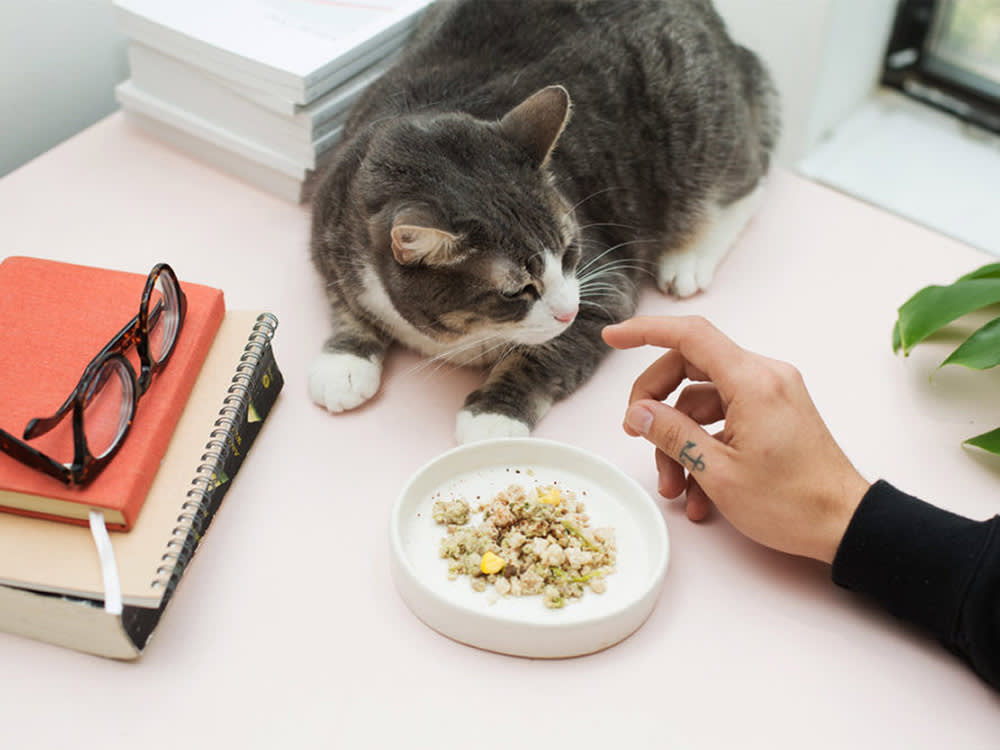
Walk into any pet store and try to find cat food that isn’t grain-free. Go ahead, look. You will scan the big-box aisle and the fancy boutique alike and come up with almost nothing. Somewhere along the way, “grain-free” stopped being a specialty diet and became the default, the thing every bag shouts on the front, as if grains were an ingredient your cat had been begging to escape.
Here is the part the packaging leaves out. For cats specifically, the grain-free question is mostly a marketing answer to a question your cat never asked. The real decisions that shape a cat’s health happen somewhere else entirely, in the protein, the moisture, and one particular amino acid. Let’s put grain in its actual place and then talk about what belongs in the bowl.
Cats are barely allergic to grain in the first place
The usual reason people reach for grain-free is allergies, and it is a reasonable instinct pointed at the wrong target. When cats do develop food allergies, they are far more likely to react to a protein, chicken, beef, fish, than to a carbohydrate. A true grain sensitivity is genuinely rare.
The number of cats with a real, diagnosable grain sensitivity is very small. Far more often, the itchy or upset-stomach cat in front of me is reacting to a protein, and pulling grain out of the food does nothing for that. You end up changing the label without changing the problem.
If you suspect a food allergy, the way to actually find it is with your vet, through a proper elimination diet or an allergy panel, not by guessing at the grain. Swapping to a grain-free bag off the shelf is a shot in the dark that usually misses.
The DCM scare is mostly a dog story
The most serious cloud hanging over grain-free food is a heart condition called dilated cardiomyopathy, or DCM, in which the heart muscle weakens and enlarges and, at its worst, can be fatal. Starting in 2018, the FDA began investigating a pattern of DCM in pets eating “grain-free” diets built heavily on peas, lentils, other legumes, and potatoes in place of grain.
Two things are worth holding in your head at once. First, the overwhelming majority of those reported cases were in dogs, not cats. Second, in cats, DCM has a well-known history that predates the grain-free trend entirely: it was classically tied to diets low in taurine, an amino acid cats must get from their food. Decades ago, taurine deficiency was a leading cause of feline DCM, until pet-food makers started adding enough of it. Whether modern grain-free formulas reintroduce any risk for cats is still an open scientific question rather than a settled fact.
In cats, the DCM story really runs through taurine, not grain. A complete, properly formulated food should already have taurine covered. My worry isn’t the word ‘grain-free’ on the bag, it’s a boutique recipe that leans hard on legumes and hasn’t been through real feeding trials.
What actually matters when you buy cat food
Forget the front of the bag for a second and turn it over. A few things do the heavy lifting:
Look for the AAFCO statement. Somewhere on the label there should be a line saying the food is complete and balanced to the standards of the American Association of Feed Control Officials, ideally backed by feeding trials rather than just a formulated-to-meet claim. That single sentence tells you the food is designed to be a full diet, not a topper.
Match the life stage. Buy food labeled for your cat’s actual stage, kitten, adult, or all life stages. A growing kitten and a senior cat are not chasing the same nutrients.
Prioritize protein and moisture. Cats are obligate carnivores built to run on animal protein, and most get far too little water from dry food alone. A high-protein recipe and plenty of moisture, whether from wet food or a high-moisture fresh diet, do more for a cat’s long-term health than the presence or absence of grain ever will.
Change food slowly. Whatever you switch to, ease into it over a couple of weeks, mixing more of the new food in gradually. A sudden diet change is a reliable way to trigger vomiting or diarrhea, and cats are dramatic about it.
And the single most useful move: talk to your vet before a switch, especially if your cat has any medical history. Your vet knows things a label cannot.
If you want grain-free anyway, buy it well
None of this means grain-free food is bad. Plenty of grain-free recipes carry the AAFCO label and are perfectly good food. The trouble is concentrated in boutique formulas that swap grain for a heavy load of peas, lentils, and potatoes and skip the rigorous testing. If you like the idea of grain-free, the smart version is to look for high protein, real moisture, an AAFCO complete-and-balanced statement, and, ideally, a brand that runs feeding trials. Human-grade fresh options such as Raised Right are one route for people who want to avoid high-carb fillers specifically.
A few recipes that fit the “grain-free done thoughtfully” description, drawn from what our editors and their cats have actually eaten:
- Smalls builds its human-grade fresh food around named ingredients like chicken, green beans, peas, and kale, and formulates to AAFCO profiles for all life stages.
- Open Farm homestead recipe pairs Animal Welfare Certified chicken and turkey with chickpeas and pumpkin for cats who need high protein.
- The Honest Kitchen makes a high-moisture cod-and-salmon recipe suited to adult cats and kittens who are obsessed with fish.
- ZIWI Peak mackerel is a low-carb, whole-prey recipe (about 92 percent fish, plus green mussels sourced from New Zealand) with none of the grain-or-potato fillers.
- Made by Nacho offers a pâté of sustainably caught fish, bone broth, and flaxseed with a texture picky cats tend to like.
- Cat Person wet meals are moisture-forward and higher in protein than the industry standard, with a big lineup for fussy eaters.
- Lucy Pet uses quinoa as an easily digestible, protein-rich base in its grain-free dry food.
- Iams grain-free trays are a budget-friendly option with added vitamin E and fish oil for skin and immune support.
What’s new since this was written
The science has moved, mostly toward caution rather than alarm. As of 2024 and 2025, large reviews of the evidence have concluded that a direct, causal link between grain-free diets and DCM still has not been proven. DCM turns out to be multifactorial, shaped by genetics, individual susceptibility, and overall diet formulation, not by the single fact of whether a food contains grain. Researchers even found that nearly all grain-free products already contained enough of the building blocks a body needs to make taurine, which complicates the original taurine-deficiency theory.
The FDA, for its part, has said it does not plan to issue further public updates until there is meaningful new scientific information to share. That is not the same as the case being closed. Diet-associated DCM tied to boutique, legume-heavy recipes is still something cardiologists watch for. The honest bottom line for a cat parent in 2026 is unchanged: a well-formulated, tested, high-protein food matters far more than the grain-free label, and your vet is the right person to help you read past the marketing.
References
- U.S. Food and Drug Administration. “FDA Investigation into Potential Link between Certain Diets and Canine Dilated Cardiomyopathy.” Accessed July 2026. https://www.fda.gov/animal-veterinary/outbreaks-and-advisories/fda-investigation-potential-link-between-certain-diets-and-canine-dilated-cardiomyopathy
- Cornell Feline Health Center. “Feeding Your Cat.” Accessed July 2026. https://www.vet.cornell.edu/departments-centers-and-institutes/cornell-feline-health-center
- “Grain-Free Diets for Dogs and Cats: An Updated Review Focusing on Nutritional Effects and Health Considerations.” Animals, 2025. https://www.mdpi.com/2076-2615/15/14/2020
- American Association of Feed Control Officials. “Understanding Pet Food Labels.” Accessed July 2026. https://www.aafco.org/consumers/understanding-pet-food/
Not a substitute for your vet. Our guidance is educational. For urgent symptoms, contact a vet or emergency clinic right away. Editorial standards
Dr. Nair is a veterinarian focused on diet and feeding. She covers everyday nutrition, treats, and the many "can they eat this?" questions owners ask, grounding each answer in what is actually safe and sensible for dogs and cats.
Meet our experts ↗Keep reading
 FoodWet Cat Food and the 2-Hour Rule: The Clock Starts the Second You Open the CanDr. Amara Solis · 7 min
 FoodPeas Off Your Plate Are Fine for Cats. Peas in the Bag Are the Ones to Read AboutDr. Amara Solis · 6 min
 FoodYour Senior Cat Isn't Picky. The Food Is the Wrong Temperature.Dr. Mara Chen · 7 min
 FoodYour Cat Can Eat Dog Food. One Missing Nutrient Means They Can't Live on ItDr. Ravi Mehta · 7 min
 FoodFor a Carnivore, 'Is It Safe?' Is the Wrong Question About Human FoodDr. Priya Nair · 6 min
 FoodYour Kitten Isn't Starving. Weigh Them Every Week.Dr. Priya Nair · 7 min