


Your Cat Probably Taught Itself to Fetch, and That's the Real Headline
A survey of more than 8,000 cat owners found 4 in 10 cats fetch. The surprising part is not the number. It is that most cats start the game on their own, and it tracks with personality, not prey drive.

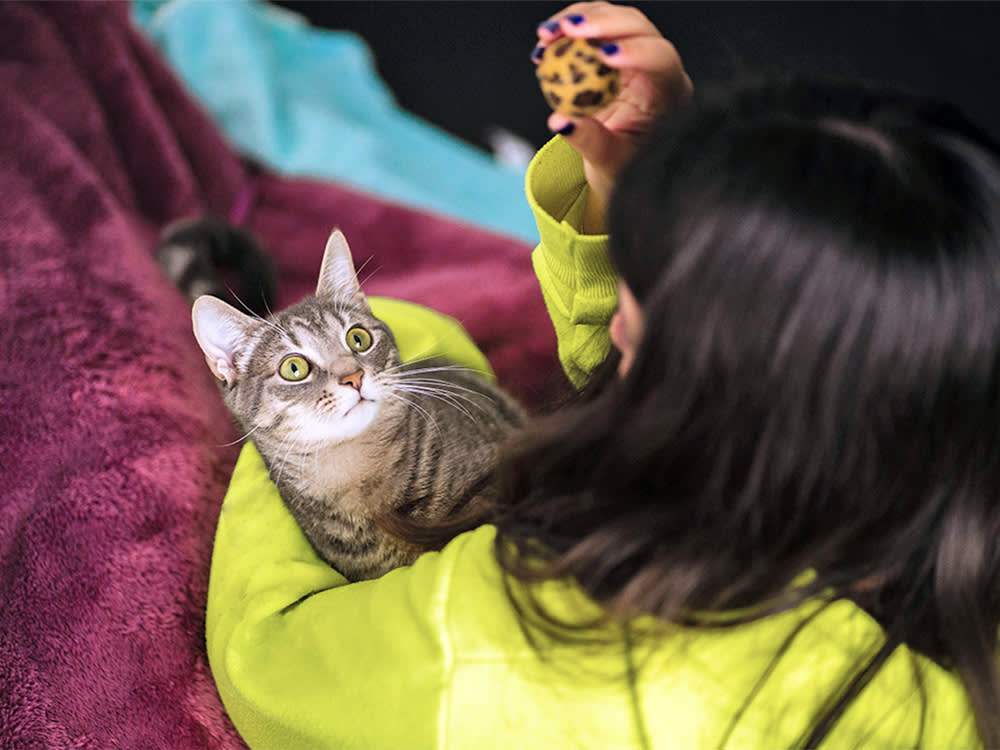
The stat everyone repeated from this study is that four in ten cats play fetch. It is a fun number, but it is the least interesting thing the research found. The genuinely surprising result is buried a layer down: for most of these cats, nobody taught them. The cat picked up a bottle cap, dropped it at someone’s feet, and a game was born. Fetch in cats is less a trick you install and more a behavior your cat was already offering, if you knew to throw the thing back.
That reframing matters, because it changes what you do with the information. You are not training a reluctant animal. You are noticing an invitation.
What the survey actually measured
To gauge how common fetching really is, researchers analyzed responses from 8,224 cat owners, each describing how often their cat performed 100 different behaviors, with data collected between 2015 and 2023. The result, published in PLOS ONE in September 2024: 40.9 percent of cats were reported to sometimes, usually, or always play fetch.
The patterns underneath the number are the useful part. Cats kept indoors and cats in dog-free homes fetched more. Male cats fetched more than females. Younger, healthy cats fetched more than older cats or cats managing health problems. And fetch rarely traveled alone. About 58 percent of cats carried toys or objects around the house, and 39 percent initiated interactive play by bringing a toy to their person. In other words, the fetch itself sits inside a broader “I brought you this” repertoire that a lot of cats run without any prompting.
For scale, the same team surveyed dog owners and found 77.8 percent of dogs fetch. Dogs still lead, but cats playing at more than half the dog rate is a long way from the aloof-loner stereotype.
The finding that flips the script
Here is the result worth sitting with. When the researchers looked at what predicted fetching, the strongest link was not prey drive. It was personality. Fetching correlated more tightly with how playful and active a cat was than with how strong its hunting instinct measured.
That single detail changed how I talk to owners about it. People assume fetch is a hunting thing, so they think their calm, non-hunty cat won’t do it. But the data says the better question is whether your cat is playful and busy, not whether it is a killer. A goofy, high-energy lap cat is a more likely fetcher than a stone-cold mouser who mostly naps.
Why cats fetch at all still traces partly to instinct. Cats are stalk-and-rush hunters built for short chases, and the arc of a fetch, the chase, the pounce, the grab, maps onto that wiring. In the wild, a cat that makes a catch often carries it off to a safer spot or back to its kittens, which looks a lot like a cat trotting a toy back to your chair. But the survey’s own numbers say the through-line to your cat is temperament first, predator second.
How to find out if your cat is a latent fetcher
Because most feline fetch is self-started, your job is less “teach” and more “make it easy to offer.” Working from what the study associated with fetching, here is a low-pressure way to test the waters:
- Play to the personality, not the prey drive. If your cat is active and playful, it is a candidate regardless of how much it “hunts.” Start there.
- Pick a carriable object. Fetchers overwhelmingly favor things they can grip and haul: a crinkle ball, a small soft mouse, a hair tie, a bottle cap. Light and mouth-sized beats big and plush.
- Throw short, then read the return. Toss it a few feet. If your cat chases and grabs, that is act one. If it carries the object back even part way, throw it again immediately. The reward for fetching is another throw.
- Let the cat set the length. Fetch sessions in cats are short by nature. Two or three retrieves can be a complete, satisfying round. Stop before your cat does.
- Do not force a non-starter. A cat that grabs and walks off is not failing. It is simply not a carrier, and that is common and fine.
The bigger point behind the research is a little reputational. Cats get painted as independent and standoffish, yet fetch is a plain example of a cat choosing to interact with us, on its own initiative, for no reward but the game. If your cat has ever dropped something weird at your feet and stared, that was the pitch. All you had to do was throw it back.
References
- Delgado, Mikel M., et al. “Making fetch happen: Prevalence and characteristics of fetching behavior in owned domestic cats (Felis catus) and dogs (Canis familiaris).” PLOS ONE, September 2024. https://journals.plos.org/plosone/article?id=10.1371/journal.pone.0309068
- Purdue University College of Agriculture. “Fetch, kitty! New research shows that cats are more eager to retrieve than you might think.” https://ag.purdue.edu/news/2024/09/fetch-kitty-new-research-shows-that-cats-are-more-eager-to-retrieve-than-you-might-think.html
Leila Torres leads our Living coverage, from home life and travel to the products and rescue stories that come with sharing a life with animals. She edits and writes across the section, with a soft spot for pieces about the bond between people and their pets.
Meet our experts ↗Keep reading
 TrainingYour Cat Holds a Picture of You in Their Head, Even When You Leave the RoomDr. Mara Chen · 4 min
 TrainingMaking Biscuits Isn't One Thing. How to Read What Your Cat MeansJames Okafor · 8 min
 TrainingYour Cat Isn't Running Hot and Cold. They're Running a Consent System.Dr. Amara Solis · 7 min
 TrainingYour Cat Rubbing Your Legs Isn't a Hug. It's a Deposit.Dr. Priya Nair · 7 min
 TrainingYour Cat's Tail Isn't Talking to You. It's Talking to Whatever They're Looking At.Dr. Nina Kohl · 7 min
 LivingYour Cat Isn't Watching You Cook. He's Reading the Room.Dr. Mara Chen · 7 min