


Yes, You Can Dye Your Dog for Halloween. No, Not Like That.
Coloring your dog's coat for Halloween is fine, if you follow a groomer's rules about which products and which body parts. The face is off-limits, cats are a hard no, and human hair dye is dangerous.

Affiliate disclosure. This article contains affiliate links. We may earn a small commission if you buy through a link, at no extra cost to you. How we handle recommendations.
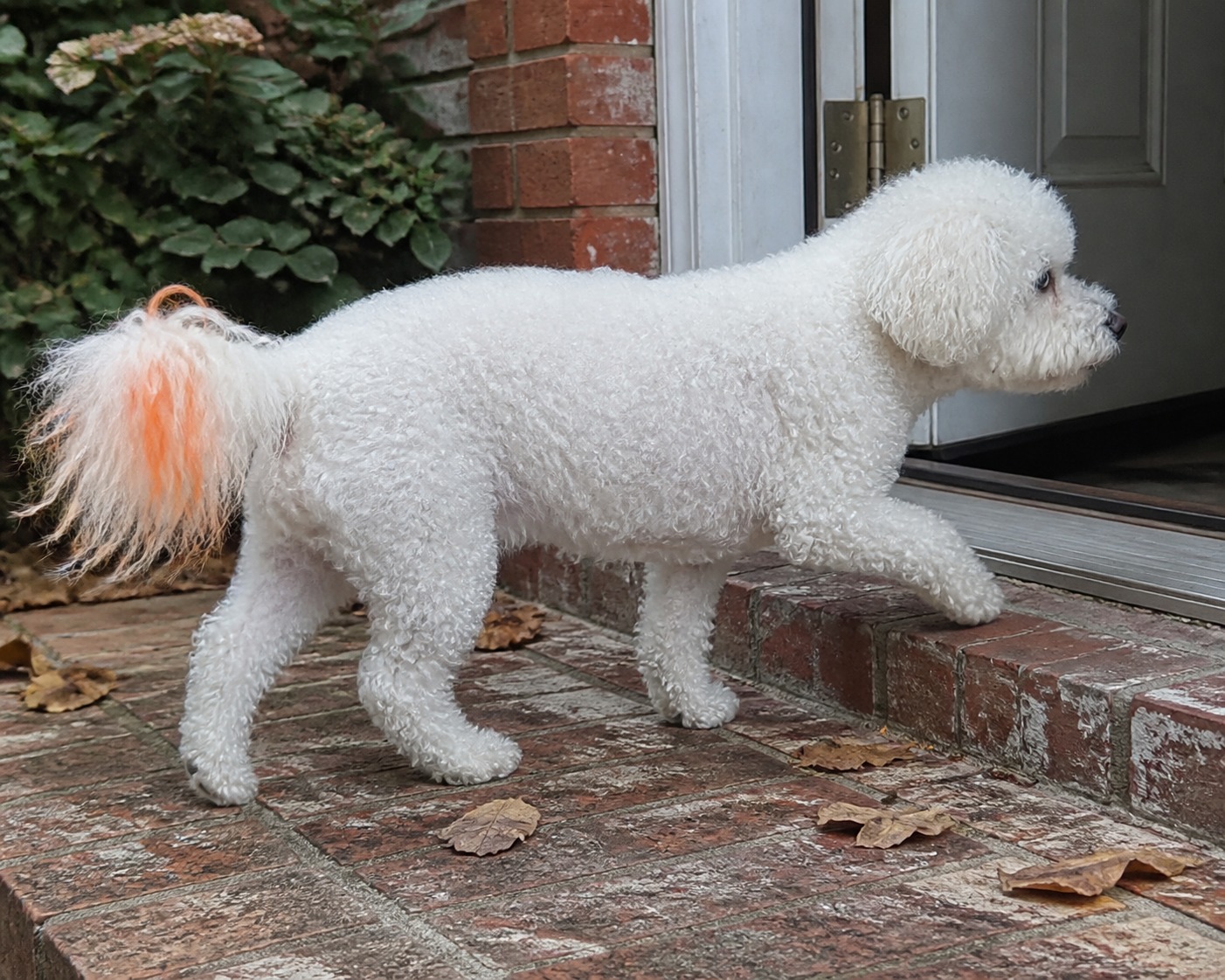
Every October, the same question makes the rounds: is it cruel to dye your dog for Halloween, or is it harmless fun? The honest answer is that it’s neither, on its own. Whether a splash of color is a delight or a trip to the emergency vet comes down almost entirely to what you put on your dog and where you put it. Get those two things right and a festive dog is a happy dog. Get them wrong and you’ve turned a costume into a chemistry problem.
So let’s skip the hand-wringing and do this properly. Here are the rules that actually matter.
Rule one: dog-specific products, always
This is the non-negotiable one. The human hair dye in your bathroom cabinet is formulated for human skin and scalps and is not safe for dogs, full stop. Dogs lick themselves, their skin chemistry is different, and the ammonia and peroxide in salon dye have no business anywhere near them. If you’re going to add color, it has to be a product made and labeled specifically for dogs.
The good news is those products exist and they’re easy to find. Temporary, washable options are the friendliest place to start. OPAWZ Blow Pens are non-toxic, washable airbrush-style pens, ideal for exactly the kind of light touch this whole piece is arguing for. For fuller coverage, PetPaint is a non-toxic colored spray designed for dogs, though it’s messier to work with than the pens. If you want something longer-lasting, dog-safe semi-permanent and permanent dyes exist too, but those need to be shampooed in and dried, so they’re more of a project than a Tuesday-night whim.
Rule two: pick your zones, and leave the face to a professional
Where you apply color matters as much as what you use. The safest canvas is the parts of your dog that are easy to reach, easy to see, and far from the eyes, nose, and mouth. A tail is close to perfect. A little color there or along the back is low-risk and, frankly, looks better than a dog drowning in dye anyway.
The face is a different story. Do not dye your dog’s face at home. Full stop. The area is packed with sensitive tissue, and a drip into an eye or up a nose turns a cute idea into an injury. If you’re set on facial color, that’s a job for a professional groomer who does creative work, not a kitchen-table experiment.
Rule three: never a cat
This one’s short. Don’t dye a cat. Cats groom obsessively, ingesting whatever’s on their coat, and they’re far more sensitive to many chemicals than dogs are. There is no home cat-dyeing that’s a good idea. If the thought crossed your mind, uncross it.
The costume half of the equation
Plenty of “dyed dog” looks are really costume-plus-color, so a word on the fabric part. When you’re choosing an outfit, the enemy is friction. Make sure nothing rubs or chafes where it slides over your dog, especially in the armpits. The simplest test is the best one: put it on, and let your dog walk around the house in it while you watch. If they move naturally, you’re good. If they freeze, hunch, or try to back out of it, believe them.
A few more comfort notes:
- Skip tight boots. Beyond being uncomfortable, snug boots can mat the fur on the feet. If your look needs them, keep it brief.
- Brush out afterward. Any dog with fluff should get a good brush-out once the costume comes off, so nothing tangles or mats where the fabric sat.
- Watch the clock. No costume should stay on for hours. It’s a photo op, not an outfit for the day.
Skin, licking, and the overheating trap
Here’s a reassuring fact: for most dogs, their own fur acts as a barrier between a costume and their skin, so irritation is less common than you’d think. That doesn’t mean you get to stop paying attention. Watch for signs of genuine discomfort, not the mild “what is this” wariness every dog shows the first time, but real distress, and honor it if you see it.
Two specific risks are worth naming. First, overheating: a thick or heavy costume can cook a dog fast, so if the outfit is warm, keep sessions short and skip it entirely on a mild-to-warm day. Second, licking: because dogs will taste whatever’s on them, the “non-toxic, dog-safe” rule from up top isn’t a formality. It’s the reason it’s safe when your dog inevitably licks a dyed spot.
How the pros actually apply color
A little technique goes a long way, and the best trick is also the gentlest. Rather than blasting a whole dog with spray, deposit a small amount of color, on the tail, say, then run a brush through it. The brush glides the pigment along the coat and distributes it far more evenly than spraying does, and it keeps you in control of exactly how much goes where. The airbrush pens make this especially clean; a single stroke of color, brushed out, reads as intentional rather than chaotic.
Which is really the whole aesthetic argument here: subtle wins. A hint of color, a single dyed tail, a themed accent, all look sharper than a dog turned into a walking finger-painting. When people go overboard, the result tends to read as a mess rather than a costume.
The best-dressed Halloween dogs I see always did less than they wanted to. One dog-safe color, one zone, brushed through so it looks deliberate. The failures are almost always someone reaching for the human box dye or trying to freehand a whole face at home. If you only remember two words, make them ‘dog-specific’ and ‘tail.‘
The lowest-effort win: accessories
If all of this feels like a lot, here’s your escape hatch. Clothing and accessories tend to bother a dog far less than a head-to-toe costume, and a single accessory can carry an entire look. A chunky faux-gold chain and suddenly your dog is a tiny mob boss. A bandana, a themed collar, a hat they’ll tolerate for exactly one photo. Every dog is different, and you know yours. Keep them comfortable, keep it short, and have fun with it.
What newer research and product standards add
The market for pet-safe color has grown up a lot, and the meaningful shift is transparency: reputable brands now market food-grade pigments and clearly label products as washable, semi-permanent, or permanent so you can match the commitment to the occasion. That’s genuinely useful, but “pet-safe” is a marketing phrase, not a guarantee for your specific dog. Dogs with skin allergies, sensitivities, or any history of dermatitis should get a nod from your vet before their coat becomes a canvas, and a tiny patch test a day ahead is never a bad idea. The technology got better; the caution is still on you.
References
- American Kennel Club. “Is It Safe to Dye Your Dog’s Fur?” AKC. https://www.akc.org/expert-advice/grooming/is-it-safe-to-dye-your-dogs-fur/
- ASPCA. “Halloween Safety Tips.” ASPCA. https://www.aspca.org/pet-care/general-pet-care/halloween-safety-tips
Not a substitute for your vet. Our guidance is educational. For urgent symptoms, contact a vet or emergency clinic right away. Editorial standards
Sasha Ford is a certified cat behaviour consultant who has worked with shelters, catteries, and private clients across the country. They review all feline behaviour content at The Pet Times, with expertise in multi-cat households, indoor enrichment, and stress-related disorders.
Meet our experts ↗Keep reading
 Health & WellnessRainbow Dogs Are Everywhere. Two Products Separate Art From an ER Visit.Dr. Priya Nair · 7 min
 Health & WellnessSkip the Tomato Juice. The Real Skunk Fix Is Chemistry.Dr. Ravi Mehta · 6 min
 Health & WellnessYour Dog's Cracked Paws Are Trying to Tell You SomethingDr. Lena Park · 8 min
 Health & WellnessMud Won't Hurt Your Dog. What's Living In It Might.Dr. Priya Nair · 6 min
 Health & WellnessBaby Shampoo on a Dog: Fine for the Rescue Bath, Wrong for the RoutineDr. Lena Park · 6 min
 Health & Wellness'Natural' Dog Shampoo Isn't a Safety Claim. Nobody Is Checking.Dr. Priya Nair · 7 min