


Oat Milk Is Fine for Your Dog. The Carton Is the Problem.
Plain oat milk is safe for dogs in small amounts. The trouble is what's actually in most cartons: added sugar, oils, gums, and sometimes xylitol. A vet on reading the label instead of the headline.

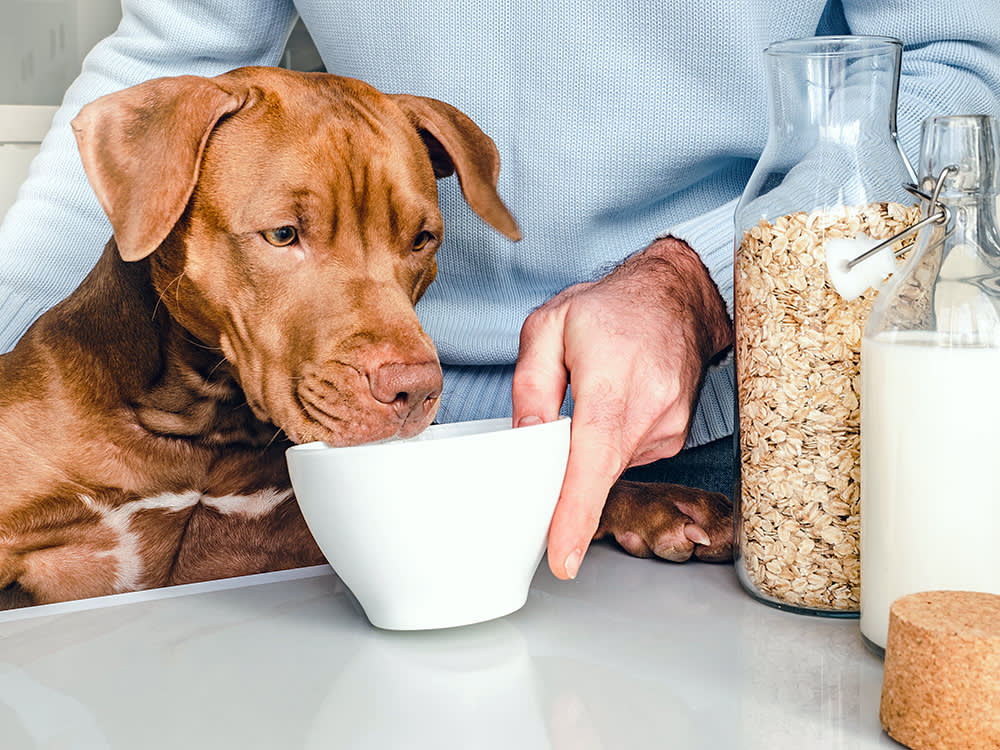
Oat milk has quietly taken over the coffee shop, the fridge, and now, apparently, the internet’s dog-food questions. So here’s the clean answer and the catch that comes with it: plain oat milk is safe for your dog in small amounts. The problem is that “plain oat milk” and “the oat milk in your fridge” are frequently two different products, and the gap between them is where the actual risk lives.
Most of the worry online is aimed at the oats. That’s the wrong target. Oats aren’t the issue. The issue is everything the manufacturer stirs in around the oats to make the carton taste good and pour thick, plus the simple fact that your dog was never missing oat milk to begin with. Flip the carton over and read the ingredient list, and you’ll understand this treat better than any headline can tell you.
Start here: your dog doesn’t need it
Before the safety details, the honest framing. Oat milk is not a nutritional requirement for a dog, full stop. If your dog eats a complete and balanced food, its nutritional bases are already covered, and it is getting the right nutrients in the right proportions. Oat milk adds calories and, at best, a modest bonus of things the diet already supplies.
That doesn’t make it bad. It makes it a treat, and treats are judged by a different, lower bar: is it safe, and is it worth the calories? For plain oat milk the answer to the first is usually yes, and the answer to the second is “sure, occasionally, if your dog enjoys it.” Just don’t reach for it thinking you’re doing your dog a favor its kibble wasn’t already doing.
Why oat milk sidesteps the dairy problem
The one genuine advantage oat milk has over the obvious alternative is real. Most adult dogs are lactose intolerant. Puppies produce lactase, the enzyme that breaks down the milk sugar lactose, so they can handle their mother’s milk. As dogs mature, lactase production drops off, and undigested lactose moving through the gut is what produces the classic cow’s-milk aftermath: gas, cramping abdominal pain, and diarrhea.
Oat milk isn’t made from milk at all. It’s made by blending oats with water and straining out the solids, which leaves a drink that is naturally lactose-free, and also nut-free and gluten-free. So a splash of plain oat milk skips the dairy stomach-ache entirely. That’s why it comes up as a swap for dogs, and it’s a fair one, as far as it goes.
Nutritionally, plain oat milk brings a little something along for the ride. Compared with cow’s milk it’s higher in fiber, notably beta-glucan, a soluble fiber best known for lowering cholesterol in people. Dogs rarely struggle with high cholesterol, but beta-glucan is also studied for anti-inflammatory and immune effects. Oat milk also carries some vitamin E and thiamine, and tends to run higher in iron, potassium, and phosphorus than cow’s milk while being lower in calories and fat. Cow’s milk still wins on protein, vitamin A, and calcium, oat milk is short on essential amino acids and adequate calcium, but for an occasional treat, none of that matters much. You’re not feeding it for nutrition.
The label is the whole story
This is the part that actually protects your dog, so slow down here. “Oat milk is safe” is only true for plain, unsweetened oat milk. Commercial cartons are a different animal, and a few common additions turn a harmless treat into one to avoid.
Xylitol is the one that matters most. Any oat milk marketed as sugar-free, diet, or low-sugar could be sweetened with xylitol, a sugar substitute that is severely toxic to dogs. In dogs, xylitol triggers a rapid insulin release that can crash blood sugar into hypoglycemia, with vomiting, weakness, loss of coordination, collapse, seizures, and in serious cases death. This isn’t a “too much is bad” situation; it’s a keep-it-entirely-away situation. Read the label, and if you see xylitol, or birch sugar, which is the same thing, the carton is off-limits.
Added sugar is the next flag. Flavored oat milks, vanilla, honey, and the like, pile on sugar your dog doesn’t need. It won’t poison a dog the way xylitol does, but a habit of sugary treats stacks calories and, over time, feeds weight gain and its downstream problems. Chocolate oat milk is a hard no for the obvious reason: chocolate is toxic to dogs.
Oils and gums round out the list. To get that creamy body and long shelf life, many oat milks include added oils and thickeners such as guar gum, gellan gum, or carrageenan. These aren’t toxic, but they’re not doing a dog any favors either, and in a sensitive-stomached dog they can be exactly what tips a treat into a bout of diarrhea.
The cleanest choice, if you want to share, is a plain unsweetened oat milk with a short ingredient list, or oat milk you make at home, where you control everything that goes in.
Even plain oat milk has a ceiling
Suppose you’ve got the plainest, cleanest oat milk on the shelf. There’s still a limit, and it’s the fiber. That same beta-glucan and oat fiber that sounds healthy can, in quantity, send a dog’s digestive system sideways, loose stool, cramping, the works, especially if the dog isn’t used to it. Keep it to a splash. Think a tablespoon or two for most dogs as an occasional thing, not a filled bowl. Most dogs recover from an oat-milk overindulgence within a day or two on their own, but call your vet if signs are severe or don’t resolve. And introduce it slowly the first time, watching how your dog reacts before making it a regular thing.
If oat milk isn’t a hit, no loss
Plenty of dogs won’t even like it, oat milk looks like cow’s milk but tastes nothing like it, and since your dog needs it about as much as it needs a hat, that’s fine. There are better-loved options in the same spirit: a small dab of plain unsweetened yogurt, a spoon of dog-friendly ice cream, or simple whole-food treats like cooked lean meat, plain scrambled egg, or a few dog-safe fruits and vegetables. Run any new human food past your vet first, particularly if your dog has a health condition.
What’s new since this was written
The oat milk aisle has gotten more crowded and more processed, which makes label-reading more important, not less. Barista and “extra creamy” formulations have multiplied, and those are precisely the ones most likely to carry added oils, higher sugar, and stabilizing gums, so a dog-friendly splash should come from the plainest version on the shelf, not the frothy barista carton.
There’s also growing research interest in beta-glucans for pets specifically. Recent work has looked at beta-glucan supplementation for canine conditions like inflammatory bowel disease, skin disease, and joint health. It’s early, and it does not mean pouring oat milk is a treatment for anything, the amounts and forms studied are targeted supplements, not a splash of a grocery drink. But it’s a reminder that the interesting part of oat milk for dogs is the oat fiber itself, not the packaged beverage built around it.
The bottom line
Plain, unsweetened oat milk is a safe occasional treat for most dogs, and it’s gentler on the gut than cow’s milk because it’s lactose-free. The danger isn’t the oats; it’s the carton, added sugar, oils, gums, and above all xylitol in any sugar-free version. Read the ingredient list before you pour, keep the serving to a splash, and remember your dog isn’t missing anything if you skip it entirely.
References
- Zhang, Y., et al. “Oat milk analogue versus traditional milk: Comprehensive evaluation of scientific evidence for processing techniques and health effects.” Food Chemistry: X, 3 Sept. 2023. PMC10534225
- Vetvicka, V., et al. “Translating Human and Animal Model Studies to Dogs’ and Cats’ Veterinary Care: Beta-Glucans Application for Skin Disease, Osteoarthritis, and Inflammatory Bowel Disease Management.” Microorganisms, 25 May 2024. PMC11205328
- Xylitol and Your Dog: Danger, Symptoms and Treatment — U.S. Food & Drug Administration
Common questions
Is oat milk better for dogs than cow's milk?
For the gut, often yes, because oat milk is lactose-free and most adult dogs are lactose intolerant. But 'lactose-free' isn't the same as 'good for your dog.' A plain oat milk avoids the dairy stomach-ache; it doesn't add anything your dog's food isn't already providing.
What's the dangerous ingredient to watch for in oat milk?
Xylitol, a sugar-free sweetener that's severely toxic to dogs. Any oat milk labeled sugar-free or diet could contain it, so those are off-limits. Chocolate-flavored versions are also out.
How much oat milk can a dog have?
Treat it as an occasional splash, not a bowlful. Like all treats, it should stay under about 10 percent of your dog's daily calories, and even plain oat milk can cause loose stool if a dog drinks a lot at once.
Not a substitute for your vet. Our guidance is educational. For urgent symptoms, contact a vet or emergency clinic right away. Editorial standards
Dr. Chen is a small-animal veterinarian who leads health and safety coverage at The Pet Times. She writes and reviews the bulk of our illness, condition, and safety content, translating clinical guidance into clear, practical advice owners can act on at home.
Meet our experts ↗Keep reading
 FoodCan Dogs Eat Almonds? Why This Snack (and Most Nuts) Belongs to YouDr. Lena Park · 4 min
 FoodThe Real Problem With Ritz Crackers Isn't the Salt. It's the Whole RecipeDr. Priya Nair · 5 min
 FoodPapaya for Dogs: The Enzyme Is the Point, and Also the CatchDr. Priya Nair · 6 min
 FoodShrimp for Dogs: The Cooking Rule Protects You BothDr. Lena Park · 7 min
 FoodChicken Feet Are Safe for Your Dog — Until You Watch How They ChewDr. Mara Chen · 7 min
 FoodYour Dog Can Have Pineapple. The Sweet Part Isn't the Problem.Dr. Priya Nair · 6 min