


Your Dog Isn't Color Blind. They're on a Blue-and-Yellow Budget
Dogs see color, just a narrower band than you do. Here is the science of their blue-yellow world and, more useful, how to pick toys, gear, and training cues your dog can actually see.

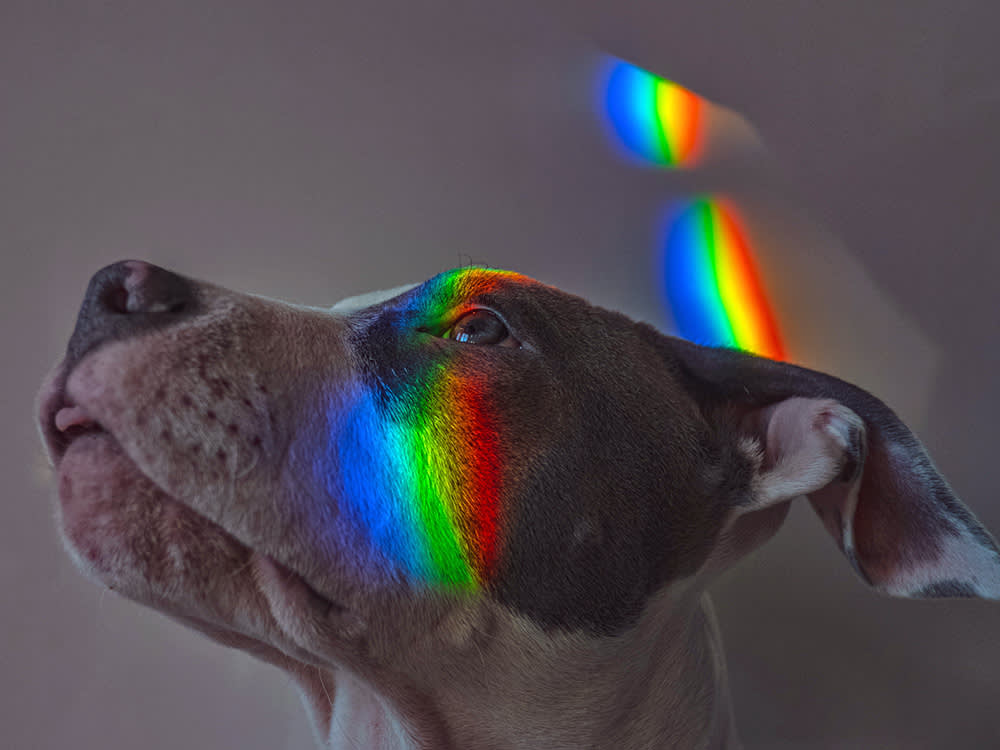
Watch a dog choose between two identical balls, one blue and one red, sitting on green grass, and you will often see them go straight for the blue one. People read this as preference. It is closer to necessity. From where your dog is standing, the red ball is barely there at all, and the blue one is the brightest thing on the lawn.
That single observation is more useful than the question everyone actually types into a search bar, which is “are dogs color blind.” The honest answer to that question is “the question is wrong.” Dogs are not color blind, not in the way most people mean. But once you understand what they do see, the payoff is not trivia. It changes which toys you buy, which training gear your dog can find, and why your dog sometimes seems to lose a ball that is sitting in plain sight. Let’s start with the part you can act on, then earn it with the science.
The blue-yellow rule, and how to use it tomorrow
Here is the whole thing in one sentence: your dog sees the world built mostly from blues and yellows, and everything you choose for them should respect that.
Toys. Buy blue or yellow. A blue or yellow toy stands out sharply against grass, dirt, snow, and most indoor floors. The bright red and orange toys that dominate pet-store shelves are designed to catch your eye on the rack, not your dog’s eye on the lawn. On green grass, a red toy can sink into the background and effectively disappear, which is why so many dogs run right past the ball you swear you threw three feet in front of them.
Training gear. The same logic applies to anything your dog needs to track: a recall target, a flirt pole lure, an agility contact zone, a treat-dispensing toy you toss across the yard. Pick blue or yellow and you remove a perception problem you did not know you were creating.
Fairness in the field. If your dog “fails” to find a dark-red Kong in a green yard, that is not stubbornness or a bad nose having an off day. It is a vision task you accidentally made nearly impossible. Switch the color and watch the behavior change.
That rule alone is worth the article. Now here is why it is true.
What “dichromat” actually means
Color vision starts with cones, the cells in the retina that respond to specific wavelengths of light. Most humans have three types, which is why we are called trichromats: short-wavelength cones for blue, medium for green, and long for red. The interplay of all three builds the full rainbow you experience.
Dogs have two cone types, not three. That makes them dichromats, and it puts their color vision in the same broad category as a person with red-green color blindness. They are not seeing in grayscale. They are seeing a real but narrower palette.
The specifics are sharper than most articles admit. Researchers have measured a dog’s two cone types as peaking at roughly 429 nanometers, in the blue-violet range, and 555 nanometers, in the yellow-green range. Those two peaks are the anchors of a dog’s entire color world. Anything close to 429 or 555 nanometers is vivid and easy for your dog to tell apart. The trouble is everything in the gap between them.
Because dogs lack that third, long-wavelength cone, the whole red-green region of the spectrum has nothing to pull it apart. So a dog likely sees:
- Blues and violets as genuinely blue
- Yellows as yellow
- Greens as a washed-out yellowish gray
- Oranges and reds as more yellow, sliding toward a muddy brownish-gray for the deepest reds
That is the mechanism behind the blue-yellow rule. A red ball on green grass is two colors that both land in the dog’s dead zone, which is the worst-case scenario you can hand a dog’s eyes.
Why the eyes traded color for other jobs
A dog’s retina did not skimp on color cones by accident. It spent that budget elsewhere, and knowing where helps explain your dog.
Dogs carry a much higher proportion of rods, the cells that handle low-light and motion, than humans do. They also have a reflective layer behind the retina called the tapetum lucidum, the thing that makes their eyes glow yellow-green in a photo. It bounces light back through the retina for a second pass, which is a real advantage at dawn, at dusk, and in the dark. The cost is a little sharpness, because that bounced light scatters slightly.
So the dog eye is tuned for a different priority than yours. Where human eyes invested in fine color discrimination in bright light, dog eyes invested in catching movement and seeing when the light is low, the conditions a predator that hunts at the edges of the day actually faces. Your dog did not get a worse eye. They got an eye built for a different job.
How we actually know all this
It would be fair to ask how anyone knows what a creature that cannot describe its experience is seeing. The answer is two independent lines of evidence that happen to agree, which is what makes the conclusion trustworthy rather than a just-so story.
The first is anatomical. Examine the cone cells in a dog’s retina under the right instruments and you can read their photopigments directly. That is where the 429 and 555 nanometer peaks come from. The biology says two cones, blue and yellow-green, full stop.
The second is behavioral, and it is more clever. A 2013 study tested whether dogs would chase a reward based on its color or its brightness. The dogs consistently chose by color, proving that color is not just present in their vision but is information they actively use to make decisions. Then a 2017 study borrowed the Ishihara test, the famous grid of colored dots that reveals color blindness in people. Researchers rebuilt it for dogs so the dots formed the shape of a running cat that animated in a loop, and watched which color combinations the dogs could pick out against a gray background.
When the cells in the eye and the choices in the experiment tell the same story, you can believe it. Both say dogs see a real, if limited, world of color, and both say blue and yellow are where that world lives.
The bottom line
“Color blind” is a label that makes your dog sound worse off than they are and, more importantly, tells you nothing useful. The accurate version is that your dog is a dichromat living on a blue-and-yellow budget, with a green-to-red dead zone and an eye that traded fine color for excellent motion and low-light vision.
The reason any of this matters is sitting in your toy bin right now. Pick blue and yellow for the things your dog needs to see, stop blaming them for losing red toys in the grass, and you have turned a piece of eye anatomy into a better day at the park. That is the whole point of knowing it.
References
- Neitz, Jay, Timothy Geist, and Gerald H. Jacobs. “Color Vision in the Dog.” Visual Neuroscience, vol. 3, no. 2, 1989, pp. 119–125. https://doi.org/10.1017/s0952523800004430
- Kasparson, Anna A., Jason Badridze, and Vadim V. Maximov. “Colour Cues Proved to Be More Informative for Dogs than Brightness.” Proceedings of the Royal Society B: Biological Sciences, vol. 280, no. 1766, 2013, p. 20131356. https://doi.org/10.1098/rspb.2013.1356
- Siniscalchi, Marcello, et al. “Are Dogs Red–Green Colour Blind?” Royal Society Open Science, vol. 4, no. 11, 2017, p. 170869. https://doi.org/10.1098/rsos.170869
- Pongrácz, Péter, et al. “Do You See What I See? The Difference between Dog and Human Visual Perception May Affect the Outcome of Experiments.” Behavioural Processes, vol. 140, 2017, pp. 53–60. https://doi.org/10.1016/j.beproc.2017.04.002
- Jordan, Gabriele, and John Mollon. “Tetrachromacy: The Mysterious Case of Extra-Ordinary Color Vision.” Current Opinion in Behavioral Sciences, vol. 30, 2019, pp. 130–134. https://doi.org/10.1016/j.cobeha.2019.08.002
Common questions
Are dogs completely color blind?
No. Dogs are not color blind in the sense of seeing only gray. They are dichromats, with two types of color cones instead of the three most humans have, so they see a narrower range. Their world is built mainly from blues and yellows, with reds and greens collapsing into yellowish tones and grays.
What colors can dogs see best?
Blue and yellow. A dog's two cone types peak at roughly 429 nanometers (blue-violet) and 555 nanometers (yellow-green). Colors near those peaks are vivid and easy for a dog to tell apart. Colors in between, especially in the green-to-red range, are where their vision goes flat.
Can dogs see red and green?
Not the way you do. Dogs lack the long-wavelength cone that lets humans separate reds and greens, so a red ball on green grass largely blends into one muddy yellow-gray field for them. This is why a red toy on the lawn is one of the hardest things you can ask a dog to find by sight.
What color toys should I buy for my dog?
Blue or yellow, almost always. Those two colors sit right on your dog's cone peaks, so a blue or yellow toy pops against grass, dirt, snow, and indoor floors. Red and orange toys, which look bright to you, can vanish into a lawn from your dog's point of view.
Do dogs rely on color or other senses more?
Color matters to dogs, and a 2013 study found they will choose an object by color over brightness, but vision overall is not their dominant sense. Dogs lead with smell and hearing, and their eyes are tuned more for catching motion and seeing in low light than for fine color detail.
Dr. Mehta is a board-certified veterinary nutritionist who evaluates pet food formulations, ingredient quality, and the science behind dietary trends. He writes and reviews all nutrition content at The Pet Times, including our food rankings and feeding guides.
Meet our experts ↗Keep reading
 TrainingYour Dog Has a Real Personality. Their Breed Barely Explains It.Dr. Nina Kohl · 8 min
 TrainingDogs Don't Forgive After a Fight. What They Do Is SmarterDr. Ravi Mehta · 5 min
 TrainingYour Dog Is Reading Your Face Right Now. The Science Is Wild.Dr. Amara Solis · 6 min
 Training"You Can't Teach an Old Dog New Tricks"? They're Teaching Themselves.Dr. Nina Kohl · 6 min
 TrainingYour Dog Doesn't Remember Your Face. They Remember How You Made Them Feel.Dr. Mara Chen · 5 min
 TrainingYou Didn't Make Your Puppy Shy. Biology Did, Before They Were Born.Dr. Amara Solis · 5 min