


Those Aren't Face Decorations. Your Dog 'Feels' the World With Them — So Don't Trim Them.
A dog's whiskers aren't a mustache or a grooming afterthought. They're a hardwired touch organ that helps a dog map its surroundings, protect its eyes, and even show emotion. Here's how they work, and why cutting them is a bigger deal than it looks.

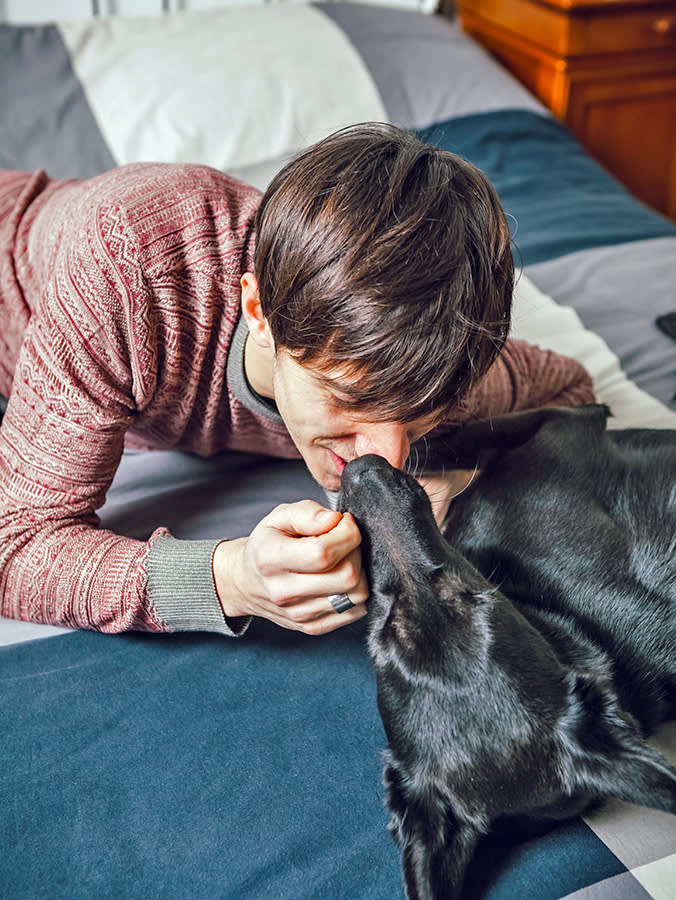
Look closely at your dog’s face and the whiskers start to seem almost expressive — perking forward when something exciting happens, flattening back when your dog is scared. They add character, sure. But if you think they’re just fancy facial hair, you’re missing what they actually are: one of the most sophisticated sensory tools on your dog’s body.
Dog whiskers do far more than tickle your arm or telegraph a mood. They are a genuine touch organ, and that single fact is the reason they should almost never be cut.
What a whisker really is
The proper name is a giveaway that these aren’t ordinary hairs. Whiskers are “sinus hairs,” or vibrissae, and they’re rooted much deeper than the fur around them — set into specialized, blood-filled follicles packed with nerve endings. There are actually two kinds, though most people only ever notice one. The long, thick, obvious ones on the muzzle, chin, cheeks, and above the eyes are macrovibrissae. Tucked just above the upper lip are the much smaller microvibrissae, easy to overlook.
What makes them a sensory instrument rather than just stiff hair is the wiring. Like many mammals, dogs have follicle-sinus complexes built specifically to gather information, and each whisker’s follicle has a tiny muscle attached that lets the dog make fine adjustments to the hair’s position. That controllability is the whole trick — a dog can angle its whiskers to sample the world more precisely. Humans have nothing equivalent, not even the bushiest beard or eyebrows, which is exactly why it’s so hard for us to grasp how much a dog relies on them.
The jobs whiskers do
A dog’s whiskers pull several kinds of duty at once, all of it helping the dog interact with its surroundings.
Reading objects up close. You’ve almost certainly watched your dog stretch its neck toward something new and give it a careful once-over without touching it with anything but its face. Those small whiskers above the lip gather detail about the shape and texture of things, especially anything the dog is thinking about eating. (This does not guarantee good judgment about what to eat — ask anyone who’s fished a sock out of a Labrador — but the dog at least inspected it first.) The longer facial whiskers, meanwhile, respond to pressure, displacement, and tension, feeding the dog a picture of how close an object is, what its surface is like, and even subtle shifts in air currents that might signal something moving nearby.
Guarding the eyes. Some whiskers are essentially a trip-wire for the face. Touch the ones set over the eyes or along the muzzle, and the dog blinks on reflex — a built-in defense that snaps the eyes shut before something can poke or scratch them.
Getting around. Whiskers help a dog judge space and move with confidence. There are accounts of vision-impaired dogs who suddenly struggled to navigate familiar rooms after their whiskers were cut off. A dog can use them to gauge whether a gap is wide enough to fit through — if the cheek whiskers brush the edges, the dog knows it’s going to be a tight squeeze. If you’ve ever wondered why the cheeks sprout whiskers at all, that’s the main reason.
Showing how they feel. Whiskers are also part of a dog’s silent vocabulary. Flattened against the face, they tend to signal fear and an attempt to look small and non-threatening. Flared and forward, they read as alert, interested, or aroused. It’s one more channel your dog uses to broadcast its mood.
Where the whiskers are
Dogs carry whiskers in tidy, consistent sets, though depending on coat color and fluffiness you might have to hunt for some of them. The main clusters:
Above the eyes. The supraorbital or superciliary vibrissae, perched above the eyelids and angled in toward the center of the face. Beyond their general sensing role, they help protect the eyes — and they can hide easily on a dog with bushy brows or a dark coat.
On the muzzle. The big, obvious set most people picture — the mystacial (“mustache-y”) vibrissae. These do the heavy lifting on judging distance and detecting nearby objects, and they trigger the blink-and-flinch reflex when something rushes toward the face.
On the chin. Whiskers along the skin under the jaw, helping the dog locate things on the ground and stay spatially aware.
On the cheeks. Two clusters, one on each side, sitting in the stretch between the mouth’s corner and the ear. These are the gap-measuring specialists that help a dog decide whether it’s safe to squeeze through an opening.
Above the lip. The subtle microvibrissae used for delicate, fine-detail touch. They don’t stand out, but they help the dog build a fuller picture of whatever it’s investigating.
Can you cut them? (Please don’t.)
Plenty of dogs have had their whiskers trimmed over the years, and some breed standards even called for it in the show ring. Cutting whiskers usually causes no visible harm, so it’s easy to assume it’s fine. It isn’t, at least not for no reason.
Trimming whiskers takes away a working sensory organ. Since a dog leans on its vibrissae to find its way, register threats, and interact with the world, removing them undercuts its ability to protect itself, dodge obstacles, and read its surroundings — and it does nothing for the dog’s health or appearance. There are legitimate exceptions: a dog might need whiskers cut for a surgical procedure, or if one is growing in a way that causes a problem. But “the groomer thinks it looks tidier” is not one of them. If your dog needs regular grooming, make a point of telling your groomer to leave the whiskers at full length.
The good news for anyone whose dog has already been trimmed: whiskers grow back. It’s slow — often months to return to full length — and it happens on the dog’s own shedding schedule, with whiskers falling out and regrowing naturally over time. So the thick, wiry hair you occasionally find on the floor isn’t cause for alarm.
Caring for whiskers (which is mostly leaving them alone)
Whiskers are self-maintaining, so “care” is really just not damaging them. A few pointers if you groom at home:
Trim with care around the face. Locate the whiskers before you start clipping, and keep the surrounding hair a little longer to reduce the odds of nicking one by accident. Try not to touch the whiskers as you work, because a dog may flinch or jerk when they’re contacted — which is how grooming mishaps happen for both of you. And even if your dog needs no trimming at all, be gentle around the whiskers at bath time: don’t tug them or scrub hard nearby, since they’re sensitive enough that very little touch overstimulates them.
What newer research adds
If anything, the case for leaving whiskers alone has gotten stronger. A 2025 study in Scientific Reports took a detailed look at the canine vibrissal system and confirmed just how richly innervated and genuinely functional these follicles are — reinforcing that whiskers are a real, active sensory organ rather than a passive bit of hair. In plain terms, the more closely scientists look, the more the trimming-for-looks habit seems like removing equipment your dog is actively using.
That research sits alongside earlier work on “body size awareness” showing dogs really do assess whether their bodies will fit through openings, and on the animal-welfare downside of routinely shaving vibrissae. The through-line is consistent: whiskers earn their keep, and cosmetic trimming isn’t a neutral choice.
Bottom line
Because your dog uses its whiskers in ways we can’t fully feel or see, the kindest policy is to leave them in their natural state. Trimming or shaving them to achieve a sleeker look has long been common, but it’s unnecessary and it strips away an important sensory tool. Don’t cut your dog’s whiskers, and make sure whoever grooms your dog knows to leave them exactly where they are.
References
- Döring, Dorothea, et al. “The canine vibrissal system as a highly innervated and functional sensory organ.” Scientific Reports, vol. 15, 9212, 17 Mar. 2025. https://doi.org/10.1038/s41598-025-91629-1
- Döring, Dorothea, et al. “The importance of the tactile hairs in domestic dogs and the problem of trimming these from an animal welfare perspective.” Tierärztliche Praxis Ausgabe K, vol. 48, no. 3 (2020): 186–195. https://doi.org/10.1055/a-1162-1370
- Lenkei, R., et al. “That dog won’t fit: body size awareness in dogs.” Animal Cognition, vol. 23, no. 2 (2020): 337–350. https://doi.org/10.1007/s10071-019-01337-3
- Grant, R.A., et al. “What can whiskers tell us about mammalian evolution, behaviour, and ecology?” Mammal Review, vol. 52 (2021): 148–163. https://doi.org/10.1111/mam.12253
Common questions
Do dog whiskers grow back?
Yes. If whiskers are trimmed or shed, they regrow, but slowly — it can take months for one to return to full length. They're also lost and replaced naturally as part of the normal shedding cycle.
How can I tell if my dog's whiskers are healthy?
Length, thickness, and curl vary by breed, but in general a healthy dog's whiskers are noticeably longer than the surrounding fur, slightly curved, and a bit firm to the touch.
Not a substitute for your vet. Our guidance is educational. For urgent symptoms, contact a vet or emergency clinic right away. Editorial standards
Dr. Park is a board-certified emergency and critical care specialist. She reviews our health and safety content for clinical accuracy and contributes guides on recognising urgent conditions. Her focus is helping owners act quickly and correctly when it matters most.
Meet our experts ↗Keep reading
 Product PicksThe $350 Grooming Kit's Best Tool Isn't a ToolNina Vasquez · 5 min
 Health & WellnessNever Put a 2-Week-Old Puppy in the Bath. The Water Isn't the Danger, the Cold Is.Dr. Lena Park · 6 min
 Health & WellnessMost Dog Hair-Loss 'Remedies' Treat the Wrong ThingDr. Mara Chen · 9 min
 Health & WellnessNothing in Your Pantry Will Cure Your Dog's Itch. 11 Things Will Make Tonight Bearable.Dr. Nina Kohl · 8 min
 Health & WellnessThose Flakes on Your Dog Aren't Dry Skin. They're a Readout.Dr. Amara Solis · 7 min
 Health & WellnessBaby Powder on Dogs: A Pinch-Hitter That's Mostly Been ReplacedDr. Mara Chen · 7 min