


Never Put a 2-Week-Old Puppy in the Bath. The Water Isn't the Danger, the Cold Is.
A newborn puppy can't hold its own body heat, which turns a routine bath into a real risk. How to clean a very young puppy safely with a cloth, when to wait, and the warning signs to know.

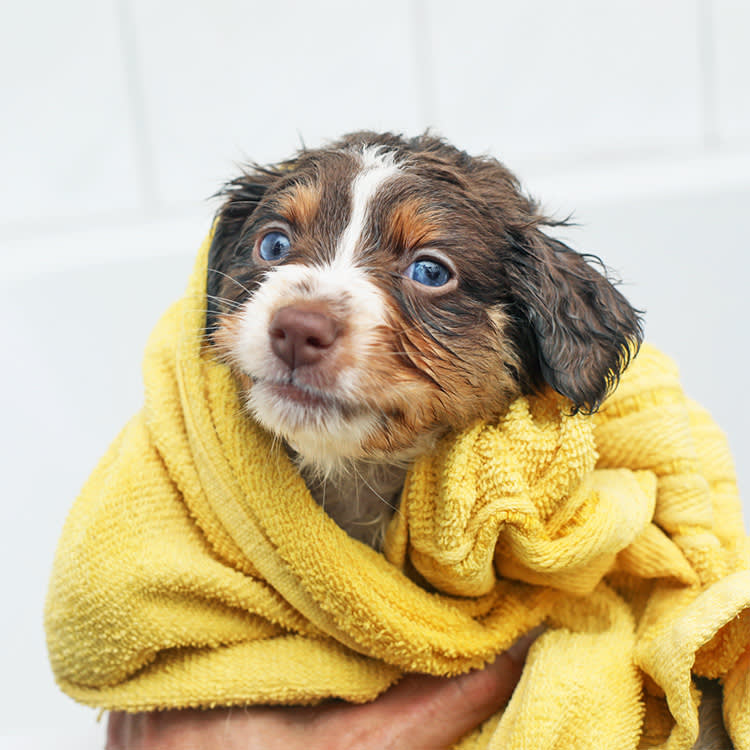
The instinct to bathe a dirty puppy is understandable, and with a two-week-old it’s the wrong move, for a reason that surprises people. The danger isn’t the water itself. It’s the temperature crash that follows. A newborn puppy is one of the most heat-fragile animals you’ll ever handle, and a bath is really just a fast, efficient way to make it cold. Once you understand that, the whole care plan follows logically: keep the puppy warm and dry, and clean it in a way that never fights those two goals.
So the honest answer to “can you bathe a two-week-old puppy” is no, not a real bath, and in most cases you won’t need to. Here’s what to do instead, and why.
Why a newborn can’t just take a bath
Newborn puppies don’t have a working thermostat yet. The system that lets an older dog hold a steady body temperature isn’t reliable until around four weeks of age. Before that, a puppy depends entirely on its mother, its littermates, and a warm room to stay warm, and it can’t correct course if it gets too cold or too hot.
That’s what makes wetness dangerous rather than merely inconvenient. Hypothermia in a newborn isn’t just shivering, it interferes with the puppy’s ability to nurse and digest milk, and it leaves the puppy more open to infection. A chilled newborn can go downhill quickly. Which is exactly why the goal is never “get the puppy clean at all costs,” but “get the puppy clean without ever letting it get cold.”
The good news is that newborns rarely need much cleaning. Mom handles hygiene with tongue baths, and she also stimulates the puppies to pee and poop, so at this age they simply don’t make much of a mess. Their whole job is to eat, sleep, and stay warm.
Cleaning without bathing: two methods
When a puppy does get into something, match the method to the size of the mess.
Spot-cleaning is for a single dirty area, like muddy paws. Gather a washcloth and a towel, dampen the cloth with warm water (damp, not saturated), and gently wipe the dirty spot. Don’t scrub, let the warm dampness loosen any crusted debris. Keep a warm dry towel ready to dry any area that got wet.
Sponge-bathing is for a puppy that managed to roll in the whole litter’s mess. Do it in a warm room, with a washcloth and a couple of warm towels on hand. Again, dampen rather than soak the cloth, and wipe gently from head to tail. Skip soap and shampoo entirely unless your vet has specifically told you to use something, even human baby shampoo can be too harsh for two-week-old skin. Then towel-dry with a warm, recently-out-of-the-dryer towel, switching towels as they get damp.
After a sponge bath, the puppy may need a little extra warmth. A heating pad under only half the box or bedding works well, with layers of bedding between the pad and the puppy so the surface never sits directly on skin. Covering only half the space gives the puppy and mom room to move off the heat if it gets too warm.
Think of it as cleaning a newborn, not bathing a dog. Damp cloth, warm room, dry fast. The moment you’re reaching for shampoo and a sink, you’ve slipped into a routine that’s built for an eight-week-old, not a two-week-old.
Gentler alternatives for small messes
Not every smudge needs even a sponge bath, and early gentle handling teaches a puppy that grooming isn’t scary. Depending on coat type, soft brushing with a gentle brush can clear crusties and keep the coat tidy, and unscented puppy-safe wipes can handle light messes. Keep in mind mom is still doing most of the cleaning herself, so plain warm water usually beats anything fancier.
Safety points to keep front of mind
A few specifics protect a puppy during any cleaning.
Protect the eyes and ears, which are still in the process of opening at two weeks, from soiled water. Protect the nose and mouth, because newborns don’t yet have the reflexes to guard their airway, and water there can lead to aspiration and pneumonia. Keep the puppy warm through the entire process, and don’t overcorrect with too much heat, no placing the puppy directly on heating pads and no hot blow dryers.
Learn the signs a puppy is in distress or failing to thrive, and act fast if you see them: lethargy, no interest in nursing, an inability to latch or suckle, constant vocalizing, or pale or blue gums. These are not wait-and-see symptoms.
When to call the vet instead of reaching for a cloth
Some hygiene problems are veterinary problems, not bath problems. Fleas are the clearest example: if mom has fleas, the puppies will too, and flea shampoos and products generally aren’t safe for very young or underweight puppies. Don’t improvise, call your vet, and prevent the problem upstream by keeping mom on a safe, appropriate flea preventative. Also call for constant diarrhea, poor appetite, signs of skin infection like bumps or scabs, or signs of maternal neglect.
What’s new since this was written
The core guidance here is well established and hasn’t reversed, current neonatal-care references still emphasize temperature stability above cosmetic cleanliness in the first weeks of life. What newer veterinary neonatology guidance reinforces is how narrow the puppy’s margin for error really is, and how much of newborn survival comes down to warmth, weight gain, and feeding rather than grooming. Healthy newborns should gain steadily, and struggling to hold temperature is treated as an early red flag worth a same-day vet call rather than home management.
The practical upshot for bathing is simply stated: unless a vet directs otherwise, keep products off newborn skin, keep the puppy dry and warm, and save the first real bath for eight weeks and up. Nothing in the current literature supports bathing a two-week-old for the sake of tidiness.
References
- Management of the Neonate in Dogs and Cats, Merck Veterinary Manual
- Care of Orphaned Puppies and Kittens, Cornell University College of Veterinary Medicine
- Neonatology: Puppy and Kitten Neonatal Management to Improve Neonatal Outcome, veterinary proceedings
- Puppy Development Stages and Thermoregulation, AAHA
Common questions
When can a puppy have its first real bath?
Wait until at least eight weeks for a full bath. Thermoregulation isn't reliable until around four weeks, and most puppies stay clean enough before eight weeks that a full bath isn't needed.
What soap can I use on a newborn puppy?
None, unless your vet specifically directs it. Even human baby shampoo can be too harsh for a two-week-old's skin. Warm water and a gentle touch are the standard.
How do I clean a newborn puppy with fleas?
Don't try to bathe fleas off a newborn. Flea shampoos and products aren't safe for very young or underweight puppies. Call your vet, and prevent fleas by treating the mother safely.
Not a substitute for your vet. Our guidance is educational. For urgent symptoms, contact a vet or emergency clinic right away. Editorial standards
Dr. Park is a board-certified emergency and critical care specialist. She reviews our health and safety content for clinical accuracy and contributes guides on recognising urgent conditions. Her focus is helping owners act quickly and correctly when it matters most.
Meet our experts ↗Keep reading
 Product PicksThe Puppy Shampoo Paradox: "Gentle" and "Scented" Don't Belong on One BottleDr. Amara Solis · 12 min
 Health & WellnessPuppy Breath Doesn't Go Bad. It Goes on Schedule.Dr. Mara Chen · 6 min
 First DaysYour Puppy's First Vet Visit Is Won Before You Leave the HouseDr. Ravi Mehta · 8 min
 Health & WellnessAnother Blue Ridge Beef Recall: Why This Keeps Happening to Raw-Fed PuppiesDr. Mara Chen · 4 min
 Health & WellnessStop Watching Your Puppy Breathe. Start Counting.Dr. Lena Park · 8 min
 Health & WellnessYour Puppy's Poop Looks Like Soft Serve. Here's When to Shrug and When to Call.Dr. Ravi Mehta · 6 min